
UPS for Furnace: Your Ultimate Guide to Never Freezing Again
The howl of a winter wind is a sound that can be cozy when you’re warm indoors. But when it’s accompanied by the sudden, dead silence of a power outage, that coziness instantly turns to dread.
Your home’s primary defense against the biting cold, the furnace, goes silent. Even with a full tank of gas or oil, without electricity, it’s nothing more than a metal box, leaving your family vulnerable and your home’s pipes at risk of freezing and bursting.
This guide explores the ultimate solution to this all-too-common winter nightmare: an Uninterruptible Power Supply (UPS). We’ll show you why a UPS isn’t just for computers and how choosing the right one can guarantee your heat stays on, no matter what the weather throws at you.
You'll Learn About
Why Your Furnace is Useless Without Electricity
Many homeowners are surprised to learn that their gas, oil, or propane furnace is completely dependent on your home’s electrical supply. While the fuel provides the heat, electricity is the lifeblood that manages and distributes it.
Several critical components require constant electrical power to function. Understanding these parts makes it clear why a simple power outage can leave you in the cold.
The Electronic Control Board: The Brain of the Operation
Think of the control board, or circuit board, as the furnace’s central nervous system. This small but vital component monitors the thermostat, controls the ignition sequence, and manages all the safety sensors.
Without power to this board, your furnace has no idea that it’s supposed to turn on. It cannot process the signal from your thermostat or initiate the process of creating heat.
The Blower Motor: The Heart of Your Home’s Circulation
The blower motor is the powerful fan that pushes the heated air from your furnace through the ductwork and into every room of your house. It is typically the most power-hungry component of the entire system.
When the power cuts out, the blower motor stops. This means even if the furnace could magically create heat, there would be no way to circulate it, leaving the warm air trapped in the unit while the rest of your house gets colder and colder.
The Ignitor and Safety Sensors
Modern furnaces don’t use a constantly burning pilot light. Instead, they use an electronic ignitor that glows red hot or creates a spark to light the burners each time the furnace cycles on. This process requires a jolt of electricity.
Furthermore, a network of safety sensors—monitoring flame presence, exhaust gases, and temperature limits—all need power to operate. If these sensors lose power, they will prevent the furnace from running as a safety precaution.
What is a UPS and How Can It Power a Furnace?
An Uninterruptible Power Supply (UPS) is, at its core, a sophisticated battery backup system. Its primary job is to provide instantaneous, clean power to connected devices the very moment that utility power is lost.
When the power is on, the UPS keeps its internal battery charged while allowing utility power to pass through to the furnace. The second the power fails, it seamlessly switches to its battery, and your furnace continues to run without even a flicker.
The Single Most Important Feature: Pure Sine Wave Output
When selecting a UPS for your furnace, you will encounter two main types of power output: simulated sine wave and pure sine wave. This is not a minor technical detail; it is the most critical factor for the health and longevity of your furnace.
Utility power from the wall outlet is delivered in a smooth, consistent wave form known as a pure sine wave. A pure sine wave UPS creates a near-perfect replica of this power, making it ideal for sensitive electronics and all types of motors. Furnace blower motors and modern control boards are designed to run on this clean power.
A cheaper, simulated (or modified) sine wave UPS creates a blocky, stepped approximation of a power wave. While this is fine for simple electronics, it can cause significant problems for a furnace’s motor, causing it to run hot, make a buzzing sound, and suffer premature failure. Using a simulated sine wave UPS can permanently damage your furnace. For this reason, you must insist on a model with a pure sine wave output.
How to Choose the Perfect UPS for Your Furnace: A Step-by-Step Guide
Selecting the right UPS requires a little bit of homework, but getting it right ensures reliable performance when you need it most. You need to match the UPS capacity to your furnace’s specific power needs.
Step 1: Find Your Furnace’s Power Consumption
First, you need to determine how much electricity your furnace uses. You can usually find this information on a data plate or sticker on the inside or outside of the furnace cabinet. Look for a rating in Amps (A) or Watts (W).
If the plate only lists Amps, you can calculate the running Watts with a simple formula: Watts = Volts x Amps. Since a standard US household circuit is 120 Volts, you just multiply the Amp rating by 120. For example, a furnace rated at 5 Amps uses 600 Watts (120V x 5A).
Be aware of the “startup” or “inrush” current. A motor requires significantly more power for the first second or two as it starts up than it does while it’s running. Your UPS needs to be able to handle this initial surge.
Step 2: Calculate the Required UPS Capacity (VA Rating)
UPS systems are rated in Volt-Amps (VA), which measures “apparent power.” While related to Watts, the VA rating is always higher. You do not need to understand the complex electrical engineering behind this.
A simple, safe rule of thumb is to choose a UPS with a VA rating that is at least 1.5 to 2 times your furnace’s calculated running wattage. This provides a crucial buffer to handle the motor’s startup surge and prevents the UPS from being overloaded.
So, for that furnace using 600 Watts, you should look for a UPS with a rating of at least 900VA, with a 1200VA or 1500VA model being a much safer choice.
Step 3: Determine Your Desired Runtime
The next question is: how long do you want the furnace to run during an outage? A standard UPS might provide 10-30 minutes of runtime for a typical furnace. This is often enough to outlast the brief, flickering outages that are common in storms.
However, for longer-term peace of mind, you may want several hours of protection. Runtime is determined by the size of the UPS batteries and the load on them. Keep in mind the furnace isn’t running constantly; it cycles on and off to maintain the temperature set by your thermostat. A lower thermostat setting will result in a longer overall runtime.
Many larger UPS models allow you to connect external battery packs. These can extend the runtime from minutes to many hours, providing a robust solution for prolonged outages.
A Quick Guide to Sizing Your Furnace UPS
To simplify the process, here is a table with general estimates. Always verify with your specific furnace’s data plate for the most accurate sizing.
| Furnace Type | Typical Running Watts | Recommended Minimum UPS VA Rating (Pure Sine Wave) |
|---|---|---|
| Standard-Efficiency Gas Furnace (PSC Motor) | 300 – 500 W | 750 VA – 1000 VA |
| High-Efficiency Gas Furnace (ECM/Variable-Speed Motor) | 500 – 800 W | 1000 VA – 1500 VA |
| Standard Oil Furnace | 600 – 900 W | 1200 VA – 2000 VA |
UPS vs. Generator: Which Backup Power Solution Is Best?
A generator is another popular option for backup power, so how does it stack up against a UPS for this specific task? The answer depends on your primary goal.
The Case for a UPS
The biggest advantage of a UPS is its instantaneous and automatic switchover. There is zero delay. One moment the power is on, the next it’s off, and your furnace never even knows the difference. This is perfect for protecting your system during short, frequent outages and ensuring continuous operation.
Additionally, a UPS is silent, produces no fumes, and requires no fuel. It can be safely placed in your basement or utility closet right next to the furnace. Maintenance is minimal, typically just a battery replacement every 3-5 years.
The Case for a Generator
A generator’s main strength is its extended runtime. As long as you can supply it with fuel (like gasoline, propane, or natural gas), it can run for days on end, powering not just your furnace but your refrigerator, lights, and other essentials too.
However, this comes with downsides. Most portable generators require manual setup and starting in the middle of a storm. They are also very noisy, produce dangerous carbon monoxide exhaust (requiring them to be far from the house), and demand regular maintenance to ensure they will start when needed.
For whole-home comfort, a generator is a powerful tool. But for seamless, automatic, and silent protection specifically for your furnace, a UPS is the superior choice.
Installation and Critical Safety Considerations
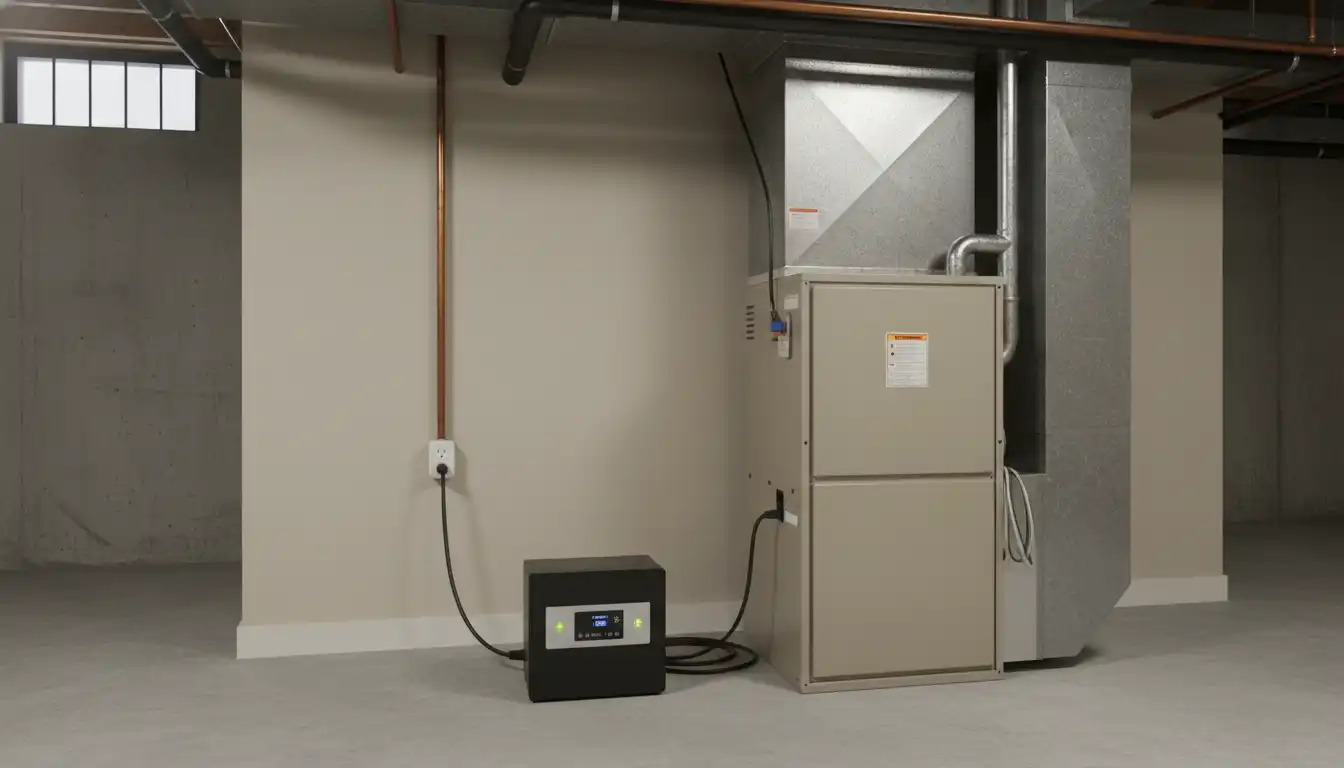
For most plug-in UPS models, installation is straightforward. You simply plug the UPS into a grounded wall outlet and then plug your furnace’s power cord into one of the designated “Battery Backup” outlets on the UPS.
However, it is crucial to follow safety best practices. Ensure the UPS is placed in a location with adequate ventilation to prevent overheating. Never plug a UPS into an extension cord or power strip; it should always have a direct connection to the wall outlet.
While a plug-in setup is simple, if your furnace is hardwired, you will need a qualified electrician to install a dedicated outlet for the UPS. Given the importance of your heating system, professional installation is always the safest bet to ensure everything is done to code.
Unlock Peace of Mind with Smarter Features
Modern UPS systems offer more than just basic battery backup. Investing in a unit with advanced features can provide even greater protection and convenience for your home’s heating system.
Automatic Voltage Regulation (AVR)
Power from the grid isn’t always stable. Brownouts (dips in voltage) and surges (spikes in voltage) can be just as damaging to sensitive electronics as a full-blown outage. A UPS with AVR constantly monitors incoming power and corrects these fluctuations without switching to battery, protecting your furnace’s delicate control board from damage.
This is a feature that works 24/7, providing a valuable layer of defense even when the power stays on. Considering the high cost of replacing a furnace control board, AVR is a feature worth paying for.
LCD Screens and Smart Monitoring
Many higher-end UPS models feature an LCD screen that provides real-time information. You can instantly see the current load, estimated runtime remaining on battery, and the health of the batteries themselves.
This information is invaluable during an outage, helping you make informed decisions, such as lowering the thermostat to conserve battery life. It removes the guesswork and gives you total visibility into your backup power status. Even if your home experiences frequent heating issues, such as situations where you find heat works downstairs but not upstairs, having stable power ensures the furnace itself isn’t the root cause.
The Critical Sump Pump Connection
A major vulnerability many homeowners overlook is the connection between a winter power outage and basement flooding. A sudden thaw or winter rainstorm during an outage can quickly lead to a flooded basement if your sump pump has no power.
When selecting a UPS for your furnace, consider if the same unit—or a second, dedicated one—could also power your sump pump. The startup power draw of a sump pump is significant, so you will need a large UPS (likely 2200VA or higher) to handle both. Protecting your furnace and your basement from water damage with one integrated solution is a powerful strategy for total home protection.
Your Furnace’s Best Insurance Policy
In the end, think of a pure sine wave UPS as an insurance policy for your home’s comfort and safety. You pay for it once, and it sits quietly, ready to act in an instant when you need it most. It’s a small investment that protects the far more expensive and critical heating system you rely on all winter.
The peace of mind that comes from knowing a power outage won’t leave your family in the cold is invaluable. By choosing the right size and type of UPS, you can ensure your furnace keeps running, your home stays warm, and your winter remains worry-free.
