
Bathtub Lumbar Angle: The Secret to True Bathroom Comfort
The ideal bathtub lumbar angle for maximum comfort generally falls between 108° and 125° degrees relative to the seat floor, or a slope of 18° to 35° from the vertical wall. While personal preference plays a significant role, an angle that is too steep (closer to 90°) forces an upright, rigid posture that strains the lower back, whereas an angle that is too reclined can cause bathers to slide down, preventing full relaxation. Finding the “sweet spot” depends on whether you prefer to sit up and read or fully recline and soak.
You'll Learn About
The Hidden Ergonomics of Your Bath
Most homeowners obsess over the length, width, and material of a new bathtub, yet they completely overlook the single most critical factor for physical comfort: the lumbar angle. This specific measurement determines how your spine aligns with the tub’s surface. If you have ever settled into a stunning, expensive freestanding tub only to feel your lower back ache within five minutes, the lumbar angle is the culprit.
The problem is prevalent in modern “minimalist” designs. To achieve sharp, clean lines, manufacturers often create tubs with nearly vertical interior walls. While these look sleek in architectural photos, they are ergonomically disastrous for the human body. Your spine has a natural “S” curve, and forcing it against a flat, vertical surface creates pressure points and muscle tension.
Conversely, a tub with an extreme slope might seem luxurious, but it introduces a different set of problems. Without proper foot support or the right tub length, a steep recline turns your relaxing soak into a constant core workout as you struggle to stop yourself from floating away. Understanding the mechanics of this angle is the first step to curating a bathroom that functions as a true sanctuary.
Defining the Bathtub Lumbar Angle
To make an informed decision, you must first understand what “lumbar angle” actually means in the context of bathroom fixtures. It is not simply the slant of the back wall. It is the degree of inclination where your back rests, measured typically from the horizontal floor of the tub.
The Measurement Confusion: Interior vs. Exterior
One major source of frustration for buyers is the discrepancy between interior and exterior angles. A bathtub might have a boxy, rectangular exterior with 90-degree corners to fit perfectly into a tiled alcove. However, the interior well—the part you actually sit in—must be molded differently.
Never assume the outside shape dictates the inside comfort. A “box” style tub can still have a generous 120-degree interior slope if the rim is wide enough to accommodate the difference. When reading specification sheets, always look for the “interior backrest angle” or “lumbar slope.” If the manufacturer only provides the exterior dimensions, you are flying blind regarding comfort.
The “Vertical Deviation” Metric
Some industry experts and ergonomic guides prefer to measure the angle as a deviation from the vertical line. In this system, a 0-degree angle is a straight-up wall. A comfortable reading position might be a 15-degree slope, while a lounge position is a 30-degree slope. This method is often more intuitive for visualizing how far back you will be leaning. If you see a spec sheet listing a “25-degree backrest,” they are almost certainly using this vertical deviation method, not measuring from the floor (which would be an impossible acute angle for a human to sit in).
The Buoyancy Factor: Why Dry Testing Fails
Here is a crucial insight that almost no showroom salesperson will tell you: Your body interacts with the lumbar angle differently when submerged in water.
When you test a tub in a showroom, you are dry and fully subject to gravity. A steeper angle might feel supportive and upright. However, once you add water, buoyancy reduces your effective body weight. In a steep tub, this buoyancy can make you feel like you are tipping forward. In a highly reclined tub, it lifts your torso, causing you to float off the backrest entirely unless the texture of the tub provides grip.
For this reason, experts recommend choosing a lumbar angle that feels slightly too reclined when dry. The water will naturally push you into a more upright equilibrium. If you buy a tub that feels perfectly upright when dry, it will likely feel confining and rigid when filled.
Ideal Angles for Different Bathing Styles
Not all bathers have the same objective. Your “ideal” angle depends entirely on what you do while you are in the tub.
The Reader (15° – 20° Slope)
If your primary goal is to read a book, scroll on a tablet, or sip a glass of wine, you need stability. A more upright angle, roughly 15 to 20 degrees from vertical (or 105° – 110° from the floor), is superior here. This posture keeps your head naturally supported without requiring you to crane your neck forward to see your book. It also prevents the “sliding” effect, allowing you to keep your hands dry and elevated.
The Soaker (25° – 35° Slope)
For deep relaxation, muscle recovery, and meditation, a reclined angle is non-negotiable. You want to offload the weight of your head and shoulders into the tub itself. A slope of 25 to 35 degrees from vertical (115° – 125° from the floor) mimics the posture of a lounge chair. This angle opens up the diaphragm for better breathing and distributes hydrostatic pressure evenly across the chest and abdomen.
Comparing Bathtub Types by Lumbar Support
Different categories of bathtubs tend to have inherent structural limitations or advantages regarding their backrest angles. The table below outlines what you can typically expect from common tub styles.
| Bathtub Style | Typical Lumbar Angle (from floor) | Ergonomic Rating | Best For |
|---|---|---|---|
| Standard Alcove | 100° – 110° | Low to Medium | Space saving; upright reading; showering. |
| Modern Freestanding | 115° – 125° | High | Deep soaking; aesthetic appeal; full reclining. |
| Japanese Soaking (Ofuro) | 95° – 105° | Specialized | Full submersion; upright posture; small spaces. |
| Slipper Tub | 120° – 135° | Very High | The ultimate lounge experience; neck support. |
| Drop-In / Deck Mount | Varies Widely | Medium | Custom installations; often limited by deck framing. |
The Slipper Tub: The King of Angles
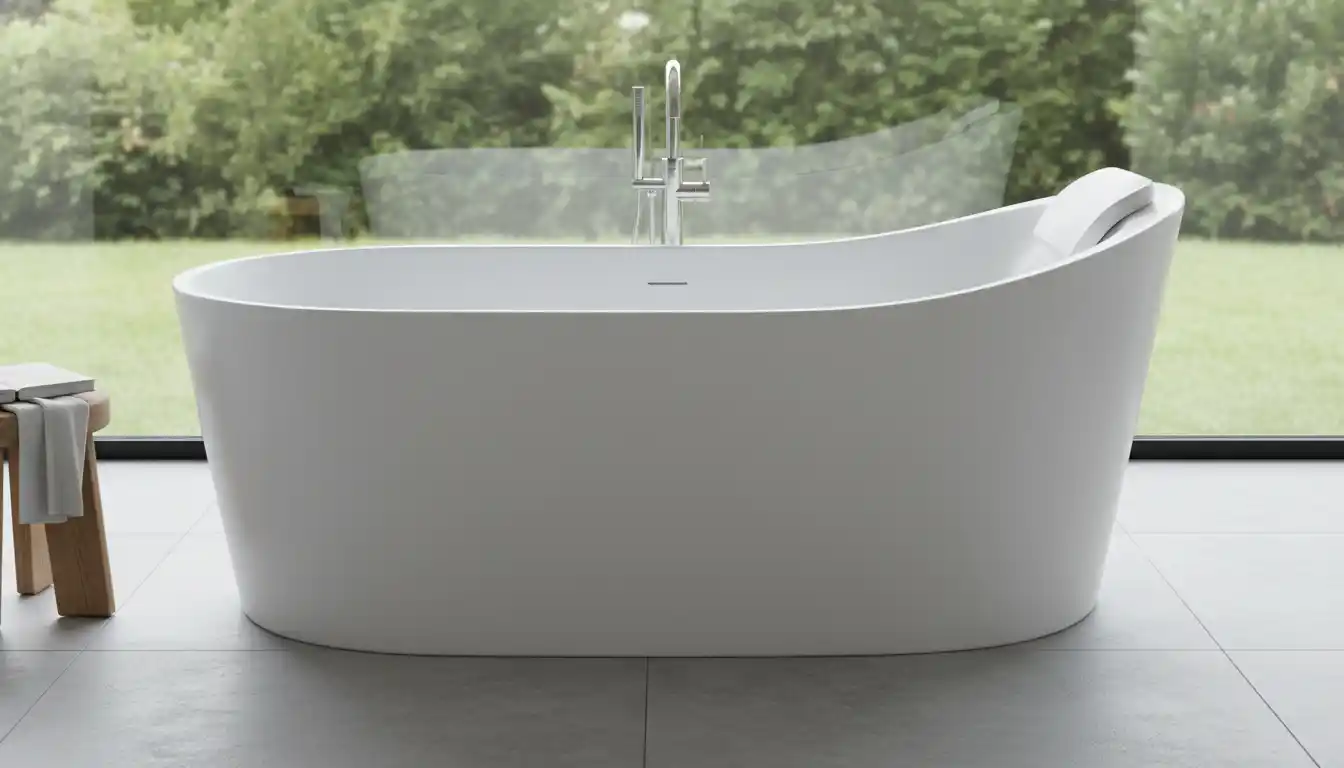
If lumbar support is your priority, the “Slipper” tub is the gold standard. Named for its resemblance to a vintage high-heeled shoe, this design features one (Single Slipper) or two (Double Slipper) elevated ends. The geometry is specifically engineered for reclining.
The high back of a slipper tub does more than just look dramatic; it extends the lumbar angle support all the way up to the cervical spine (neck). In a standard flat-rimmed tub, a reclined angle often leaves your head unsupported, forcing you to tense your neck muscles. The slipper shape supports the entire spinal column, allowing for total muscular release. If you have the floor space, this is often the best ergonomic investment.
Japanese Soaking Tubs: The Vertical Exception
You might notice that Japanese soaking tubs (Ofuro) have very steep sides, often near 90 or 95 degrees. Yet, they are renowned for relaxation. How is this possible?
The ergonomics of an Ofuro are completely different from a Western tub. In a Western tub, you extend your legs horizontally. If the back is straight, your hamstrings and lower back form a tight L-shape that becomes painful. In a Japanese tub, the water is much deeper (often chin-deep), and there is usually a built-in seat. You sit in a posture similar to a chair.
Because your knees are bent and your feet are lower than your hips, the strain on the lumbar region is neutralized. The buoyancy of the deep water takes 90% of the weight off your spine. Therefore, a steep lumbar angle is perfectly comfortable in an Ofuro, whereas it would be torture in a shallow American alcove tub.
Solutions for Uncomfortable Angles
Perhaps you are stuck with a rental apartment tub that has a 90-degree back wall, or you already installed a beautiful but uncomfortable modern tub. You do not need to rip it out. There are practical ways to modify the effective lumbar angle.
1. The Full-Back Bath Pillow
Avoid the small, neck-only pillows. They only push your head forward, worsening the angle problem. Instead, look for a full-body bath mattress or a large, wedge-shaped back pillow. These accessories physically fill the void between your back and the vertical wall, creating an artificial slope. Look for “3D Air Mesh” technology, which allows water to flow through the pillow so it doesn’t become a heavy, waterlogged sponge.
2. The Foot Brace Technique
Sometimes the angle is fine, but the tub is too long, causing you to slide down until your back is unsupported. The solution is to shorten the tub. A bathtub shortener or foot brace is a suction-cup barrier that you place at the foot end of the tub. By bracing your feet against this, you can maintain your position against the backrest without engaging your core muscles.
3. Water Level Adjustment
If your tub is too steep, filling it higher can help by increasing buoyancy. If your tub is too reclined and you feel floaty, try filling it slightly less. Reducing the water level increases your effective body weight, grounding you more firmly against the bottom of the tub and preventing the “float away” sensation.
Installation Considerations for Reclined Tubs
When planning a bathroom renovation, choosing a tub with a generous lumbar angle introduces specific installation challenges that are often overlooked until it is too late.
The “Footprint” Trap
A tub with a 125-degree interior slope will essentially be longer than a tub with a steep back, or it will have a smaller bathing well floor. If you are trying to fit a tub into a specific tiled niche, you must account for the rim. A highly reclined tub often has a thick top rim or a “rolled” edge that eats up inches of room space. Ensure your contractor measures the base footprint versus the rim footprint.
Wall Clearance
For freestanding tubs with extreme lumbar slopes, you cannot place the tub directly against the wall. The lip of the tub might touch the wall, but the curve of the body often flares outward. Furthermore, if you plan to use a floor-mounted tub filler, you need significantly more gap behind the “head” of the tub to accommodate the plumbing and the slant of the vessel.
How to Measure Before You Buy
Do not rely on the spec sheet alone. When you visit a showroom, bring a simple protractor app on your smartphone, but more importantly, use your body.
The “dry sit” test protocol:
- Remove your shoes and bulky jackets.
- Sit in the tub and extend your legs fully.
- Scoot your hips back until they touch the wall.
- Lean back. Pay attention to your neck. Does your head naturally rest on the rim, or is it hovering in mid-air?
- Check for “bridging.” Place your hand behind your lower back. Is there a large gap? If your shoulders hit the wall but your lower back doesn’t, the angle is likely too steep or the curve is poorly designed for your height.
- Imagine the water. Remember that in water, you will float slightly up. If you are barely touching the bottom now, you will likely be floating uncontrollably when the tub is full.
The Role of Material in Lumbar Comfort
The friction coefficient of the bathtub material interacts directly with the lumbar angle. This is a subtle nuance that separates high-end bathroom design from standard renovations.
Acrylic and Fiberglass: These are smooth and slippery. If you choose a highly reclined angle (over 125°), you will slide down easily. You will almost certainly need a textured bottom or a bath pillow to maintain that angle.
Solid Surface / Stone Resin: These materials have a matte, velvety texture that provides natural grip. They allow for steeper, more aggressive lumbar angles because the material “holds” your skin, preventing you from sliding. This is why many high-end stone tubs can get away with sleeker, more upright profiles while remaining comfortable.
Cast Iron: Extremely slippery when enameled. A cast iron tub with a steep back is very difficult to relax in without sliding. Vintage clawfoot tubs (cast iron) often have extremely generous slopes (slipper style) to counteract this slipperiness.
Conclusion
The “bathtub lumbar angle” is not just a technical specification; it is the defining feature of your bathing experience. A beautiful tub that hurts your back becomes nothing more than a large, expensive laundry hamper. By prioritizing a slope between 108° and 125°, understanding the physics of buoyancy, and matching the angle to your specific bathing style—whether you are a reader or a soaker—you can ensure your new bathroom is a place of genuine restoration. Before you commit to a purchase, sit in the tub, ignore the exterior aesthetics, and listen to what your spine is telling you. That 15-degree difference is the line between a quick wash and a luxurious, hour-long escape.
If you are also considering other high-end kitchen and bath upgrades, you might want to explore the differences between professional range brands like NXR and Zline to ensure every fixture in your home meets your standards for performance and design.
