
32″ Sink in a 33″ Cabinet? The #1 Mistake to Avoid
You’re in the middle of a kitchen renovation, and it’s time to choose the fixtures. You’ve found the perfect, spacious 32-inch sink that you can already imagine making daily chores a breeze. But then comes the crucial question that can bring your design dreams to a screeching halt: will a 32-inch sink actually fit in your 33-inch cabinet?
The math seems simple—a one-inch difference should be plenty of room, right? Unfortunately, it’s far more complex. Squeezing a large sink into a slightly larger cabinet is a common renovation puzzle, and the answer is a firm “maybe,” depending on several factors that installers and experienced DIYers know all too well.
You'll Learn About
Why a 1-Inch Difference Isn’t a Guarantee
The standard rule of thumb in kitchen design is that your sink base cabinet should be at least three inches wider than your sink. This recommendation exists for a good reason. It provides ample room for not just the sink basin itself, but for all the essential components that are hidden from view.
The success of fitting a 32-inch sink into a 33-inch base hinges on a few critical variables. The most important factor is the type of sink you choose—undermount versus drop-in. Other vital considerations include the actual interior dimensions of your cabinet, the space required for mounting hardware, and clearance for your faucet and plumbing.
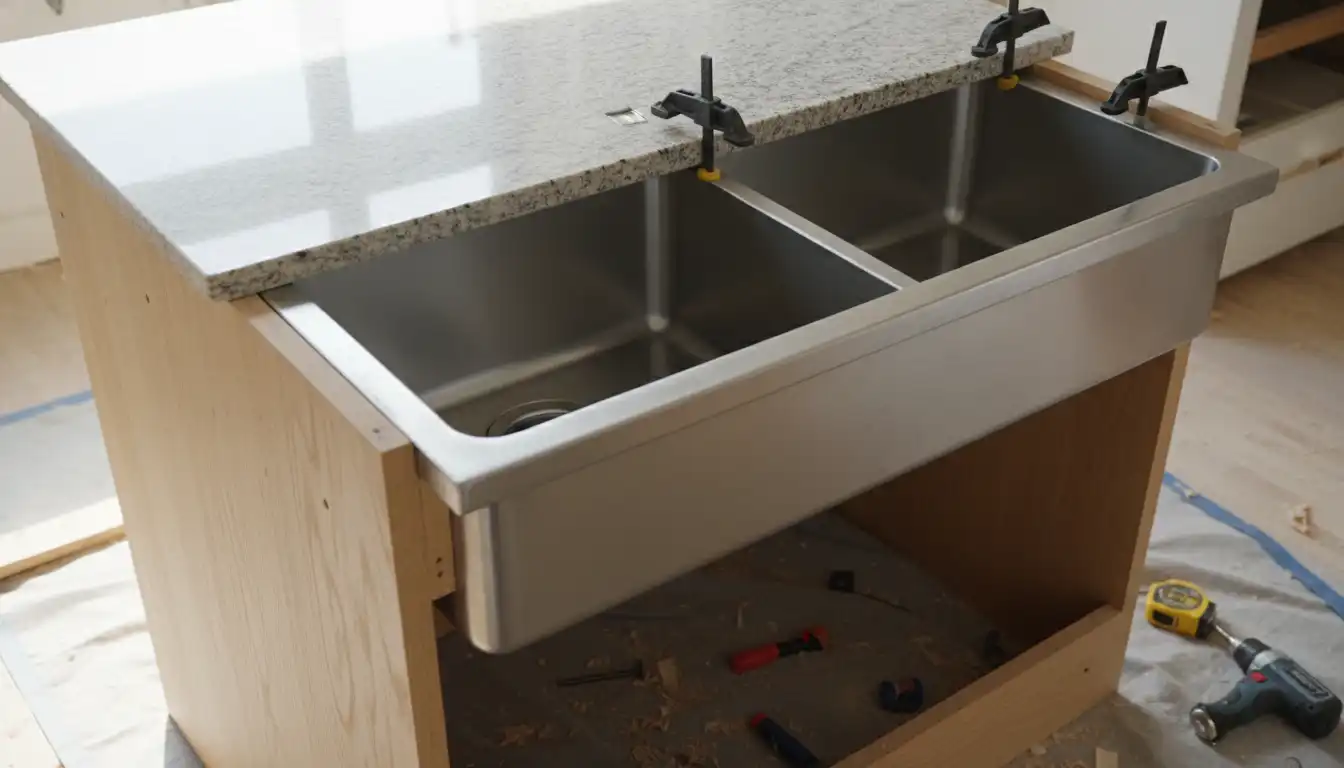
Undermount vs. Drop-in: The Decisive Factor
How a sink is mounted is the single most important element that determines whether this tight fit is possible. An undermount sink presents a much greater challenge than a drop-in model because of how it attaches to the countertop.
This is where many homeowners make their number one mistake: assuming all sink types have the same space requirements. Understanding the difference is key to avoiding a costly and frustrating installation problem.
The Challenge of Undermount Sinks
Undermount sinks are prized for their seamless, modern look, as they are installed directly beneath the countertop. However, this installation method requires clips and brackets to be fastened to the underside of the counter, securely holding the sink in place. These clips require physical space *inside* the cabinet walls.
With only half an inch of clearance on each side in a 33-inch cabinet, there is often not enough room for these essential mounting clips. Attempting to force the fit can lead to an insecure sink, potential leaks, and voided warranties from both the sink and cabinet manufacturers.
The Flexibility of Drop-in (Top-Mount) Sinks
A drop-in sink, also known as a top-mount or self-rimming sink, is a much safer bet for a tight installation. As its name suggests, the sink is dropped into a hole cut in the countertop, and its rim rests on top, supporting the weight of the entire unit.
Because the rim handles the support, the primary concern is whether the sink’s basin—the part that sits inside the cabinet—can clear the interior cabinet walls. A 32-inch drop-in sink is far more likely to fit comfortably within a 33-inch cabinet than its undermount counterpart.
| Feature | Undermount Sink in 33″ Cabinet | Drop-in Sink in 33″ Cabinet |
|---|---|---|
| Fit Difficulty | High Risk / Often Not Possible | Likely to Fit with Proper Measurement |
| Primary Obstacle | Lack of space for mounting clips | Ensuring the basin fits inside |
| Cabinet Modification | Often required (scooping/notching) | Rarely required |
| Installation Method | Attached to the underside of the counter | Supported by its rim on the countertop |
| Aesthetic | Seamless and modern | Visible rim on counter |
The Step-by-Step Guide to Measuring for a Perfect Fit
Never trust the label on the box alone. “33-inch cabinet” refers to the exterior width. The actual usable space inside is always less. To determine if your sink will truly fit, you must take precise measurements and consult the manufacturer’s specifications.
Step 1: Measure Your Cabinet’s True Interior Width
The most critical measurement is the distance from the inside left wall to the inside right wall of your sink base cabinet. Cabinet walls are typically 1/2-inch to 3/4-inch thick, meaning a 33-inch cabinet may only have 31.5 to 32 inches of interior space. This is your absolute maximum clearance.
Measure at the very top of the cabinet where the sink will sit. This simple step will immediately tell you if the sink’s basin has any chance of fitting.
Step 2: Consult the Sink’s Specification Sheet
Every reputable sink manufacturer provides a detailed specification sheet, which is your most reliable source of information. Look for a field labeled “minimum cabinet size.” If this number is 36 inches or higher, attempting to install it in a 33-inch cabinet is a significant risk, especially for undermount styles.
Pay close attention to the sink’s overall dimensions and the recommended cutout size. These figures are based on ideal installation conditions, including ample room for hardware.
Step 3: Account for Mounting Hardware and Obstructions
For an undermount sink, the mounting clips are the biggest hurdle. These clips can require up to an inch of clearance on each side. If your cabinet’s interior width is 31.5 inches and your sink’s overall width is 32 inches, the installation is physically impossible without modifying the cabinet.
Also, check for any internal cabinet obstructions, like support braces or corner joinery, that could interfere with the placement of the sink basin or its clips.
When It’s Too Tight: Cabinet Modification Strategies
If you’re determined to make it work, particularly with an undermount sink, skilled installers sometimes employ modification techniques. These methods should be performed by experienced professionals, as a mistake can compromise the structural integrity of your cabinetry and countertop support.
Scooping the Cabinet Walls
One common technique is “scooping” or “scribing” the top inside edges of the cabinet walls. This involves using a jigsaw or oscillating multi-tool to carefully trim a shallow portion of the cabinet side, creating just enough extra space for the sink’s rim and mounting clips to fit.
This must be done with extreme precision. Removing too much material can weaken the cabinet, jeopardizing its ability to support a heavy countertop filled with a sink full of water.
Alternative Mounting Methods
For undermount sinks in tight spaces, some installers forgo traditional clips altogether. Instead, they build a custom wood support frame inside the cabinet for the sink to rest on. Another method involves using a sink harness or strap system that supports the sink from underneath without needing side clearance.
These are non-standard solutions that require expertise but can make an otherwise impossible installation achievable. Disregarding the manufacturer’s recommended installation method, however, may void the sink’s warranty.
Beyond the Fit: Long-Term Considerations
Successfully installing the sink is only half the battle. A tight fit can create new challenges down the road, affecting everything from plumbing to everyday functionality.
A large sink basin leaves very little room to work underneath. Installing the faucet, garbage disposal, P-trap, and water lines can become incredibly difficult. This lack of space also makes future repairs or replacements more complicated and potentially more expensive.
Modifying cabinets to fit a sink can also have consequences for your countertop, especially with heavy materials like quartz or granite. The top edges of the cabinet walls provide critical support; cutting into them can weaken that support over time. After any modifications, it is essential to protect the exposed wood. Learning how to seal inside of cabinets becomes a vital step to prevent moisture from wicking into the raw material and causing damage.
A well-planned kitchen focuses on seamless integration. A perfectly fitted sink contributes to this custom look, just as ensuring your fridge doesn’t stick out creates a flush, built-in appearance. Similarly, just as vanity heights dictate faucet choices in a bathroom, the limited space in a tight cabinet installation can restrict your options for kitchen faucets, especially those with large bases or complex hardware.
The Final Verdict: Should You Put a 32″ Sink in a 33″ Cabinet?
So, can you install a 32-inch sink into a 33-inch cabinet? The answer depends on your tolerance for risk and your choice of sink.
For a drop-in sink, the answer is likely yes, provided your precise interior cabinet measurements allow the basin to fit. For an undermount sink, the answer is probably no, unless you are willing to hire a skilled professional to perform significant cabinet modifications and use alternative mounting techniques.
The golden rule is to always follow the sink manufacturer’s guidelines for the minimum required cabinet size. Choosing a slightly smaller sink—such as a 30-inch model for your 33-inch cabinet—is the surest way to guarantee a smooth, secure, and trouble-free installation that will serve you well for years to come.
