
Honed Granite vs Soapstone: The #1 Truth Before You Choose
Choosing a countertop is one ofthe biggest decisions in a kitchen remodel. You’re stuck between two stunning, dark, matte-finish options: honed granite and soapstone. They look deceptively similar from a distance, but choosing the wrong one for your lifestyle can lead to years of regret and frustration.
This isn’t just about aesthetics; it’s about daily life. One stone is built to remain pristine and unchanged, while the other is designed to evolve and tell a story. Making the right choice means understanding their core differences to avoid a costly mismatch with how you actually live in your kitchen.
You'll Learn About
The Core Dilemma: A Tale of Two Stones
At first glance, both honed granite and soapstone offer a sophisticated, non-reflective surface that designers and homeowners love. But their fundamental properties, born from different geological origins, set them on completely different paths in terms of performance and maintenance. Honed granite is a tough, igneous rock that has its shiny polish removed for a soft, matte look, while soapstone is a softer, metamorphic rock rich in talc.
Understanding these differences is the key to choosing a surface you will love for decades, not just for its initial look. One demands protection, while the other embraces imperfection as part of its charm.
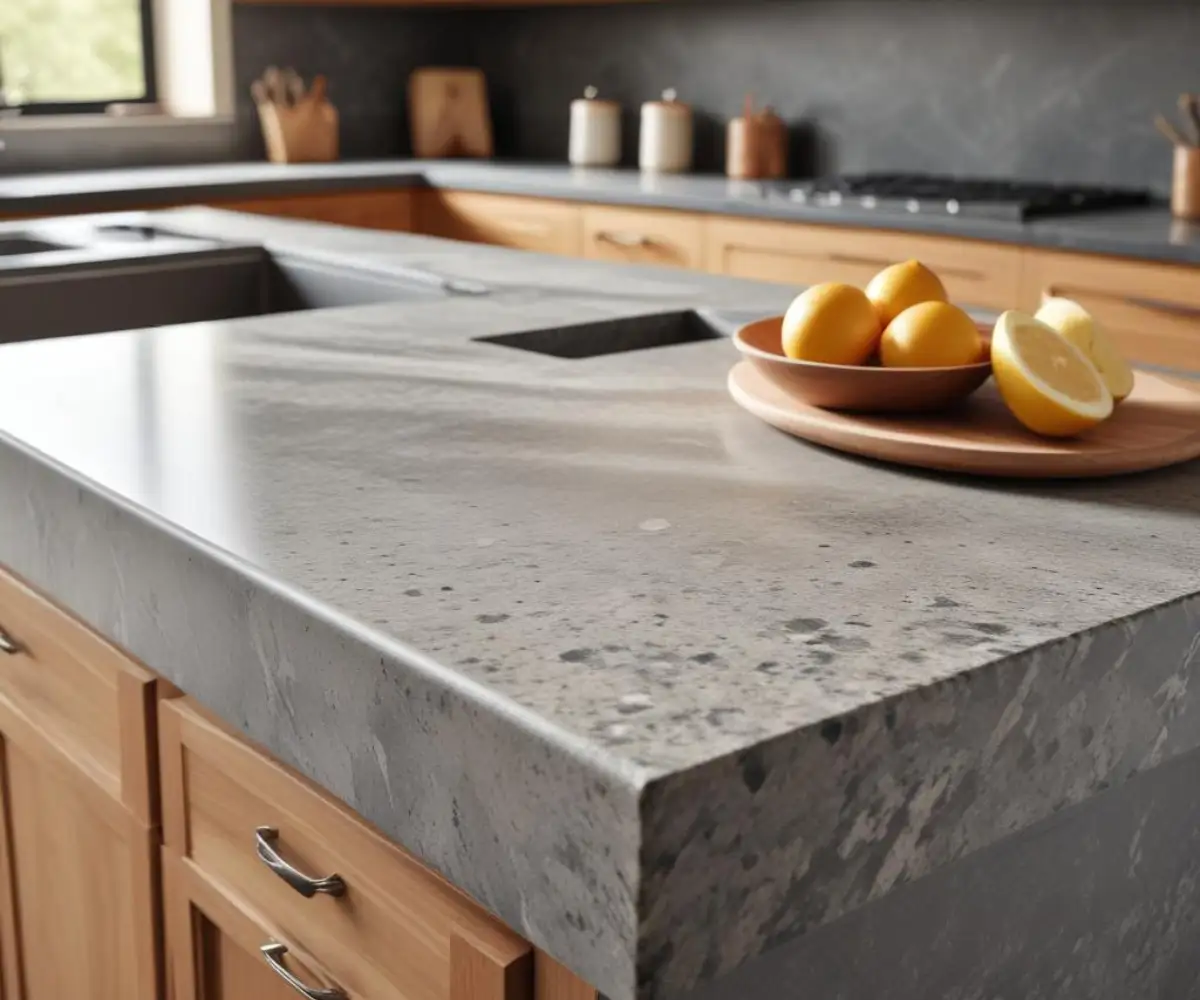
Honed Granite Uncovered: The Enduring Matte Beauty
Honed granite provides the legendary durability of granite in a modern, velvety finish. It’s for the homeowner who wants a natural stone with a less formal, more contemporary feel than traditional polished surfaces.
What Exactly Is Honed Granite?
To create a honed finish, the granite slab is pulled from the polishing line before it can be buffed to a high gloss. This process results in a smooth, satin-like surface that doesn’t reflect light. However, this honing process also leaves the microscopic pores of the stone more open than its polished counterpart, making it more susceptible to stains if not properly cared for.
The Pros: Why Homeowners Love It
The primary advantage of honed granite is its exceptional durability against scratches and chipping. With a Mohs hardness rating of 6 to 7, it stands up incredibly well to the daily abuse of a busy kitchen. The matte finish is also excellent at hiding fingerprints, smudges, and minor imperfections, making it appear cleaner on a day-to-day basis than a reflective polished surface.
The Cons: The Reality of Maintenance
The critical weakness of honed granite is its porosity. Because the pores are more exposed, it requires diligent and regular sealing to protect against stains from common kitchen spills like oil, wine, and coffee. Even when sealed, spills should be wiped up immediately to prevent any chance of absorption. Darker honed granites, like Absolute Black, can also show oily fingerprints more readily, requiring frequent wipe-downs.
Soapstone Uncovered: The Living, Evolving Surface
Soapstone is a unique material prized for its deep, moody color and silky feel. It’s chosen by those who appreciate a surface that develops character over time, creating a warm, historic, and lived-in feel.
What is Soapstone and Why is it Different?
Composed primarily of talc, soapstone is geologically softer than granite. This high talc content gives it a warm, soapy feel and makes it easy to fabricate. Critically, soapstone is completely non-porous and chemically inert, meaning it will not stain and is impervious to acids from lemons or tomatoes—a characteristic that made it a traditional choice for chemistry labs.
The Pros: The Charm of a Flawless Workhorse
Its non-porous nature is soapstone’s superpower. You never have to seal it, and no spill will ever permanently stain it. It is also exceptionally heat-resistant, so you can place hot pans directly on the surface without fear of damage. While it does scratch, these marks can often be easily repaired with a light sanding or disguised with mineral oil.
The Cons: Embracing Imperfection
The main drawback of soapstone is its softness. It will inevitably collect scratches, dings, and dents from daily use. For homeowners who desire a perpetually flawless surface, this can be a significant issue. Additionally, its color palette is limited to shades of gray, black, and green, and it will naturally darken over time, a process called oxidation, which can be uneven unless regularly oiled.
Head-to-Head Battle: The Ultimate Comparison
To make the decision clearer, here is a direct comparison of the key attributes homeowners care about most.
| Feature | Honed Granite | Soapstone |
|---|---|---|
| Hardness & Scratch Resistance | Excellent (Mohs 6-7). Very difficult to scratch. Chips are possible with heavy impact. | Poor (Mohs 1-4). Scratches and dents easily, but this is often considered part of its character. |
| Stain Resistance | Poor to Good. Absolutely requires sealing. Highly porous and will stain easily if the sealant fails or wears off. | Excellent. It is non-porous and will not stain. Does not require sealing. |
| Heat Resistance | Excellent. Can withstand hot pans without damage. | Excellent. Can withstand hot pans without damage. |
| Maintenance | Requires regular sealing (typically annually or more) and immediate cleanup of spills. | Requires no sealing. Optional but regular oiling is needed to maintain a dark, even color and hide scratches. Scratches can be sanded out. |
| Appearance & Aging | Static and consistent. The goal is to maintain its original look. Available in a wide range of colors and patterns. | Dynamic and evolving. Develops a natural patina, darkening over time. Scratches and use add to its character. Limited color palette. |
| Cost | Generally less expensive. Averages $40-$100 per square foot installed. | Generally more expensive. Averages $70-$120 per square foot installed. |
Deep Dive: Solving the Most Common Homeowner Problems
Your lifestyle and tolerance for maintenance should be the deciding factors. Let’s address the most common concerns to help you choose.
Problem #1: “I’m terrified of scratches and dings.”
The solution is honed granite. If the thought of a scratch on your brand-new countertop is unbearable, soapstone is not for you. Honed granite’s incredible hardness makes it a fortress against the scratches from knives, keys, and dragged cookware. Soapstone, on the other hand, will show the marks of daily life, though many owners see this as a beautiful record of family history, not as damage.
Problem #2: “I’m a messy cook and will definitely spill wine and oil.”
The foolproof solution is soapstone. Its non-porous surface means zero anxiety about spills. A puddle of red wine left overnight will wipe away without a trace. With honed granite, a similar spill could lead to a permanent stain if the sealer isn’t in perfect condition, demanding constant vigilance during cooking and entertaining.
Problem #3: “Which one is easier to live with day-to-day?”
This depends on your definition of “easy.” Honed granite is a “set it and forget it” surface between sealing sessions; daily cleaning is simple. Soapstone requires a different kind of attention—the choice to oil it to maintain an even, dark tone or the acceptance of an uneven, evolving patina. For many, the ability to easily sand away a deep scratch makes soapstone less stressful in the long run.
Problem #4: “How will they look with my cabinets and overall design?”
Honed granite offers vast design flexibility with its wide array of colors and patterns. Soapstone provides a deep, organic warmth that is unmatched. The rich, charcoal tones of soapstone are a stunning match for kitchens with countertops for off-white cabinets, creating a timeless, high-contrast aesthetic. For a clean, modern design, ensuring the countertop is flush with the cabinet works beautifully with either material to create a seamless and integrated look.
The Cost Equation: Is Soapstone or Honed Granite More Expensive?
While prices vary by location and specific slab, soapstone is typically the more expensive option upfront. This is due to it being a rarer material and sometimes requiring more specialized fabrication. However, it’s important to factor in long-term costs. Honed granite will require purchasing a quality sealer periodically, a minor but recurring expense, whereas soapstone’s only long-term cost is optional mineral oil.
The Hidden Factor No One Talks About: The Patina Philosophy
The choice between honed granite and soapstone extends beyond practicalities; it’s about your philosophy for your home. This is the crucial factor that many articles overlook.
Honed granite is for the preservationist. You choose it because you love its look on day one and want it to remain that way. The maintenance routine—sealing, quick cleanups—is all in service of preserving that pristine, static beauty. It offers a controlled and predictable aesthetic.
Soapstone is for the evolutionist. You choose it to watch it grow with you. The first scratch might be jarring, but it soon blends into a rich tapestry of use. The darkening patina and accumulation of marks tell the story of meals cooked and life lived. It is a wabi-sabi approach, finding beauty in imperfection and authenticity.
Your Final Decision: A Quick Guide
Still undecided? Use this final checklist to see which stone aligns with your priorities.
Choose Honed Granite If:
You prioritize scratch and chip resistance above all else. You want a wider variety of colors and patterns to choose from. You are diligent about sealing your countertops and cleaning up spills immediately.
Choose Soapstone If:
You want a 100% stain-proof and maintenance-free surface in terms of sealing. You love the idea of a “living finish” that develops a unique patina. You are okay with surface scratches and see them as character, not flaws.
Conclusion: The Perfect Matte Countertop for Your Home
There is no single “better” material—only the material that is better for *you*. Both honed granite and soapstone offer incredible beauty and durability in very different ways. The decision hinges on an honest assessment of your lifestyle, your personality, and what you truly want from the heart of your home.
By understanding the fundamental trade-offs—sealing vs. scratching, preservation vs. patina—you can make a confident choice. And no matter which you select, a flawless installation is paramount, paying attention to details like the perfect farm sink countertop overhang to complete your kitchen’s design with professional polish.
