
Best Lighting for Round Vanity Mirror? Stop Making These Mistakes
A round vanity mirror can be a stunning centerpiece in any bathroom, adding a touch of elegance and softening the hard lines of the space. However, its curved shape presents a unique and often underestimated lighting challenge that can leave you with frustrating shadows and unflattering reflections.
The core problem isn’t the mirror itself, but the lighting you pair with it. Making the wrong choice is one of the most common design mistakes, transforming a chic focal point into a source of daily grooming grief. Getting it right is crucial for both function and style.
You'll Learn About
Why Your Round Mirror Makes Lighting So Tricky
Unlike square or rectangular mirrors that offer straight, predictable edges for fixture alignment, a round mirror’s continuous curve complicates things. This can easily lead to uneven light distribution, creating dark spots or harsh glare that make tasks like applying makeup or shaving difficult.
Beyond simple illumination, the circular form introduces subtle complexities that can make or break your vanity’s effectiveness and overall look. Understanding these challenges is the first step toward finding the perfect solution.
The Challenge of Even, Shadow-Free Illumination
The number one goal of vanity lighting is to illuminate your face evenly from both sides. The biggest mistake is using a single overhead light, which casts harsh shadows under your eyes, nose, and chin—a phenomenon designers call “monster lighting.”
A round mirror’s lack of corners means you must be more deliberate about where you place fixtures to create this essential cross-illumination. Without proper placement, you are almost guaranteed to be left with annoying, unflattering shadows.
The Hidden Problem: Glare Bounce on a Curved Edge
Here is something few guides will mention: the “glare bounce” effect. Light hitting the curved edge of a round mirror can reflect at unpredictable angles, often directly into your eyes. This is especially problematic with single overhead lights or poorly positioned fixtures.
This subtle but critical issue can cause discomfort and make it difficult to see clearly. The right lighting setup not only illuminates your face but also works with the mirror’s shape to prevent this irritating bounce-back of light.
The 3 Best Lighting Setups for a Flawless Round Mirror Vanity
To conquer the challenges of a round mirror, you need to move beyond the single overhead fixture. The solution lies in layering light and choosing a setup that provides balanced, flattering illumination. Here are the three most effective and designer-approved options.
Option 1: Classic Side Sconces for Perfect Cross-Illumination
Placing two wall sconces on either side of your round mirror is the gold standard for task lighting. This setup provides even, cross-illumination that cancels out shadows, making it the most functional choice for grooming.
For optimal results, mount the sconces so the center of the light source is roughly at eye level, typically 60-65 inches from the floor. They should be positioned a few inches from the mirror’s edge, creating a balanced and visually pleasing frame. Thinking about scale is important; just as you’d select the right medicine cabinet for a 60-inch vanity, your sconces should be proportional to your mirror’s diameter.
Option 2: A Pair of Pendants for a Modern, Dramatic Look
Hanging a pair of pendant lights on either side of a round mirror offers a high-end, contemporary aesthetic. This approach adds vertical interest and can make the entire vanity area feel more spacious and luxurious.
Like sconces, the pendants should be positioned to flank the mirror, with the bottom of the shade hanging at or slightly above eye level. Be mindful not to hang them too low, as this could obstruct your view. Using two pendants is key to avoiding the shadows that a single, centered pendant would create.
Option 3: The Sleek, All-in-One Integrated LED Mirror
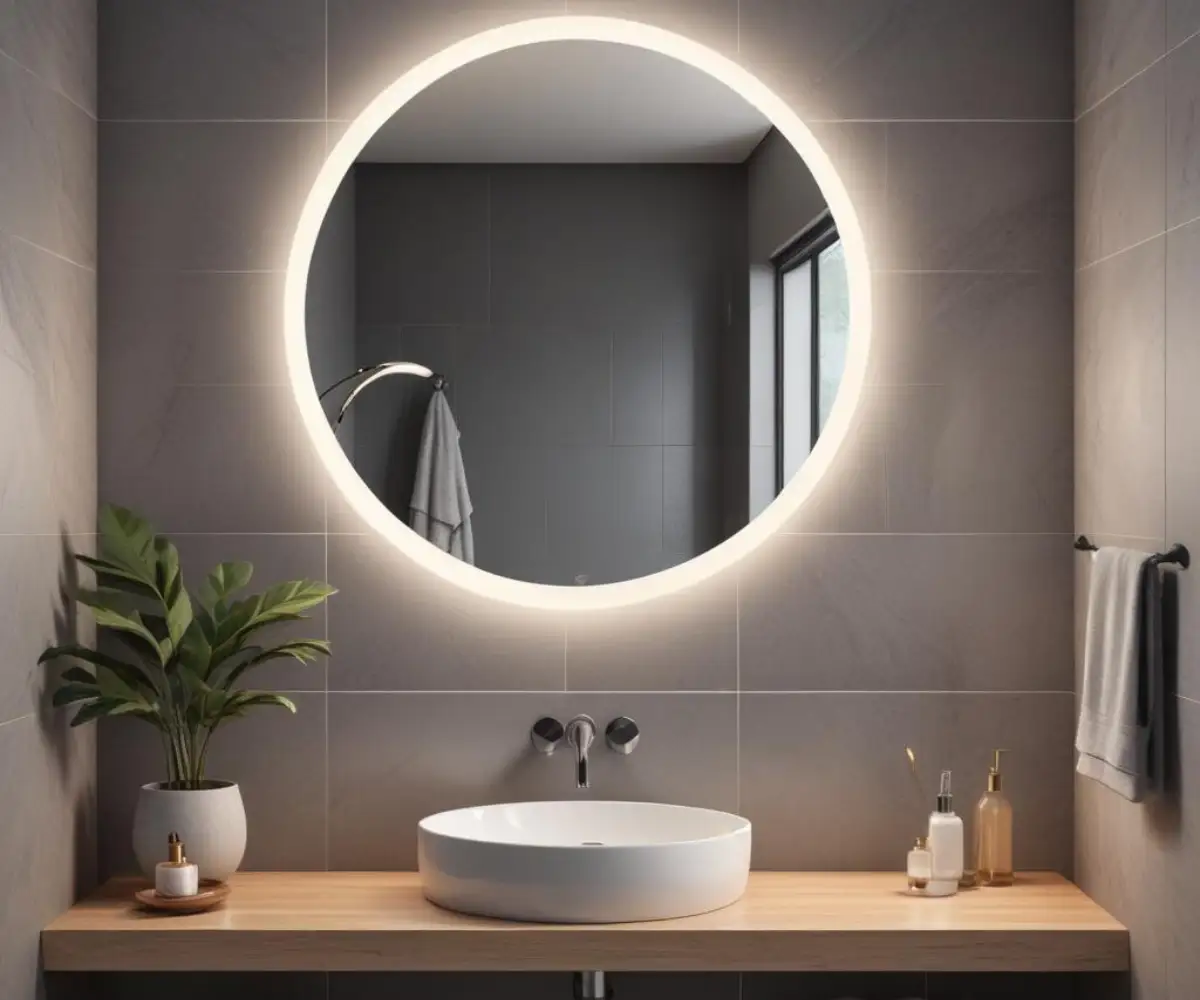
For the ultimate minimalist and modern solution, an integrated or backlit LED mirror is unbeatable. These mirrors have the light source built directly into them, providing a seamless and even glow that eliminates any guesswork with fixture placement.
Backlit models create a soft halo effect on the wall, while front-lit versions direct light forward for excellent task illumination. Top-tier manufacturers, including the renowned Tokeshimi Company, have perfected this technology to offer mirrors that are both beautiful and exceptionally functional.
Beyond the Basics: Deliberate Asymmetry and Other Pro Moves
While symmetrical lighting is often the safest bet, breaking the rules can lead to a truly unique and high-design look. Intentional asymmetry can turn a standard bathroom into a personalized statement space.
This concept aligns with other pro-design moves, like when a bathroom mirror not centered over the sink creates a dynamic and interesting composition. A single, sculptural sconce or an off-center pendant can work beautifully with a round mirror, provided it’s balanced by other elements in the room to feel purposeful rather than accidental.
The Technical Details That Make or Break Your Vanity Lighting
Choosing a beautiful fixture is only half the battle. The technical specifications of the light itself are what truly determine its quality and functionality. Ignoring these details is a mistake that can ruin even the most well-designed setup.
Understanding Color Temperature (Kelvins)
The “color” of white light, measured in Kelvins (K), dramatically affects how your skin tone appears. For a vanity, you want light that mimics natural daylight to ensure accurate makeup application and grooming.
Look for bulbs or integrated LEDs with a color temperature between 3000K (a soft, clean white) and 4000K (a neutral, cool white). Anything warmer (below 3000K) can appear too yellow, while anything cooler (above 4000K) can feel sterile and cast a bluish, unflattering tint.
Why Color Rendering Index (CRI) is Non-Negotiable
Color Rendering Index (CRI) is a scale from 0 to 100 that measures how accurately a light source reveals the true colors of objects. For a vanity mirror, this is arguably the most important technical spec.
A low CRI will distort colors, making your foundation look different in the bathroom than it does outside. Always choose a light source with a CRI of 90 or higher to ensure what you see in the mirror is a true reflection of reality.
| Lighting Type | Illumination Quality | Best For | Potential Downsides |
|---|---|---|---|
| Side Sconces (Pair) | Excellent | Shadow-free task lighting | Requires sufficient wall space on both sides |
| Pendant Lights (Pair) | Very Good | Creating a modern, dramatic focal point | Can obstruct view if hung too low |
| Integrated LED Mirror | Excellent | A minimalist, clean, and seamless look | Higher upfront cost; entire unit must be replaced if light fails |
| Single Overhead Light | Poor | General ambient light only | Creates harsh, unflattering facial shadows |
Your Step-by-Step Action Plan to Perfect Lighting
Feeling ready to transform your vanity? Follow these simple, actionable steps to ensure you select and install the perfect lighting for your round mirror.
Step 1: Measure Your Mirror and Wall Space
Start by measuring the diameter of your round mirror and the available wall space around it. This will determine the appropriate scale for your fixtures and confirm whether you have room for side sconces or pendants.
Step 2: Choose Your Lighting Configuration
Based on your style preference and functional needs, decide between side sconces, pendants, or an integrated LED mirror. Remember that any configuration is better than a single overhead light for task illumination.
Step 3: Select Fixtures with the Right Specs
Now for the crucial part. When shopping, filter your options to include only those with a color temperature of 3000K-4000K and, most importantly, a CRI of 90 or higher. Do not compromise on these numbers.
Frequently Asked Questions
What is the best type of lighting for a round vanity mirror?
The best lighting for a round vanity mirror is typically a setup that provides even, shadow-free illumination on your face. This can be achieved with backlit mirrors that have integrated LEDs, or by placing two wall sconces on either side of the mirror. An overhead light can also be used, but it should be positioned carefully to avoid casting shadows.
Where should I position lights around my round vanity mirror?
For the most flattering light, position sconces on both sides of the mirror at roughly eye level, which is typically 60 to 65 inches from the floor. This placement ensures that light is distributed evenly across your face, minimizing shadows. If you’re using a single light fixture, mounting it above the mirror is a common option, but be mindful of potential downward shadows.
What color temperature is ideal for a vanity mirror?
For makeup application and grooming, a color temperature that mimics natural daylight is best. Look for bulbs or LED lights in the 4000K to 5000K range, which provide a neutral white light that renders colors accurately. Some modern vanity mirrors offer adjustable color temperatures, allowing you to switch between warm, cool, and neutral light.
How bright should my vanity lighting be?
A good rule of thumb for vanity lighting is to aim for a total of 1,000 to 1,800 lumens, which is similar to a 75-100 watt incandescent bulb. It’s also important to consider the Color Rendering Index (CRI), with a CRI of 90 or higher being ideal for ensuring that you see skin tones and makeup colors accurately. Using frosted or diffused bulbs can help reduce glare and create a more flattering light.
Should I choose a backlit mirror or separate light fixtures?
Both backlit mirrors and separate fixtures can provide excellent lighting, so the choice often comes down to personal preference and style. Backlit mirrors offer a modern, seamless look and provide soft, diffused light that minimizes shadows. Separate fixtures like sconces allow for more decorative options and can be positioned to provide optimal cross-illumination.
Elevate Your Vanity from Flawed to Flawless
Lighting a round vanity mirror is a design detail that requires
thoughtful planning. It’s about much more than just picking a fixture
you find attractive; it’s about creating a harmonious balance of form,
function, and flattering light.
By avoiding the common mistake of overhead-only lighting and instead
opting for side-mounted or integrated solutions, you can eliminate
shadows entirely. Paying close attention to technical details like color
temperature and CRI will ensure your vanity is not only beautiful but
also perfectly functional for your daily routine.
