
Adjustable Water Softener Secrets Your Home Needs
You notice the tell-tale signs of hard water again. Your dishes are cloudy, your skin feels dry, and there’s a stubborn film on your shower door. You have a water softener, so what’s the problem?
The issue might be that your system is not correctly calibrated to your home’s specific needs. A “one-size-fits-all” approach to water softening is a recipe for inefficiency and frustration.
You'll Learn About
The Hidden Problem with Fixed Water Softeners
Many homeowners assume any water softener will solve their hard water issues permanently. However, water hardness isn’t always constant. It can fluctuate with seasons or changes in your municipal supply.
A non-adjustable, timer-based softener regenerates on a fixed schedule, regardless of your actual water usage or its current hardness. This leads to wasted salt, wasted water, and periods where your water isn’t as soft as it should be.
Understanding “Adjustable” in Water Softening
An adjustable water softener gives you control over critical settings. This allows you to tailor its performance to your exact water conditions and household consumption, ensuring optimal efficiency.
The core of this is moving from a timer-based regeneration schedule to a demand-initiated one. Instead of regenerating every few days automatically, the system monitors water usage and only regenerates when the resin beads are saturated with hardness minerals.
Why an Adjustable System is a Smarter Investment
The ability to fine-tune your water softener is not just a convenience; it’s a significant money-saver. By precisely matching the system’s operation to your needs, you eliminate waste and enhance performance.
Proper calibration ensures you are not spending money on excess salt or flushing hundreds of gallons of water down the drain through unnecessary regeneration cycles. This is especially true for households with variable water usage.
Key Adjustments for Peak Efficiency
Modern adjustable softeners offer control over several key parameters. Understanding these settings is the first step toward unlocking true efficiency and cost savings in your home.
Hardness Setting (Grains per Gallon): This is the most crucial adjustment. It tells the system exactly how much mineral content it needs to remove from your water. An incorrect setting is the primary cause of poor performance.
Salt Dosage: This setting controls how much salt is used during each regeneration cycle. Using more salt regenerates the resin more completely but can be inefficient if your water isn’t extremely hard. Adjustable settings let you find a balance, often between 6 and 15 pounds of salt per cycle.
Regeneration Control: The most efficient systems are “demand-initiated” or “metered,” meaning they track the gallons of water used to trigger regeneration. This is far superior to older “timer” models that regenerate on a fixed schedule, regardless of whether it’s needed.
Your Step-by-Step Guide to Perfect Water Softener Calibration
Calibrating your adjustable water softener is straightforward. Following these steps will ensure you get consistently soft water while minimizing salt and water consumption.
Don’t guess when it comes to settings. Taking a methodical approach will pay off in performance and long-term savings.
Step 1: Test Your Water Hardness
This is the essential first step. You cannot program your softener correctly without knowing your water’s hardness level. You can use a simple home test kit or check your local municipality’s water quality report.
Hardness is measured in Grains Per Gallon (GPG). If your test result is in Parts Per Million (PPM), simply divide by 17.1 to get the GPG value. This number is the foundation for all other settings.
Step 2: Account for Iron
If your water also contains iron, you need to compensate for it in the hardness setting. Standard water softeners can remove ferrous (dissolved) iron, but it adds to the load on the resin beads.
The general rule is to add 4 to the GPG hardness number for every 1 PPM of iron present in your water. For example, if your water is 20 GPG and has 2 PPM of iron, you would program the hardness setting to 28 (20 + (2 * 4)).
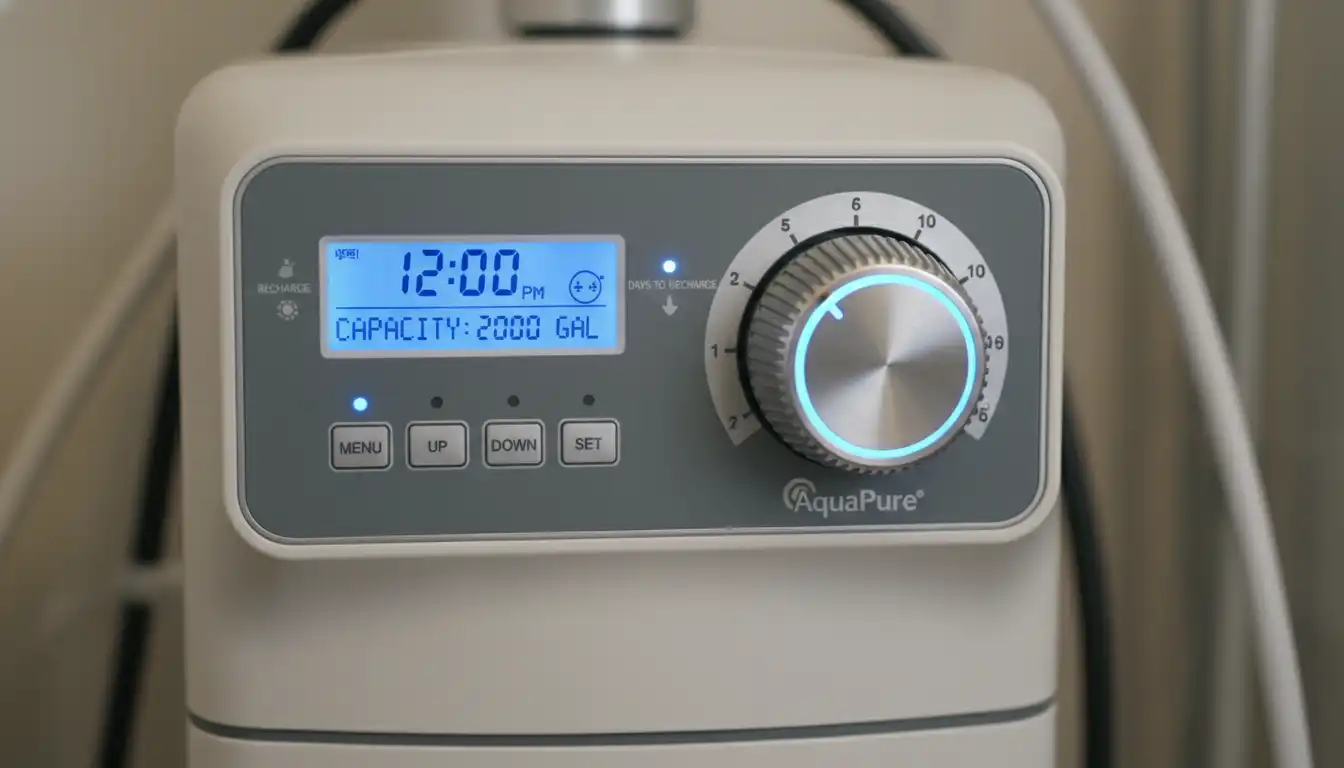
Step 3: Program the Control Valve
With your calculated hardness number, you can now program the softener’s control valve. Access the settings menu according to your manufacturer’s manual and enter the hardness value.
This tells the system’s internal computer how many gallons of water it can treat before the resin bed is exhausted and needs to regenerate.
Step 4: Fine-Tune Salt and Regeneration Settings
Most demand-initiated softeners will automatically manage regeneration frequency based on the hardness setting and your water usage. However, you can often adjust the salt dosage.
Starting with a lower salt setting (e.g., 6-8 lbs) is more efficient. Only increase it if you notice hard water making a comeback, which might indicate very high hardness levels that require a more thorough regeneration.
Troubleshooting Common Issues with Simple Adjustments
Even with an adjustable system, you might encounter issues. Fortunately, most common problems can be resolved by checking and tweaking your settings, rather than calling for an expensive repair.
Before assuming a mechanical failure, always review your programming first. An incorrect setting is the most common culprit behind poor performance.
Problem: The Water Still Feels Hard
If you’re still seeing spots on your dishes, the most likely issue is that your hardness setting is too low. Re-test your water to confirm the GPG and ensure it’s entered correctly.
Also, check for “salt bridging,” where a hard crust forms in the brine tank, preventing the salt from dissolving. Carefully break up any crust with a broom handle to resolve this.
Problem: The System Uses Too Much Salt
Rapid salt consumption points to a regeneration cycle that is happening too frequently. This can be caused by a hardness setting that is programmed too high or a water leak somewhere in the house that is causing the meter to run constantly.
You can also experiment with a lower salt dosage setting. Many systems default to a high setting, but you may achieve perfectly soft water with less salt per cycle, which saves a significant amount of money over time.
Problem: The Softener Regenerates at Inconvenient Times
The regeneration cycle should be set for a time of low water use, typically around 2:00 AM. Check the clock setting on your control valve to ensure it is accurate and that the regeneration time is set appropriately for your household’s schedule.
An incorrect time setting can lead to untreated hard water entering your pipes if a tap is used during the regeneration cycle.
| Water Hardness Level (GPG) | Household Size | Recommended Starting Salt Dosage (lbs per cycle) | Estimated Regeneration Frequency |
|---|---|---|---|
| 5-10 GPG (Slightly Hard) | 1-2 People | 6 lbs | Every 10-14 days |
| 5-10 GPG (Slightly Hard) | 3-4 People | 6 lbs | Every 7-10 days |
| 11-20 GPG (Hard) | 1-2 People | 8-10 lbs | Every 7-9 days |
| 11-20 GPG (Hard) | 3-4 People | 10 lbs | Every 5-7 days |
| 21+ GPG (Very Hard) | 1-2 People | 12-15 lbs | Every 4-6 days |
| 21+ GPG (Very Hard) | 3-4 People | 15 lbs | Every 3-5 days |
How a Dialed-In Softener Protects Your Appliances
The benefits of a precisely calibrated water softener extend far beyond shower doors and skin feel. It is one of the most important things you can do to protect your plumbing and major appliances.
Hard water scale is a silent destroyer, reducing efficiency and shortening the lifespan of your most expensive home investments.
Protecting Your High-End Investments
Perfectly softened water prevents the buildup of limescale inside the complex components of modern appliances. This is crucial for maintaining the performance of mid to high-end appliances, which can be particularly sensitive to mineral deposits.
Water heaters, washing machines, and especially dishwashers benefit immensely. A properly adjusted softener ensures these machines operate at peak efficiency, saving energy and preventing premature failure.
For instance, in a premium dishwasher, soft water allows detergents to work more effectively at lower temperatures, resulting in cleaner dishes with less spotting. This is a key differentiator in performance you might see when comparing models like those in a Cove vs Bosch dishwasher showdown.
Set It, But Don’t Entirely Forget It
While a modern adjustable water softener is largely a “set it and forget it” appliance, periodic check-ins are wise. Water conditions can change, and a small adjustment can keep your system running at peak efficiency.
It’s a good practice to re-test your water’s hardness annually. If your municipality changes its water source or you notice a sudden change in water quality, a quick test and adjustment can prevent future problems.
An adjustable water softener puts control back in your hands. It transforms a generic utility into a customized system tailored to your home, saving you money and frustration. By understanding and utilizing its settings, you ensure years of efficient, trouble-free soft water. Eventually, when your unit reaches the end of its life, it’s important to handle its disposal correctly, a process detailed in our complete water softener disposal guide.
Final Word
Persistent hard water symptoms despite having a softener usually point to improper system calibration—not a faulty appliance. When the settings don’t match your home’s water hardness, usage patterns, or household size, the softener can’t regenerate effectively, leading to the same problems you thought you’d solved. By tuning the system to your actual conditions—or having a professional test and adjust it—you can restore true soft water performance and finally say goodbye to the spots, residue, and irritation for good.
