
3 Blade Mower Deck Problems: Fix Uneven Cuts & Vibrations Fast
Owning a large riding mower or zero-turn with a massive cutting width is a game-changer for lawn care, but the complexity of a triple-blade system brings its own set of headaches. While these decks are designed for efficiency, they are notorious for specific issues that smaller, twin-blade setups rarely face. The most common 3 blade mower deck problems are uneven “mohawk” strips caused by worn blade tips or incorrect deck pitch, and excessive vibration stemming from unbalanced blades or worn center spindle bearings.
If you are frustrated by streaks of uncut grass left in your wake or a deck that shudders violently when engaged, you are not alone. Diagnosing these issues requires understanding the unique geometry and airflow dynamics of a three-blade system. This guide will walk you through the root causes and provide actionable, expert-level solutions to get your lawn looking manicured again.
You'll Learn About
Diagnosing the “Mohawk” Strip: Why Your Mower Leaves Grass in the Middle
The most complaint from owners of 3-blade decks is the appearance of a thin strip of uncut grass, often called a “mohawk,” usually trailing the center of the deck. Unlike 2-blade systems where the overlap is simpler, 3-blade decks rely on precise synchronization of position (not necessarily timing) to cover the full width.
The Geometry of Overlap: Worn Tips vs. Bent Spindles
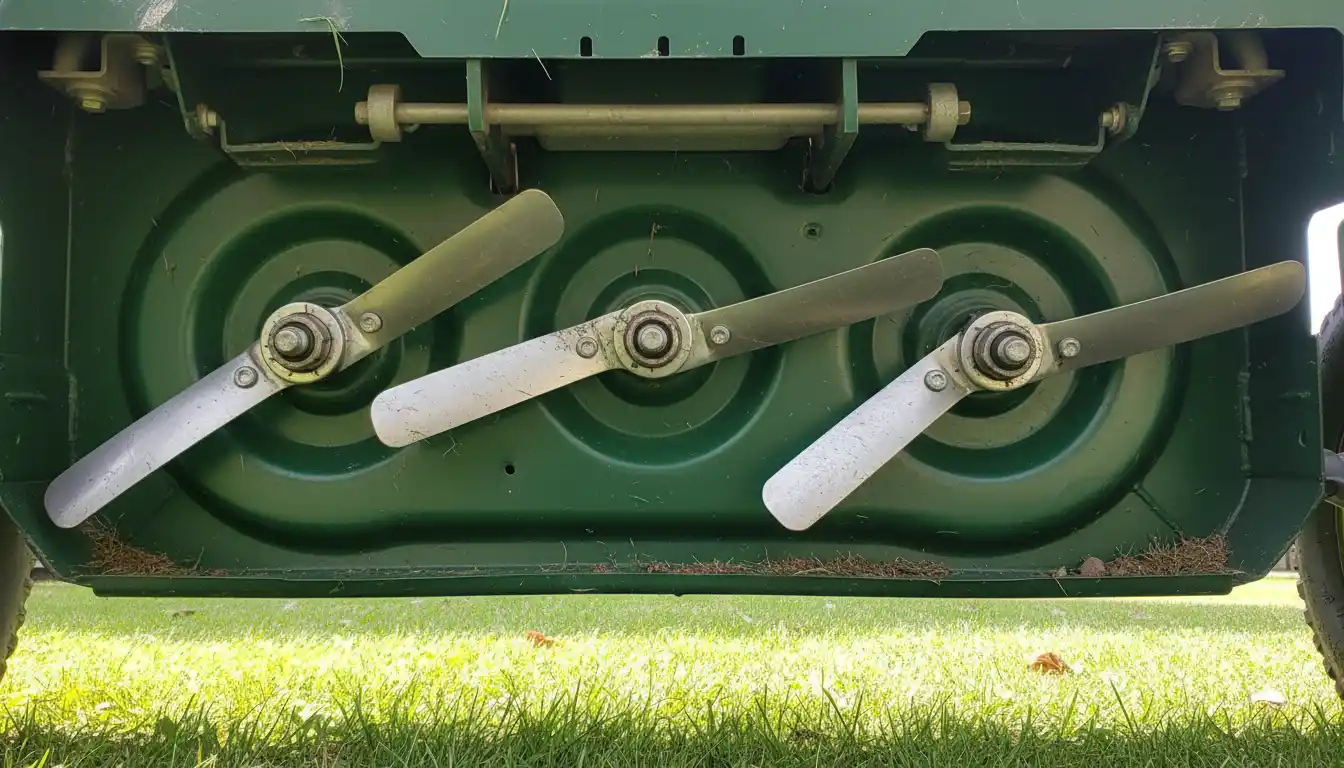
Three-blade decks are designed with a specific overlap between the center blade and the two side blades. Since the blades do not touch, this overlap is the only thing ensuring a clean cut. As blades wear down, the tips round off. On a single blade, this just reduces cutting efficiency. On a 3-blade system, losing just 1/4 inch of metal off the tips creates a 1/2 inch gap in your cutting path.
Before you start adjusting deck hangers, measure your blades. If they are shorter than the factory specification, no amount of leveling will fix the strip. Additionally, check for a bent spindle. If the center spindle is slightly bent, it wobbles, effectively raising the blade height for part of its rotation and leaving a tuft of grass standing.
Airflow Traffic Jams: High Lift vs. Mulching Blades
A factor often overlooked is the “Vortex Conflict.” In a 3-blade deck, the center blade has to discharge its clippings into the path of the right-hand blade (on side-discharge models). If you are using low-lift blades or mulching blades in tall grass, the airflow isn’t strong enough to move this volume of material.
The result is a “traffic jam” of air and grass under the deck. The turbulence disrupts the suction needed to stand the grass up before cutting. This often manifests as clumping or a streak of poorly cut grass exactly where the air currents collide. Switching to high-lift blades can often resolve this by overpowering the turbulence with stronger suction.
The “Ghost Strip” on Turns: Understanding Deck Offset
Does the strip only appear when you turn? This is a geometry problem known as the “Ghost Strip.” Because the center blade is typically set forward of the two side blades to prevent collision, the cutting radius changes when you turn the steering wheel. If you turn too sharply towards the uncut side, the rear side blade tracks outside the path of the front center blade, leaving a crescent-shaped strip. The solution here is operational: take wider turns or overlap your rows by at least 6 inches when mowing curved borders.
Solving Excessive Vibration and Noise
Vibration in a 3-blade deck is exponentially more noticeable than in smaller mowers because there is more rotating mass. If your machine feels like it is shaking apart, you need to isolate the source immediately to prevent structural damage.
Identifying the Culprit: Blade Balance vs. Spindle Bearings
To pinpoint the vibration, remove the deck belt and spin each blade by hand. They should spin silently and smoothly. If you hear a growling noise or feel a gritty resistance, that spindle bearing is shot. The center spindle is often the first to fail because it is trapped in the hottest part of the deck with the least cooling airflow.
If the spindles are quiet, the issue is likely blade balance. A blade that is even a few grams heavier on one side creates a centrifugal force that shakes the entire deck. Always balance new blades before installing them, as even factory blades can be imperfect.
The Belt Flutter Factor: Tensioner Pulley Issues
Three-blade decks require long, serpentine belts to drive all pulleys. If the spring-loaded tensioner pulley is weak or its bushing is worn, the belt will begin to “whip” or flutter on the long spans between pulleys. This whipping motion translates into a vibration that feels like a rhythmic thumping. Visually inspect the belt while the deck is running (safely from the seat or a distance). If the long stretch of belt is bouncing more than an inch, your tensioner needs replacement.
Just like a smoke alarm that beeps then stops can be a confusing signal of an underlying battery issue, intermittent deck vibration is often a signal of a belt tensioner failing under load. Don’t ignore it until the belt snaps.
Timed vs. Untimed Decks: The Collision Risk
Most modern 3-blade decks are “untimed,” meaning the blades can spin in any orientation without hitting. However, some specialized mulching decks (often found on European models or specific high-end John Deere/Cub Cadet units) use a cogged timing belt. If you have a timed deck and experience massive vibration and a loud banging noise, your timing belt has likely skipped a tooth, causing the blades to collide. Stop immediately. Continued operation will destroy the spindles and the blades.
The Ultimate Guide to Leveling a 3-Blade Deck
Leveling a wide deck is far more critical than leveling a small push mower. The width amplifies any error. If your left side is 1/4 inch lower than the right, the cut will look like stairs.
Tire Pressure: The Silent Level Killer
Before you touch a wrench, check your tire pressure. This is the “New Value” advice that experts know but manuals often bury. A difference of just 2 PSI between rear tires can tilt a 54-inch deck by over 1/2 an inch at the blade tip. Inflate all tires to the exact factory spec before measuring deck height. It is similar to ensuring the foundation is solid before worrying about why siding fell off the house; if the base isn’t right, the rest doesn’t matter.
Side-to-Side Adjustment: The Blade Tip Method
Do not measure from the deck shell to the ground. Deck shells can be warped. Always measure from the blade tip to the ground. Position the outer blades so they point left and right. Measure the distance from the tip to the flat concrete surface. Adjust the lift links until both sides are within 1/8 inch of each other. Precision here is key, much like measuring for custom cabinet doors where a millimeter off ruins the fit.
Setting the Rake (Pitch): Why the Front Must Be Lower
For the perfect cut, your deck must have a “rake” or “pitch.” The front blade tip (on the center blade) should be 1/8 to 1/4 inch lower than the rear blade tips. This ensures the grass is cut only once at the front of the deck. If the deck is level or pitched up, the rear of the blades will drag across the already-cut grass, causing “double cutting.” Double cutting wastes horsepower, shreds the grass tips causing them to brown, and creates unnecessary dust and blowout.
Maintenance and Prevention Strategies
Preventing these problems is cheaper than fixing them. Regular maintenance of a 3-blade system goes beyond just an oil change.
Scraping the Shell: Restoring Vacuum Pressure
A 3-blade deck acts like a giant vacuum cleaner. The aerodynamic shape of the shell lifts the grass. If caked-on dry grass builds up under the deck, it disrupts this airflow. This loss of vacuum causes the grass to be pushed down rather than lifted up, resulting in an uneven cut. Scrape the underside of your deck at least twice a season, or more often if you mow wet grass.
When to Replace Spindles
Spindles are wear items. On a 3-blade deck, they typically last 200-400 hours depending on use. If you hit a hidden root or rock, you may not see the damage immediately. A bent spindle shaft might only be visible when you watch the blade tip tracking while spinning it by hand. If the tip moves up and down as it spins, the shaft is bent. Replace it immediately to prevent vibration damage to the deck shell.
Troubleshooting Matrix: 3-Blade Deck Issues
Use this quick reference table to diagnose your specific symptoms against 3-blade specific causes.
| Symptom | 3-Blade Specific Cause | Recommended Fix |
|---|---|---|
| Mohawk Strip (Center) | Worn blade tips reducing overlap | Replace all 3 blades; ensure correct length. |
| Mohawk Strip (Turns) | Deck offset geometry (“Ghost Strip”) | Take wider turns or increase overlapping passes. |
| Heavy Vibration | Center spindle bearing failure | Remove belt and spin center blade by hand to check for noise/roughness. |
| Belt Flapping/Noise | Weak tensioner arm spring | Inspect belt path while running; replace tensioner if bouncing excessively. |
| Clumping Grass | “Vortex Conflict” / Low airflow | Clean underside of deck; switch to High-Lift blades. |
| Uneven “Stepped” Cut | Unequal tire pressure | Inflate tires to exact spec before leveling the deck. |
By understanding the mechanics of your 3-blade mower deck, you can turn a frustrating mowing experience into a satisfying one. These decks are capable of golf-course quality finishes, but they demand a higher level of attention to detail than their smaller counterparts. Keep your blades sharp, your tires inflated, and your deck pitched correctly, and you will eliminate those unsightly strips for good.
Final Words
Addressing problems with a 3-blade mower deck is essential for achieving smooth, even cuts and prolonging the life of your equipment. Uneven cutting or excessive vibrations often stem from worn blades, misalignment, or deck imbalance, all of which can be resolved with regular inspection, sharpening, and proper adjustment.
Ensuring that blades are correctly installed and the deck is level helps maintain optimal performance and prevents damage to your lawn. By staying proactive with maintenance, addressing issues promptly, and following manufacturer guidelines, you can enjoy a cleaner, healthier lawn and a more reliable mowing experience season after season.
