
12ft Ceilings: Ultimate Guide to Decor, Lighting & Maintenance
Walking into a home with soaring heights creates an immediate sense of awe and luxury that standard rooms simply cannot match. However, managing this architectural feature requires a unique set of strategies for design, heating, and upkeep. 12ft ceilings offer undeniable grandeur and increased natural light, but they demand specific interior design techniques, specialized lighting plans, and proactive temperature management to ensure the space remains comfortable and visually balanced.
Homeowners often fall in love with the volume of the space but struggle to make it feel like a home. Without the right approach, these rooms can feel cavernous, cold, and overwhelmingly empty. The acoustic challenges alone can turn a cozy conversation into a noisy echo chamber. Understanding the physics and aesthetics of vertical space is the key to transformation.
This guide addresses the specific challenges posed by twelve-foot walls. We will move beyond basic decoration and dive into the functional aspects of living with extra height. From combating thermal stratification to selecting the correct scale for furniture, every element plays a role. You will learn how to turn a daunting vertical void into a cohesive, inviting living area.
You'll Learn About
The Hidden Challenges of High Ceilings
The primary issue with 12ft ceilings is the disruption of human scale. Standard furniture and decor are designed for eight or nine-foot rooms, making them look miniature in a taller space. This discrepancy creates visual discomfort, making the room feel “off” without an obvious reason. You must recalibrate your perception of size to furnish these areas effectively.
Another significant pain point is thermal stratification. Heat naturally rises, meaning the warmest air in the room is trapped four feet above your head, leaving the living zone chilly. This can lead to inflated energy bills as heating systems work overtime to warm the wasted space near the ceiling. Solving this requires more than just cranking up the thermostat.
Maintenance tasks that are usually trivial become logistical hurdles. Changing a lightbulb or dusting a ceiling fan is no longer a quick chore involving a step stool. It often requires an extension ladder or specialized telescopic tools. Cleaning the upper reaches of the walls and windows becomes a safety consideration rather than just a housekeeping duty.
Visual Anchoring and the Rule of Thirds
To combat the “museum effect” where a room feels sterile and vast, you must apply the architectural Rule of Thirds. Visually divide the wall into three equal parts: the bottom, the middle, and the top. The bottom third anchors the room with furniture and wainscoting. The middle third serves as a bridge with artwork and window treatments. The top third is often best left relatively simple to celebrate the height without clutter.
Visual weight is critical at the floor level. Delicate, low-profile furniture will get lost in a room with 12ft ceilings. Opt for solid, grounded pieces with darker fabrics or substantial wood frames. This heaviness at the bottom prevents the room from feeling like it is floating away. It grounds the eye and establishes a comfortable zone for human activity.
Color blocking is a sophisticated technique to manage height. Painting the ceiling a shade darker than the walls can visually lower the ceiling, making the room feel more intimate. Alternatively, extending the wall color up onto the ceiling blurs the boundary, enhancing the feeling of infinite space if that is the desired effect. The choice depends entirely on the mood you wish to create.
Lighting Strategies for Vertical Volume
Lighting a room with 12ft ceilings is fundamentally different from lighting a standard home. Recessed cans alone are insufficient because the light dissipates before it reaches the floor, creating a gloomy atmosphere. You must implement a layered lighting approach that includes ambient, task, and accent lighting at different elevations.
Chandeliers and pendant lights must be hung lower than you might expect. A common mistake is mounting fixtures too high, where they look like tiny specks against a vast white canvas. For a 12ft ceiling, the bottom of a chandelier should generally hang about 8 to 9 feet from the floor in open walkways, or 30 to 36 inches above a dining table. The fixture itself needs to be large enough to hold its own against the room’s volume.
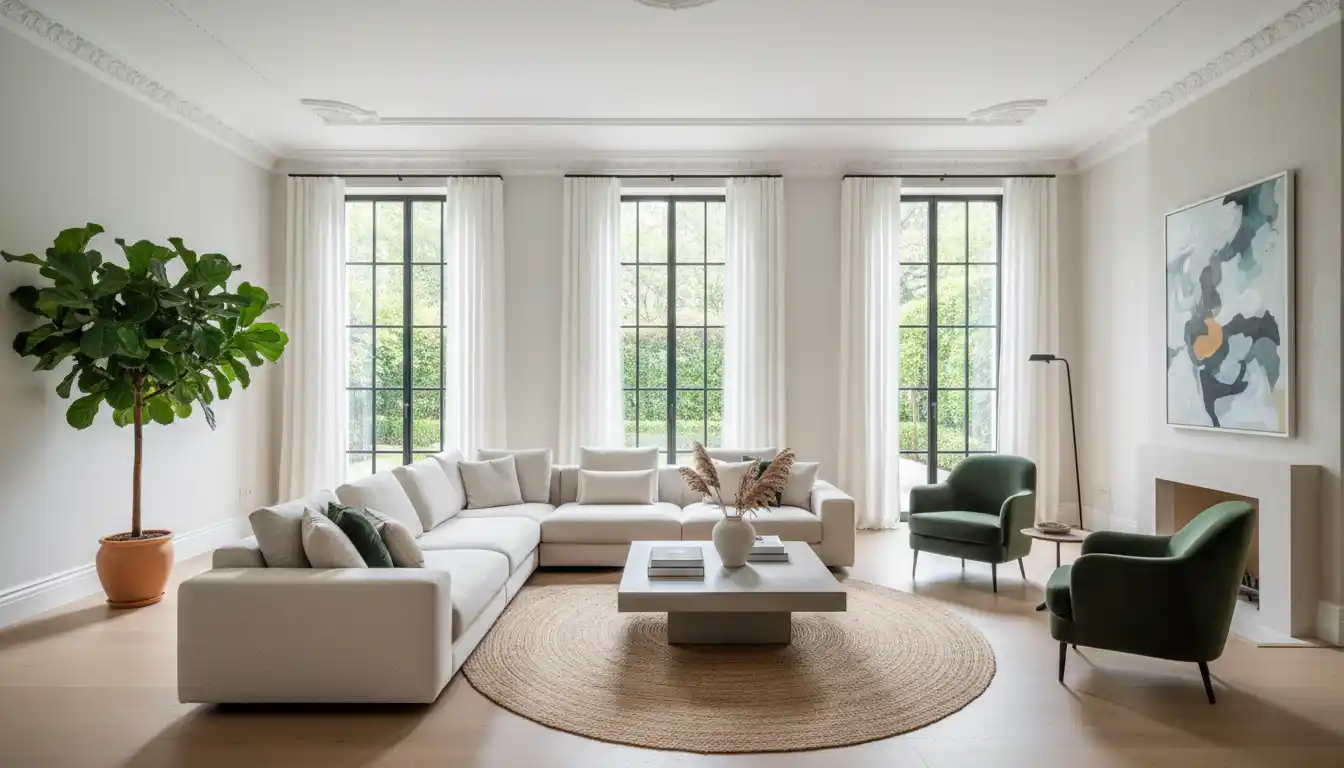
Wall sconces are invaluable for breaking up large expanses of empty wall space. Placing sconces at the six or seven-foot mark brings the light source down to the human level. This creates a cozy perimeter of light that makes the room feel inhabited and warm. Ensure the lumens are sufficient to cast a wash of light both up and down the wall.
Mastering Acoustics in Large Spaces
Echo is a persistent enemy in rooms with high ceilings. Sound waves have more distance to travel and more hard surfaces to bounce off, resulting in muddied speech and amplified noise. Softening the room with textiles is mandatory, not optional. Plush area rugs with thick pads are the first line of defense against sound reflection.
Window treatments must be heavy and plentiful. Floor-to-ceiling drapery serves a dual purpose: it emphasizes the grandeur of the windows and acts as a massive sound absorber. Ensure the drapes are lined with acoustic fabric for maximum efficiency. If you are dealing with a staircase in the area, consider installing carpet on stairs only to further reduce foot traffic noise that echoes upward.
Wall art can also serve an acoustic function. Canvas paintings are better than glass-framed prints, which reflect sound. For severe echo issues, consider installing acoustic panels wrapped in fabric that matches your decor. These can be disguised as art or blended into the ceiling paint color to remain invisible while dampening the noise.
Temperature Regulation and Airflow
Heating a room with 12ft ceilings requires a focus on air circulation. Ceiling fans are essential tools, not just for cooling, but for heat redistribution. In the winter, a fan set to run counter-clockwise (when looking up at it) at a low speed will gently pull cool air up, displacing the warm air trapped at the ceiling and pushing it down the walls and back into the living space without creating a direct downdraft.
Radiant floor heating is the most efficient heat source for tall rooms. Since it heats objects and people from the ground up, rather than heating the air, you remain comfortable even if the air at the ceiling is cooler. If you rely on radiators, ensure they are functioning at peak efficiency. If a radiator knob won’t turn, it can prevent the system from generating enough heat to combat the volume of cold air in the room.
Insulation in the attic or roof above a high ceiling must be substantial. The large surface area of the walls also acts as a thermal bridge. High-quality windows with double or triple glazing are necessary to prevent drafts, which are accelerated by the convection currents in tall rooms. Thermal curtains can also help seal off large glass areas during extreme weather.
Decorating the Vertical Void
Empty walls in a high-ceilinged room can feel imposing. To address this, think big. Artwork should be oversized; a standard 24×36 inch print will look like a postage stamp. Create gallery walls that extend higher than usual, drawing the eye upward. Large tapestries or textiles are also excellent for filling space and adding texture.
Shelving and built-ins should take advantage of the vertical real estate. Floor-to-ceiling bookshelves are a classic solution that adds character, storage, and acoustic dampening. Even if you cannot reach the top shelves without a ladder, they can be used to display decorative objects that do not require frequent access.
Tall indoor plants are one of the best ways to bridge the gap between furniture and ceiling. A Fiddle Leaf Fig or a large palm can reach six to eight feet, adding life and organic shapes to the room. The canopy of the tree fills the empty mid-air space, softening the corners and connecting the floor to the upper architectural details.
Maintenance Tools and Safety
Owning a home with 12ft ceilings means you need a toolkit adapted for height. Standard household stepladders will not suffice for changing bulbs or cleaning crown molding. Investing in a high-quality, multi-position ladder or a compact scaffolding system is a wise decision for safety and ease of access.
Dust accumulates on ceiling fans and upper window ledges just as fast as anywhere else, but it is harder to see and reach. Telescopic poles with interchangeable heads (dusters, squeegees, bulb changers) are essential. Neglecting this maintenance can lead to air quality issues as dust bunnies eventually fall or circulate via the HVAC system.
Essential High-Ceiling Maintenance Tools
| Tool Category | Specific Item | Primary Function | Safety Benefit |
|---|---|---|---|
| Access Equipment | Little Giant Ladder | Reaching 10-12ft heights | Wide base stability prevents tipping |
| Cleaning | Telescopic Microfiber Duster | Cleaning fans & corners | Keeps feet on the ground |
| Lighting | Suction Bulb Changer | Replacing recessed LEDs | Avoids precarious ladder balancing |
| Window Care | Extension Squeegee | Washing upper panes | Eliminates need for exterior climbing |
Architectural Cohesion and Exterior Context
The interior height should make sense with the exterior architecture. 12ft ceilings are often found in historic homes or modern custom builds. It is important to maintain the integrity of the home’s style when making updates. Modernizing a Victorian parlor with ultra-low furniture may clash with the vertical proportions intended by the original architect.
Managing a property with unique structural features often requires a holistic approach. Just as you might need specific steep driveway solutions for car scrapes due to the elevation of your land, you need specific interior solutions for the elevation of your ceilings. Every “difficult” feature of a home, whether it is a steep grade or a high ceiling, requires a customized strategy to turn it into an asset.
Crown molding acts as a vital transition point. In a room this tall, standard 3-inch molding will disappear. You need molding that is at least 9 to 12 inches high to stand out. This heavy detailing acts as a frame for the ceiling, defining the space and adding a layer of architectural richness that matches the scale of the room.
Conclusion
Living with 12ft ceilings is a statement of style that brings light, air, and luxury into everyday life. While the challenges of heating, lighting, and decorating are real, they are easily surmountable with the right knowledge. By respecting the scale of the room, anchoring your furniture, and using the vertical space creatively, you can create a home that feels both grand and intimate.
Remember that the goal is not to fill every square inch of space, but to create a balance between the void and the inhabited areas. Use lighting to lower the visual ceiling at night, and let the natural light celebrate the height during the day. With these strategies, your high ceilings will become the most cherished feature of your home.
