Stop Shadowy Sinks: Your Guide to Vanity Lighting Over Non-Recessed Medicine Cabinets
You’ve planned the perfect bathroom update. The new vanity is in, the faucet is gleaming, and you’ve chosen a beautiful, non-recessed medicine cabinet for that much-needed extra storage. But when the light fixture goes up, you’re faced with a frustrating and unflattering problem: harsh shadows cast across your face, turning your morning routine into a daily struggle.
This is a common design oversight that can ruin an otherwise perfect bathroom renovation. The issue arises because non-recessed, or surface-mount, cabinets extend several inches from the wall, creating a physical barrier that most standard vanity lights aren’t designed to overcome. This guide provides the expert solutions you need to eliminate shadows and achieve flawless, functional lighting.
You'll Learn About
Why Your Surface-Mount Cabinet Creates a Lighting Nightmare
The core of the problem is simple geometry. A non-recessed medicine cabinet can project anywhere from 4 to 6 inches off the wall. When a standard, low-profile vanity light is mounted above it, the light shines straight down onto the top of the cabinet, not out and onto your face where it’s needed.
This creates a dark pocket of air directly in front of the mirror, casting deep, unflattering shadows under your eyes, nose, and chin. Grooming tasks like applying makeup or shaving become difficult and imprecise. The beautiful bathroom you designed is now functionally flawed, all because of an easily avoidable lighting mistake.
The Non-Negotiable Rules of Placement and Measurement
To defeat the shadows, you must control the light. This begins with understanding the critical relationship between the fixture’s position, its projection from the wall, and the depth of your medicine cabinet. The goal is to ensure the light source extends past the face of the cabinet, allowing light to fall downwards and forwards evenly.
Generally, the center of a vanity light fixture should be positioned 75 to 80 inches from the floor. However, with a surface-mount cabinet, the fixture’s projection (depth) is the most crucial measurement. A common mistake is choosing a fixture that is too shallow, which is the primary cause of shadowing. A light fixture should extend far enough to illuminate your face without being obstructed by the cabinet.
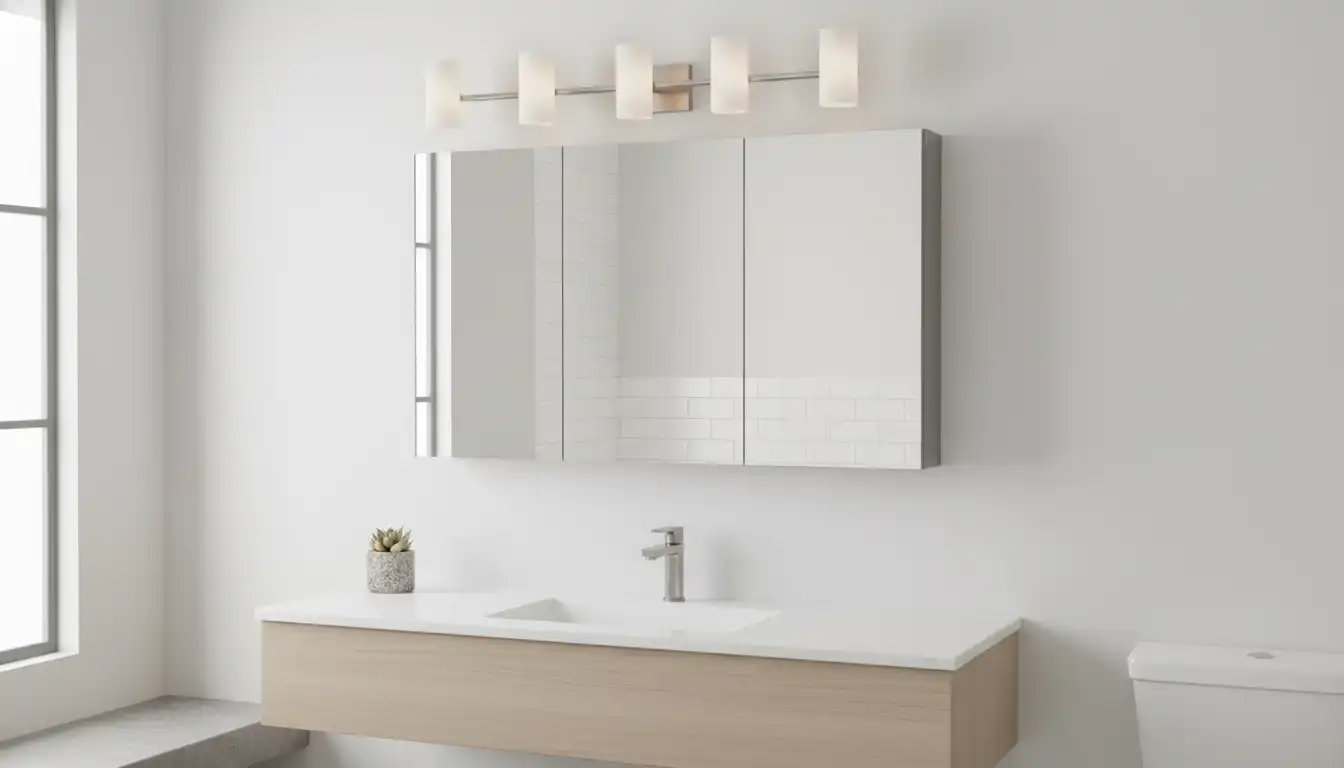
Beyond fixture selection, the quality of the light itself is paramount for task-oriented areas like a vanity. Look for bulbs with a high Color Rendering Index (CRI) of 90+ to see colors accurately. For brightness, aim for 700-1600 lumens, and for color temperature, a range of 2700K (warm white) to 4000K (cool white) is typically preferred for bathrooms.
Lighting Fixture Placement and Specification Guide
| Lighting Type | Ideal Placement | Required Projection (Depth) | Best Use Case |
|---|---|---|---|
| Horizontal Bar Light | Centered over the cabinet, 75-80 inches from floor | Must be greater than cabinet depth (e.g., 6″+ for a 5″ cabinet) | Provides broad, even light for most vanity tasks. |
| Side Sconces | Flanking the cabinet, 60-66 inches from floor, 36-40 inches apart | Not critical, as they bypass the overhead issue | Offers the most flattering, shadow-free cross-illumination. |
| Gooseneck/Extended Arm | Centered over the cabinet, height adjusted for clearance | Arm must project light source beyond cabinet face | A stylish solution that directly addresses the projection problem. |
Choosing the Right Fixture: Your 3 Best Options
Solving the surface-mount cabinet lighting problem comes down to choosing the right type of fixture. Not all vanity lights are created equal, and some are inherently better suited for this specific challenge.
1. The Extended-Depth Bar Light
The most direct solution is to select a bath bar light with enough depth to clear the medicine cabinet. Look for fixtures with a listed “extension” or “projection” of at least 1 to 2 inches more than the depth of your cabinet. This ensures the light bulbs are positioned in front of the cabinet door, allowing light to cascade down properly.
2. Vertical Side Sconces
An elegant and highly effective alternative is to bypass the overhead problem entirely. Installing vertical sconces on either side of the medicine cabinet provides cross-illumination, which is widely considered the best lighting for grooming tasks as it eliminates shadows completely. For this to work, ensure you have at least 4-6 inches of wall space on each side of the cabinet. This approach is particularly effective in various bathroom layouts, from compact powder rooms to more expansive master baths. For smaller spaces, clever placement is key, much like planning an efficient 7×6 bathroom layout.
3. The Integrated Lighting Solution
For a seamless, modern look, consider a medicine cabinet with integrated LED lighting. These units have lighting built into the mirror or frame, providing perfectly positioned, even illumination without the need for a separate fixture. Top brands offer models with adjustable brightness and color temperature. While exploring high-end options, comparing features in a Robern vs Kohler medicine cabinet guide can reveal the sophisticated technology available in these all-in-one solutions.
Installation Secrets for a Flawless Finish
Even with the right fixture, installation can present a hidden challenge. The electrical junction box is typically flush with the drywall, but your medicine cabinet projects forward. This can create an awkward gap behind the light fixture’s mounting plate, making a secure and clean installation difficult.
The Professional Solution: The Mounting Block
To resolve this, a professional technique is to create a custom mounting block. This is a piece of wood or MDF, cut slightly larger than the light fixture’s baseplate and with a thickness that matches the gap between the wall and the fixture’s ideal placement. The block is painted to match the wall color, installed over the junction box, and the light fixture is then mounted to the block.
This technique brings the mounting surface forward, creating a solid, flush base for the light. It results in a clean, integrated look that appears intentional and high-end, completely solving the unsightly gap problem that can plague DIY installations.
Bringing It All Together for a Brighter Bathroom
Successfully lighting a vanity with a non-recessed medicine cabinet is not about compromise; it is about smart planning and selecting the right components. By prioritizing a fixture with adequate projection, considering side sconces as a superior alternative, or opting for an integrated cabinet, you can eliminate shadows and create a functional, beautifully lit space.
The size of your vanity also plays a role in the scale of your lighting solution. For larger setups, such as a 60-inch vanity, ensuring adequate light coverage might mean choosing a wider light bar or more powerful sconces. Understanding what size medicine cabinet for a 60-inch vanity is appropriate will help you balance the proportions of both the cabinet and the lighting. Ultimately, the right combination of placement, projection, and fixture style will transform your bathroom from a shadowy frustration into a bright and welcoming retreat.
Frequently Asked Questions
How high should I mount a vanity light above a non-recessed medicine cabinet?
A general guideline is to position the center of the light fixture 75 to 80 inches from the floor. This height typically places the light above eye level, which helps to minimize shadows on your face when looking in the mirror. You may need to adjust this based on the height of your cabinet and ceiling to ensure proper illumination.
What size vanity light works best with a surface-mount medicine cabinet?
For a balanced look, choose a vanity light that is no wider than the medicine cabinet itself. A common recommendation is to select a fixture that is about 75% of the mirror’s width. This helps maintain pleasing proportions for the entire vanity area.
How far should the light fixture extend from the wall?
The light fixture must extend out past the depth of your non-recessed medicine cabinet. This ensures that the light can shine down on your face and the sink area, rather than just illuminating the top of the cabinet. Failing to account for the cabinet’s depth is a common issue that can lead to poor task lighting.
What are the best types of lights to install over a medicine cabinet?
Bath bars and multi-light vanity fixtures are excellent choices that provide even illumination for grooming tasks. Fixtures where the shades can be directed downwards will offer more direct light, but you must ensure there is enough clearance over the cabinet door. Alternatively, lights that point upwards can provide softer, ambient lighting by reflecting off the ceiling.
Can I use side sconces with a surface-mount medicine cabinet instead of an overhead light?
Yes, side sconces are a great alternative if you have sufficient space on both sides of the medicine cabinet. To be effective, they should be mounted at eye level, typically 60 to 66 inches from the floor, and spaced 36 to 40 inches apart to provide even, shadow-free light.
How do I avoid casting shadows on my face with an over-the-cabinet light?
To minimize shadows, the light source should be positioned correctly and extend far enough to light your face from the front. Placing the light at the recommended height of 75-80 inches from the floor helps direct light downwards onto your face. Using a fixture that is wide enough for your vanity and provides diffused light will also help to reduce harsh shadows.