
Solar Tube for Basement: Transform Your Dark, Gloomy Space!
That lower level of your home holds immense potential. Yet for many, the basement remains a dark, uninviting space reserved for storage and forgotten belongings.
The core problem is a fundamental lack of natural light. This void not only makes the space feel gloomy and cave-like but also drives up electricity bills from constant artificial lighting.
You'll Learn About
Why Your Basement Suffers from a Lack of Natural Light
Basements are, by their very design, subterranean. This positioning below ground level severely limits or completely eliminates the possibility of installing traditional windows.
Without a direct path for sunlight, these spaces rely entirely on electricity. This creates a harsh, often inadequate quality of light and a persistent disconnect from the natural rhythm of the day.
The High Cost of a Dark Basement
The consequences extend beyond aesthetics. A perpetually dark basement can contribute to a damp feeling, may discourage use for hobbies or recreation, and keeps your utility meter spinning.
Furthermore, the psychological effect is significant. Humans are naturally drawn to sunlight, and a lack of it can make a space feel oppressive and underutilized, shrinking the usable square footage of your home.
What Is a Solar Tube and How Does It Defy a Lack of Windows?
A solar tube, also known as a sun tunnel or tubular skylight, is an ingenious daylighting device. It is engineered to capture sunlight from your roof and channel it down into the darkest corners of your home, including the basement.
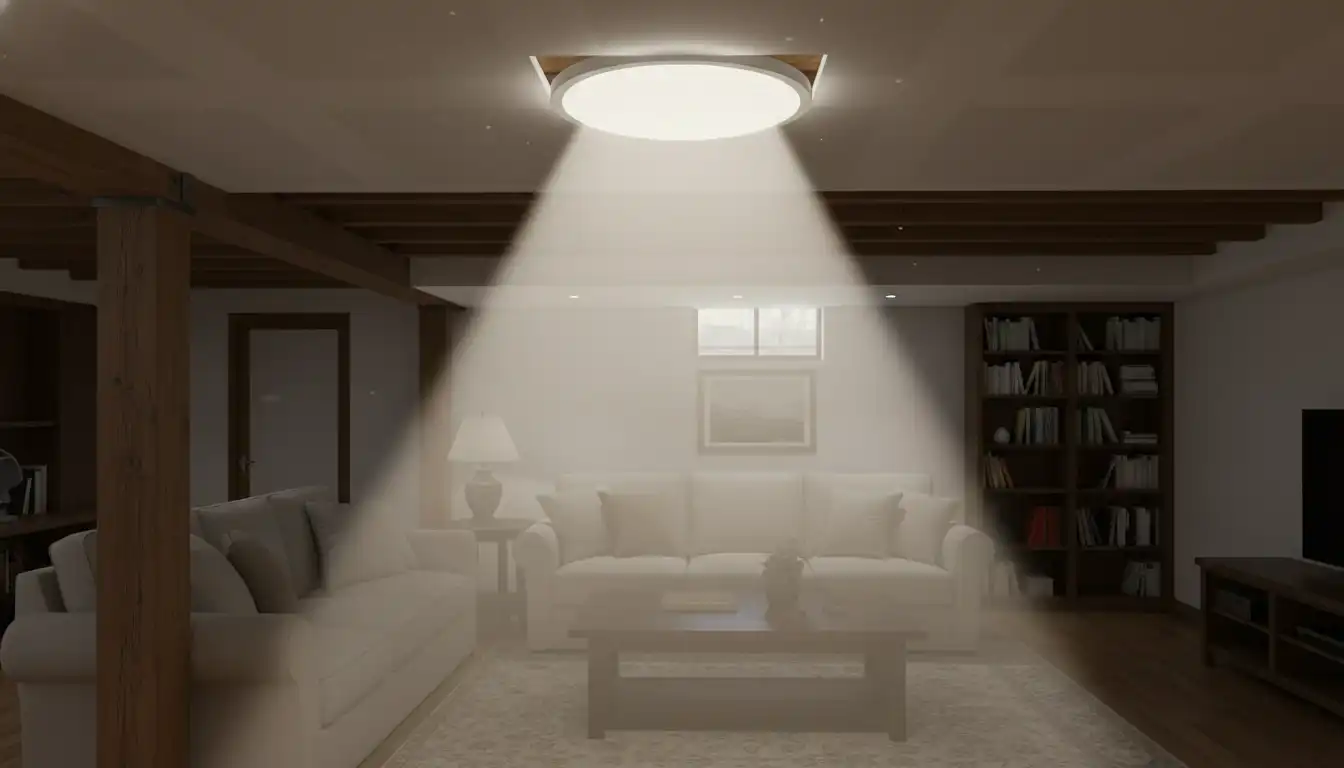
It operates on a simple three-part system. A weather-proof dome on the roof collects sunlight, a highly reflective tube transfers it downwards, and a diffuser in the ceiling spreads it evenly throughout the room.
The Magic of High-Performance Light Transfer
The interior of the tube is the real secret to its effectiveness. It is lined with a mirror-like material that can reflect up to 99% of captured sunlight, losing very little brightness even over long distances.
This means sunlight can be effectively “piped” from your sunny roof, through upper floors, and delivered directly into your basement. It functions like a periscope for daylight, bending and directing light where it could never normally reach.
The Undeniable Benefits of a Sun-Kissed Basement
Introducing a solar tube to your basement is a transformative upgrade. The benefits are immediate, impacting everything from your wallet to your well-being.
It is one of the most efficient ways to introduce full-spectrum, natural daylight into a windowless space, fundamentally changing its character and utility.
Flood Your Basement with Free, Natural Light
The most obvious benefit is the stunning amount of light. A single 10-inch solar tube can illuminate a space with the equivalent of three 100-watt bulbs on a sunny day.
This isn’t the harsh, yellow-tinted light of a bulb; it’s the full-spectrum, dynamic light of the sun. This makes colors appear truer and the entire space feel more vibrant and alive.
Slash Your Energy Bills
Every hour a solar tube is illuminating your basement is an hour your electric lights are off. This translates directly into significant energy savings over the lifetime of the device.
By harnessing free, renewable solar energy, you reduce your home’s carbon footprint and your reliance on the grid. It is a green investment that pays for itself over time.
A Healthier, Cleaner Living Environment
Natural sunlight is a known inhibitor of mold and mildew growth, which often thrive in dark, damp basements. The presence of UV rays in sunlight acts as a natural disinfectant.
Furthermore, a brightly lit space is far easier to keep clean. You can finally see the dust and dirt that hide in the shadows, simplifying your maintenance routine. Improving the light is the first step in learning how to get dust out of basement areas effectively.
Installing a Solar Tube in Your Basement: A Step-by-Step Overview
While a professional installation is strongly recommended for a watertight and optimal result, understanding the process helps you appreciate what is involved. The path from the roof to the basement requires careful planning.
The primary challenge is navigating the floors, joists, and wiring that lie between the roof and the basement ceiling. A straight, short path is always the most effective.
Step 1: Strategic Placement is Key
The process begins with identifying two key locations. First, a spot on the roof that receives ample, unobstructed sunlight throughout the day, typically south-facing.
Second, the target location in the basement ceiling where you want the light to be delivered. The goal is to create the straightest and shortest route possible between these two points.
Step 2: The Roof-Level Installation
A professional installer will cut a hole in the roof and attic. They then install a metal flashing, which is a crucial component for preventing leaks, and secure the collection dome on top.
This part of the installation must be done with precision to ensure the roof’s weather barrier remains completely intact for years to come.
Step 3: Running the Light Tube
Next, the reflective tube is assembled and run from the roof down through the intervening floors. This may require routing the tube through closets or specially constructed chases to hide it from view on the main levels.
Each section is sealed to be airtight, preventing dust or insulation from entering the tube and ensuring maximum reflectivity is maintained.
Step 4: The Final Connection and Diffuser
Finally, a hole is cut in the basement ceiling. The tube is connected, and a diffuser lens is installed, which looks similar to a flush-mount light fixture.
The ceiling is then finished for a clean look. This final step may involve minor drywall work, which must be done carefully. Understanding details like the nail in drywall weight capacity can be useful for homeowners interested in the finishing touches.
Rigid vs. Flexible Solar Tubes: Choosing for Your Basement
Solar tubes are available in two primary types: rigid and flexible. The best choice for a basement installation depends heavily on the specific path the tube needs to take through your home.
For basements, which often require long and complex runs, this choice is critical to the performance of the final installation.
| Feature | Rigid Solar Tube | Flexible Solar Tube |
|---|---|---|
| Light Output | Highest (up to 99% reflectivity) | Lower (reflectivity decreases with bends) |
| Maximum Length | Effective up to 30 feet or more | Best for runs under 14 feet |
| Installation Complexity | More complex, requires precise angles | Easier, can bend around obstructions |
| Cost | Higher initial material cost | Lower initial material cost |
| Best For Basements | Highly Recommended | Only for very short, simple runs |
Why Rigid Tubes are Superior for Basements
A basement installation almost always involves a long tube run. Rigid tubes are vastly superior in this scenario because their polished, solid interior transfers light with minimal loss of intensity.
While flexible tubes are cheaper and easier to install around obstacles, their accordion-like design causes light to bounce and scatter, leading to a significant drop in brightness. For a basement, maximizing light delivery is the top priority.
Beyond the Basics: Advanced Solar Tube Features
Modern solar tubes offer more than just a simple column of light. Manufacturers have developed a range of accessories that enhance their functionality, making them a truly integrated lighting solution.
These add-ons can provide light at night, allow you to control the brightness, and ensure the quality of light is perfectly suited for your home.
Integrated Electric Light Kits
One of the most popular accessories is a built-in electric light kit. This places a standard light bulb socket inside the tube, just above the diffuser.
This allows your solar tube to double as a standard ceiling fixture at night. You can use the same fixture for free, natural light during the day and efficient LED lighting after dark.
Daylight Dimmers and Block-Out Shades
In some situations, such as a basement home theater, you may want to control the amount of natural light coming in. A daylight dimmer allows you to adjust the brightness with a remote control.
This is achieved with a butterfly-style baffle inside the tube that can be opened or closed to regulate the flow of light, giving you complete control.
Enhanced UV Protection and Thermal Performance
The light from a solar tube is “laundered” as it passes through the dome and tube. High-quality systems filter out over 99% of harmful UV rays.
This UV protection prevents fading of furniture, photos, and fabrics in your basement. Moreover, the sealed air column within the tube provides a thermal break, ensuring it doesn’t compromise your home’s envelope, which is as important for a basement as it is when insulating Keter shed walls for energy efficiency.
Common Myths and Misconceptions Debunked
As a less common home technology, solar tubes are often surrounded by misinformation. It is important to separate fact from fiction to make an informed decision.
Addressing these myths reveals the true capability and reliability of modern tubular skylights when installed correctly.
Myth: They Only Work on Perfectly Sunny Days
This is one of the most common misconceptions. While a solar tube is brightest in direct sunlight, it is also highly effective on overcast days.
The rooftop dome is designed to collect ambient light from the entire sky. It will still draw in significant daylight even when the sun is not directly visible, though the intensity will be softer.
Myth: They Will Leak and Cause Roof Problems
A solar tube is no more likely to leak than a traditional skylight or a plumbing vent when installed by a certified professional. The key is the quality of the flashing and the installation itself.
Reputable manufacturers provide high-quality, seamless flashing systems designed to integrate perfectly with all types of roofing materials, ensuring a watertight seal.
Myth: They Are Incredibly Expensive and Not Worth the Investment
While there is an upfront cost, a solar tube is often significantly cheaper than the structural work required to install a new basement window, especially an egress window.
When you factor in the long-term energy savings and the immense improvement in usability and home value, a solar tube often provides an excellent return on investment.
Frequently Asked Questions About Basement Solar Tubes
Homeowners often have specific questions about how this technology applies to their unique situation. Here are answers to some of the most common inquiries.
How much light does a single solar tube actually produce?
The output varies by tube diameter, length, and the time of day. As a general rule, a 10-inch tube can light up a 200-square-foot room, while a 14-inch tube can handle up to 300 square feet with bright, usable light.
Can a solar tube go through a second story to reach a basement?
Absolutely. This is a very common application. The tube can be routed through the closets of a first-floor room, stacked one above the other, to create a hidden vertical chase for the tube to pass through to the basement.
Does a solar tube create a lot of heat in the summer?
No, this is a major advantage over traditional skylights. Because the system is sealed and the materials are engineered to filter out infrared wavelengths, they transfer very little heat, a phenomenon known as “cool daylighting.” You get the brightness without the unwanted heat gain.
How long do solar tubes last?
A professionally installed, high-quality solar tube is a long-term fixture. The rigid tubing and flashing are often made from aluminum and are designed to last for decades. Domes are typically made from high-impact acrylic or polycarbonate and have a lifespan of 20 years or more before any potential yellowing might occur.
Reclaim Your Basement and Let the Sunshine In
A solar tube for your basement is more than just a lighting fixture; it is a fundamental transformation of the space. It turns a dark, forgotten lower level into a bright, vibrant, and usable part of your home.
By channeling the power of the sun, you can create a healthier, more energy-efficient, and more enjoyable living environment. It is a brilliant solution to the age-old problem of the dark and gloomy basement.
