
Stop Making This Mistake With Recessed Lights Over Vanity
You envisioned a sleek, modern bathroom with clean lines, and recessed lights seemed like the perfect choice. But now, standing in front of your vanity mirror, you’re met with harsh, unflattering shadows under your eyes, nose, and chin. This common design flaw turns everyday grooming tasks like applying makeup or shaving into a frustrating exercise in futility.
The problem isn’t the recessed lights themselves; it’s the misunderstanding of their purpose. Relying solely on overhead lighting is one of the most frequent mistakes in bathroom design. This setup casts light directly downward, creating what’s known as “top-down” shadowing, which is universally unflattering and impractical for the detailed work done at a vanity.
You'll Learn About
Why Your Recessed Lighting Creates Awful Shadows
The core issue with placing recessed lights directly over the spot where you stand at the vanity is simple physics. This placement directs light straight down onto the top of your head. Consequently, every feature on your face casts a shadow downward, obscuring your reflection and making precision tasks nearly impossible.
Many homeowners make this error believing it will provide the brightest and most direct light. However, it achieves the opposite of the desired effect, creating a poorly lit workspace that feels more like a cavern than a well-designed bathroom. The result is a space that fails in both function and aesthetic appeal.
The Glare Problem and Its Impact
Another often overlooked issue is glare. When recessed lights are positioned incorrectly, they can reflect off the mirror and countertop surfaces, causing significant eye strain. This harsh, reflected light makes it uncomfortable to spend time at the vanity and detracts from the calm, spa-like atmosphere you want in a bathroom.
This poor illumination also affects how you perceive colors, from your own skin tone to your makeup. Bad lighting can lead to makeup mistakes that are only obvious once you step into natural light. A functional vanity area requires lighting that is both bright and soft, a balance that a single set of overhead recessed lights can rarely achieve on its own.
The Solution: A Layered Lighting Strategy
The secret to perfect bathroom lighting isn’t to eliminate recessed lights but to use them correctly as part of a layered system. Professional designers use three distinct layers of lighting to create a space that is both functional and inviting: Ambient, Task, and Accent lighting. Understanding these layers is the key to fixing your vanity shadow problem for good.
Recessed lights excel as a source of ambient lighting—the general, overall illumination that fills the room and allows you to navigate the space safely. When used for this purpose, they provide a clean, unobtrusive foundation for your other lighting fixtures. The mistake is asking them to also perform the job of task lighting.
The Three Essential Layers of Light
Ambient lighting is the base layer. It provides the room’s main illumination and is often achieved with recessed lights, flush mounts, or a central ceiling fixture. Its job is to create a uniform light level throughout the entire bathroom.
Task lighting is focused, brighter light directed at specific work areas. In the bathroom, the vanity is the primary task zone. This is where you need bright, shadow-free light for grooming. Wall sconces, vertical light bars, and backlit mirrors are ideal sources of task lighting.
Accent lighting is used to highlight architectural features or decor, such as artwork or beautiful tile work. It adds depth and visual interest to the room. Small, directable recessed lights or LED strips are often used for this purpose.
Perfecting Recessed Light Placement and Selection
To use recessed lights effectively as your ambient layer, placement is critical. Instead of centering them over where you stand, position them to illuminate the walking paths and general floor area. A common guideline is to space 4-inch recessed lights about 4 feet apart for an 8-foot ceiling.
Specifically, over the vanity, the recessed lights should be placed closer to the wall, centered over the edge of the countertop or sink. This placement helps illuminate the sink area for tasks like handwashing without casting direct shadows on your face. It ensures the light hits the basin, not the top of your head.
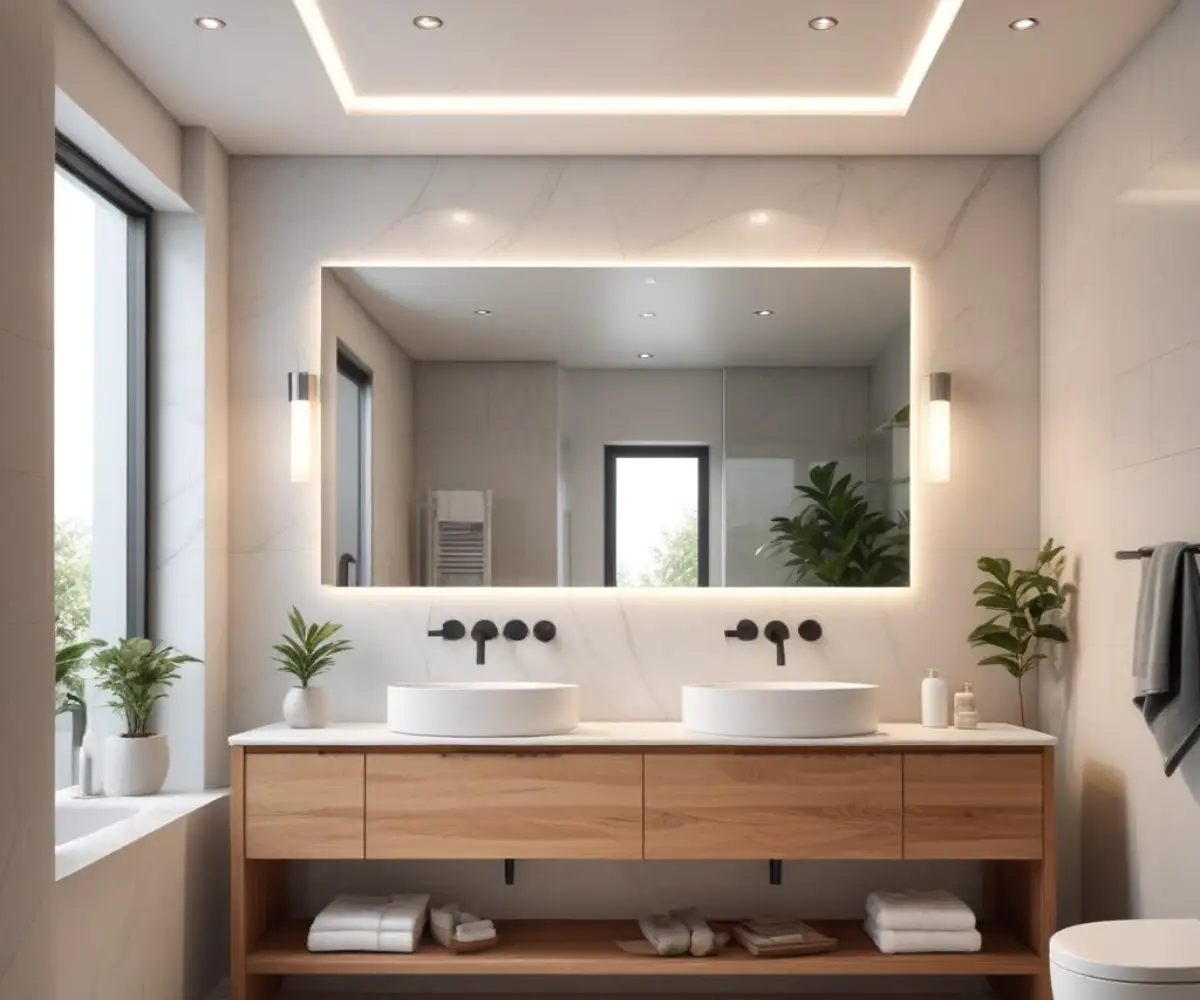
Choosing the Right Beam Angle and Color Temperature
Not all recessed lights are created equal. The beam angle determines the spread of light. For general ambient lighting in a bathroom, a wider beam angle (60 degrees or more) provides a soft, diffuse wash of light that minimizes sharp shadows and dark spots.
The Color Rendering Index (CRI) and Kelvin (K) temperature are also crucial. For a bathroom, always choose bulbs with a CRI of 90 or higher to ensure colors, especially skin tones, are rendered accurately. The color temperature should be between 3000K and 4000K for a clean, natural-looking light that is neither too yellow nor too sterile and blue.
A Deeper Dive into Light Quality
Beyond the basics, consider the psychological impact of your lighting choices. A color temperature of 3000K provides a soft, welcoming glow perfect for a relaxing evening bath. In contrast, a 4000K light is crisper and more energizing, ideal for a morning routine. Installing a dimmer switch gives you the flexibility to adjust the mood and intensity for any occasion.
The quality of the paint on your walls can also dramatically influence how the light behaves. A high-quality paint, such as one detailed in a Dunn-Edwards Acri-Hues review, will have a better light reflectance value (LRV), helping to bounce your carefully planned ambient light around the room for a brighter, more open feel.
| Recessed Light Type | Best Use Case in Bathroom | Key Features |
|---|---|---|
| Standard Downlight | General Ambient Lighting | Fixed position, provides broad, even light. Best with a wide beam angle. |
| Adjustable (Gimbal) | Accent Lighting | Can be tilted to highlight artwork, tile, or architectural features. |
| Wafer/Ultra-Thin | Remodels & Tight Spaces | Extremely thin profile, ideal for ceilings with limited clearance or obstructions. |
| Shower Trim | Showers and Wet Areas | Wet-rated for safety, often includes a sealed lens to protect from moisture. |
The Unbeatable Combination: Recessed Lights + Task Lighting
The ultimate solution to banishing vanity shadows is to pair your ambient recessed lighting with dedicated task lighting. This is the non-negotiable step that elevates a bathroom from mediocre to professionally designed. The goal of task lighting is to illuminate your face from the front and sides, creating what is known as cross-illumination.
This method fills in all the shadows created by overhead lights, providing the clear, even light needed for grooming. The best way to achieve this is with fixtures mounted on the wall around the mirror, not on the ceiling above it.
Gold Standard: Sconces on Each Side
Wall sconces mounted on either side of the mirror are the preferred choice of designers for a reason. When placed at roughly eye level (about 60-66 inches from the floor), they cast an even wash of light across your entire face. This bilateral lighting strategy is the most effective way to eliminate shadows completely.
For wider vanities with double sinks, a pair of sconces for each mirror maintains this balanced illumination. This setup ensures that every person using the vanity receives the same high-quality, flattering light.
Modern Alternatives: Vertical Bars and Backlit Mirrors
If your bathroom design is more contemporary, vertical light bars function similarly to sconces and offer a sleek, minimalist aesthetic. Placed on either side of the mirror, they provide the same excellent cross-illumination needed for a shadow-free reflection.
Another increasingly popular option is the backlit or integrated LED mirror. These fixtures have lights built directly into the mirror itself, either around the perimeter or along the sides. They offer a clean, clutter-free look while providing excellent, diffused task lighting that is perfect for makeup application and shaving.
Installation and Safety Considerations
When planning your lighting, safety is paramount, especially in a wet environment like a bathroom. Any light fixture installed inside a shower or directly over a bathtub must be wet-rated. Fixtures in the general bathroom area, including over the vanity, should be at least damp-rated to withstand humidity.
For ceilings that have insulation, it is essential to use IC-rated (Insulation Contact) recessed housings. These are specifically designed to be safely buried in insulation without creating a fire hazard. Non-IC rated fixtures require several inches of clearance from insulation, which can compromise your home’s energy efficiency.
Wiring and Professional Help
Electrical work requires precision and knowledge of local codes. Proper wiring is non-negotiable for safety and function. It’s crucial to understand that fixtures must be wired correctly, and if you ever wonder about complex situations, professional guidance is the best path forward.
Even a seemingly simple upgrade, like replacing an old fixture, can reveal complex wiring. If you encounter an issue where a specific bulb like the DCI-B12.5W-A V2 light burned out and its replacement doesn’t solve the problem, it could indicate an underlying wiring issue that needs professional attention.
Advanced Concepts for a Luxury Bathroom Feel
To truly elevate your bathroom, integrate advanced lighting controls and smart technology. Dimmer switches are a must-have for every layer of lighting. They allow you to transition from bright, functional light in the morning to a soft, relaxing glow in the evening, completely transforming the room’s ambiance.
Integrating your lights with a smart home system like Google Assistant or Amazon Alexa offers even greater control. You can create custom lighting “scenes” for different activities—such as a “Morning Prep” scene with bright, cool task and ambient light, or a “Spa Mode” with warm, dimmed accent and ambient light—all controllable with your voice.
Creating a Cohesive Design
The final touch is ensuring your lighting fixtures contribute to a cohesive design. The trim on your recessed lights should complement the finish of your faucets, sconces, and hardware. A thoughtful design can successfully mix finishes, but a poorly executed black and chrome bathroom can feel disjointed without careful planning of every element, including light trims.
By treating lighting as an integral part of the design process, not an afterthought, you create a space that is not only beautiful but also highly functional and tailored to your lifestyle.
Common Mistakes to Avoid
To ensure your project is a success, steer clear of these common pitfalls. Each one can undermine an otherwise well-planned design.
Mistake 1: Using Only Recessed Lights
As detailed, this is the number one cause of unflattering shadows at the vanity. Recessed lights are for ambient light, not task light. Always supplement them with wall-mounted task lighting.
Mistake 2: Incorrect Spacing
Placing ambient recessed lights too far apart creates dark spots, while placing them too close creates overly bright “hot spots.” Follow the general rule of spacing them roughly half the distance of the ceiling height (e.g., 4-foot spacing for an 8-foot ceiling).
Mistake 3: Choosing the Wrong Bulb
Low CRI bulbs will make you look washed out and distort colors. A color temperature that is too warm (below 2700K) can make the room feel dingy, while one that is too cool (above 4000K) can feel clinical and harsh. Stick with 90+ CRI and a 3000K-4000K range.
Mistake 4: Ignoring Dimmer Switches
A lighting system without dimmers is only operating at a fraction of its potential. Dimmers provide versatility, allowing you to control the mood and function of your bathroom lighting throughout the day. Every light switch in a bathroom should be a dimmer.
Conclusion: Your Blueprint for Perfect Vanity Lighting
Recessed lights over a vanity are not inherently bad—they are simply misunderstood and misused. By embracing a layered lighting strategy, you can unlock their true potential as a powerful tool for creating excellent ambient light. The key is to recognize their role and supplement them with dedicated, properly placed task lighting to illuminate your face.
Combine your ambient recessed lights with wall sconces, vertical bars, or a backlit mirror to deliver shadow-free cross-illumination. Pay close attention to technical specifications like CRI, color temperature, and safety ratings. And finally, put it all on dimmer switches to give yourself complete control over the look and feel of your space. By following this blueprint, you can banish the shadows for good and create a bathroom that is as functional as it is beautiful.
