
Nepeta Cat’s Meow vs Walker’s Low: The Ultimate Showdown
Choosing the perfect perennial often feels like navigating a maze of endless options, each promising vibrant color and effortless beauty. For lovers of cool-toned flowers and fragrant foliage, the search frequently narrows to one incredible plant: Nepeta, or catmint.
But even within this single genus, a tough choice emerges. Two cultivars, in particular, stand out for their popularity and performance, leaving many gardeners wondering which is truly the superior choice for their landscape: ‘Cat’s Meow’ or ‘Walker’s Low’?
You'll Learn About
The Gardener’s Dilemma: Tidy Form vs. Wild Abandon
The core problem when choosing between these two all-stars isn’t about good versus bad, but about structure versus size. Do you crave a plant that maintains a perfect, tidy mound all season, or do you prefer a larger, more sprawling presence that creates a soft, cottage-garden feel?
This decision impacts everything from garden design and maintenance chores to the overall aesthetic of your outdoor space. The wrong choice can lead to a floppy, untidy mess that smothers its neighbors or, conversely, a plant that feels too small and formal for a relaxed setting.
Understanding the Contenders: A Tale of Two Catmints
At first glance, ‘Cat’s Meow’ and ‘Walker’s Low’ seem quite similar. Both are hardy, drought-tolerant perennials that boast long bloom times with spikes of lavender-blue flowers and aromatic gray-green foliage that deters deer and rabbits.
They are both magnets for pollinators like bees, butterflies, and hummingbirds. However, their growth habits, size, and structural integrity set them worlds apart and define their best use in the garden.
‘Cat’s Meow’: The Definition of Neat and Tidy
Introduced by Proven Winners, Nepeta ‘Cat’s Meow’ was specifically bred to solve the most common complaint about older catmint varieties: flopping. Gardeners were tired of their beautiful plants splitting open in the center, especially after heavy rain or in rich soil.
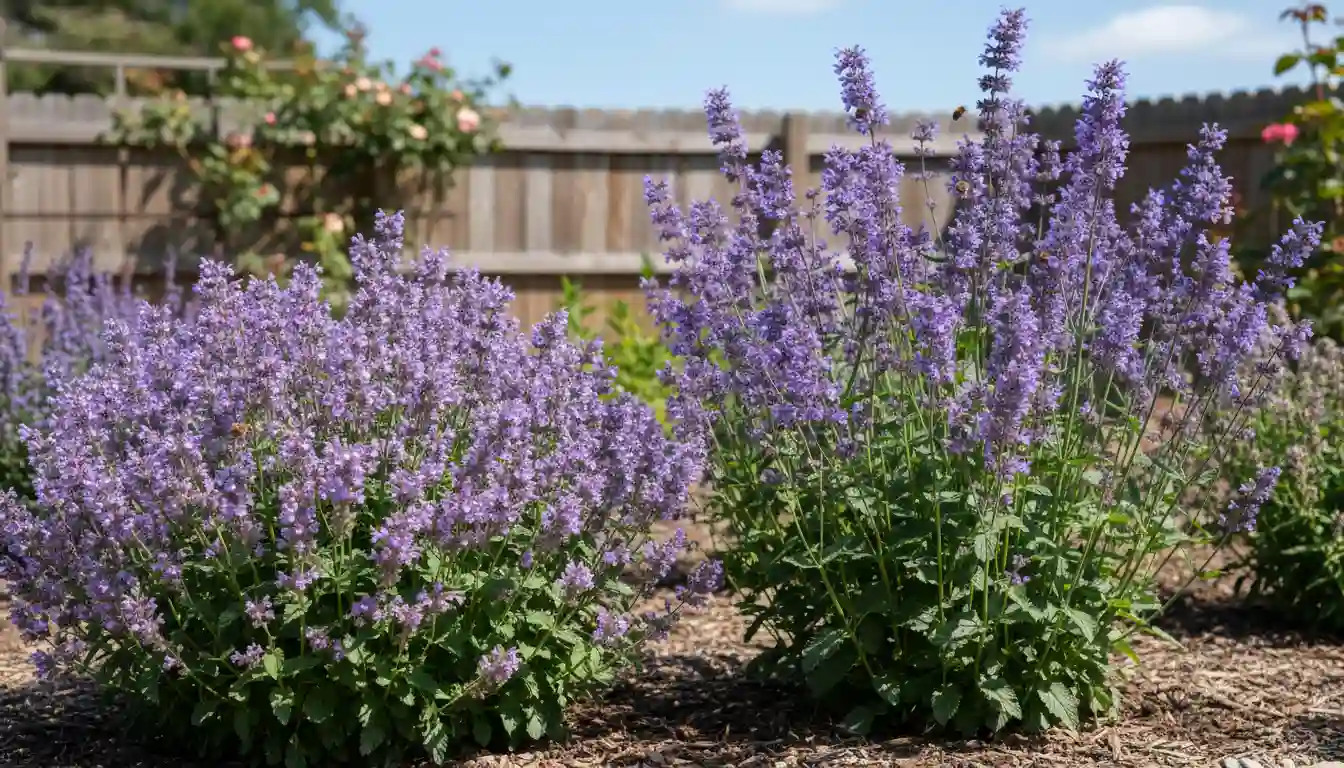
‘Cat’s Meow’ is the solution to this problem. It forms a dense, perfectly rounded mound that stays upright and compact throughout the entire season. This variety typically grows to about 17-20 inches tall and spreads 24-36 inches wide, creating a well-behaved cushion of color.
Its inherent structural strength means it requires virtually no staking or support, making it an exceptionally low-maintenance choice for gardeners who value a neat and orderly appearance.
‘Walker’s Low’: The Award-Winning Classic
Before ‘Cat’s Meow’ entered the scene, ‘Walker’s Low’ was the reigning champion of the catmints, and for good reason. It was named the 2007 Perennial Plant of the Year, celebrated for its vigorous growth and profuse flowering.
It is significantly larger than ‘Cat’s Meow’, with flower spikes that can reach 2-3 feet in height and a similar spread. ‘Walker’s Low’ has a more relaxed, arching habit. While beautiful, this is also its potential downfall. The name is a bit misleading; it was named for a garden in England, not for its short stature.
In fertile soil or with too much shade, its long stems can become lax and flop open, creating a hole in the center of the plant and encroaching on nearby companions.
Head-to-Head Comparison: Choosing Your Champion
To make the best decision for your garden, a direct comparison is essential. Understanding the nuanced differences in their architecture, bloom, and care will ensure you select the plant that truly fits your vision and maintenance style.
| Feature | Nepeta ‘Cat’s Meow’ | Nepeta ‘Walker’s Low’ |
|---|---|---|
| Size (Height x Spread) | 17-20 in. tall x 24-36 in. wide | 24-36 in. tall x 24-36 in. wide |
| Growth Habit | Dense, uniform, rounded mound | Arching, spreading, can be floppy |
| Structural Integrity | Excellent; does not flop | Prone to splitting/flopping in the center |
| Best Use | Formal edging, borders, mass plantings, containers | Informal borders, cottage gardens, cascading over walls |
| Maintenance | Minimal; shear after first bloom for rebloom | May require staking or strategic pruning to prevent flopping |
| Hardiness Zones | 3-8 | 3-8 |
The Solution: Matching the Plant to the Purpose
The best way to solve the “Cat’s Meow vs. Walker’s Low” debate is to stop thinking about which plant is better overall and start thinking about which plant is better for a specific job in your garden.
When to Choose ‘Cat’s Meow’
You should choose ‘Cat’s Meow’ if you prioritize a tidy, uniform look. Its compact, non-flopping habit makes it the superior choice for formal designs.
Use it to create a neat, continuous edge along a walkway or patio where the sprawling nature of ‘Walker’s Low’ would be a tripping hazard. It’s also perfect for mass plantings where you want a consistent, cloud-like effect without any unruly gaps. Its well-behaved nature also shines in container gardens.
When to Choose ‘Walker’s Low’
Opt for ‘Walker’s Low’ when you want to create a softer, more romantic, and naturalistic feel. Its larger size and arching stems are ideal for the middle of a border, where they can weave through and soften the edges of other plants.
It excels in cottage gardens, where a little bit of wildness is desirable. Let it cascade over a retaining wall or the edge of a raised bed to create a beautiful, spilling effect that you can’t achieve with the more upright ‘Cat’s Meow’.
Advanced Techniques for Nepeta Success
Beyond the basic choice, advanced gardening techniques can help you get the most out of whichever variety you select. Understanding how to manage their growth will elevate your garden design from average to exceptional.
The Secret to a Fuller ‘Walker’s Low’
The primary complaint against ‘Walker’s Low’ is its tendency to flop. However, this can be managed with a simple but effective pruning technique often called the “Hampton Hack.”
When the plant is about halfway to its mature height in late spring, shear the entire plant back by about one-third to one-half. This hard prune encourages the plant to develop a sturdier, more branched framework. It will delay flowering by a week or two, but the resulting plant will be much more compact and far less likely to split open.
Maximizing Blooms on Both Varieties
Both ‘Cat’s Meow’ and ‘Walker’s Low’ will rebloom vigorously if given a haircut after their first major flush of flowers fades. Once the initial blooms start to look tired, don’t just deadhead the individual flower spikes—shear the entire plant back by about half.
This not only removes the spent flowers but also encourages a fresh flush of foliage and a second, often equally impressive, round of blooms that can last into the fall. This mid-season shearing keeps the plants looking fresh and tidy.
Companion Planting for Structure and Beauty
Using other plants as companions can enhance the beauty of both Nepeta varieties and even help solve the flopping issue with ‘Walker’s Low’. Planting sturdy perennials like Sedum ‘Autumn Joy’ or small ornamental grasses nearby can provide physical support for the arching stems of ‘Walker’s Low’.
For both varieties, the cool lavender-blue flowers are a perfect complement to plants with silver foliage or flowers in shades of yellow, pink, and white. They are a classic partner for roses, beautifully hiding the often-bare lower stems of the rose bushes. For a truly stunning combination, consider pairing them with purple-blooming roses, a design choice explored in our article comparing Twilight Zone vs Ebb Tide Rose.
The Verdict: A Plant for Every Garden
Ultimately, there is no single winner in the showdown between Nepeta ‘Cat’s Meow’ and ‘Walker’s Low’. The “better” plant is the one that perfectly aligns with your garden’s design and your tolerance for maintenance.
If your garden design leans towards structure, clean lines, and low-effort tidiness, ‘Cat’s Meow’ is the undisputed champion. If you embrace a more relaxed, flowing aesthetic and don’t mind a bit of strategic pruning to maintain order, the classic charm and larger presence of ‘Walker’s Low’ will serve you beautifully. By understanding their distinct personalities, you can deploy them both with confidence, creating a stunning, pollinator-friendly garden that thrives all season long.
Frequently Asked Questions
What is the main difference between ‘Cat’s Meow’ and ‘Walker’s Low’ catmint?
‘Cat’s Meow’ is known for its tidy, mounded growth habit and strong stems that prevent it from flopping open. ‘Walker’s Low’, while a robust grower, has a tendency to be more open and wispy.
Which variety is smaller?
‘Cat’s Meow’ is the smaller of the two, typically reaching a height of 17 to 20 inches. ‘Walker’s Low’ is a larger variety, growing taller, around 24 to 30 inches in height.
Which catmint is better for a neat and tidy garden border?
Due to its uniform, non-flopping, and compact mounded shape, ‘Cat’s Meow’ is generally considered the better choice for a tidy and refined garden border. Its dense growth habit helps maintain a clean look throughout the season.
Do both ‘Cat’s Meow’ and ‘Walker’s Low’ attract cats?
While true catnip is *Nepeta cataria*, other varieties like ‘Walker’s Low’ can also be attractive to cats, though possibly less enticing. ‘Cat’s Meow’ also has the characteristic aromatic foliage of the mint family, which can be appealing to felines.
Are the flower colors different?
‘Cat’s Meow’ features sky-blue flowers with smoky purple calyxes. ‘Walker’s Low’ has lavender-blue flowers. While both are in the blue-purple spectrum, there can be subtle differences in their shades.
How does their parentage differ?
‘Cat’s Meow’ was actually bred from ‘Walker’s Low’ as the seed parent and an unknown pollen parent. ‘Walker’s Low’ is a chance seedling discovered in Mrs. Walker’s garden, believed to be a hybrid of *Nepeta racemosa* and *Nepeta nepetella*.
