
Marble Backsplash with Quartz Countertop: Avoid This #1 Clash!
The combination of a marble backsplash with a quartz countertop is the peak of kitchen luxury. It promises timeless elegance from natural stone and the bulletproof durability of modern engineering. Yet, this dream pairing can quickly turn into a design disaster if you’re not careful.
Many homeowners invest thousands into these premium materials only to create a space that feels disjointed and visually chaotic. The number one mistake is a fundamental misunderstanding of how these two distinct surfaces interact, both visually and physically. This guide will illuminate the path to a flawless pairing that is both beautiful and built to last.
You'll Learn About
The Core Problem: Why Your Marble and Quartz Don’t Match
Achieving a harmonious look between natural marble and engineered quartz is more complex than simply picking two shades of white. The conflict arises from subtle differences in pattern, color undertones, and even the way light reflects off their surfaces. Understanding these potential clashes is the first step to avoiding them.
The Battle of the Patterns: Veins vs. Flecks
The most common error is pairing a marble backsplash with dramatic, bold veining with a quartz countertop that also has a strong pattern. Natural marble has random, organic veins that are unique to each slab. Engineered quartz, on the other hand, has a manufactured pattern that can range from subtle flecks to bold, marble-like veins.
When both surfaces have competing patterns, the result is a busy, overwhelming aesthetic. Your kitchen needs a “hero” and a “sidekick.” If your marble has intricate, powerful veining, the quartz must be understated and quiet to avoid a visual battle for attention.
Undertone Wars: Cool vs. Warm Tones
A frequent and costly mistake is mismatching the undertones of the stone and quartz. Marble and quartz come in a spectrum of whites, grays, and creams, each with either a cool (blue, gray, silver) or warm (yellow, gold, beige) undertone. A cool-toned Carrara marble backsplash will clash horribly with a warm-toned, creamy quartz countertop.
This subtle discord can make the entire kitchen feel “off,” even if you can’t immediately pinpoint why. It’s crucial to identify and match these undertones precisely. This is especially important when pairing countertops with specific cabinet colors, like in choosing countertops for off-white cabinets, where undertones are key.
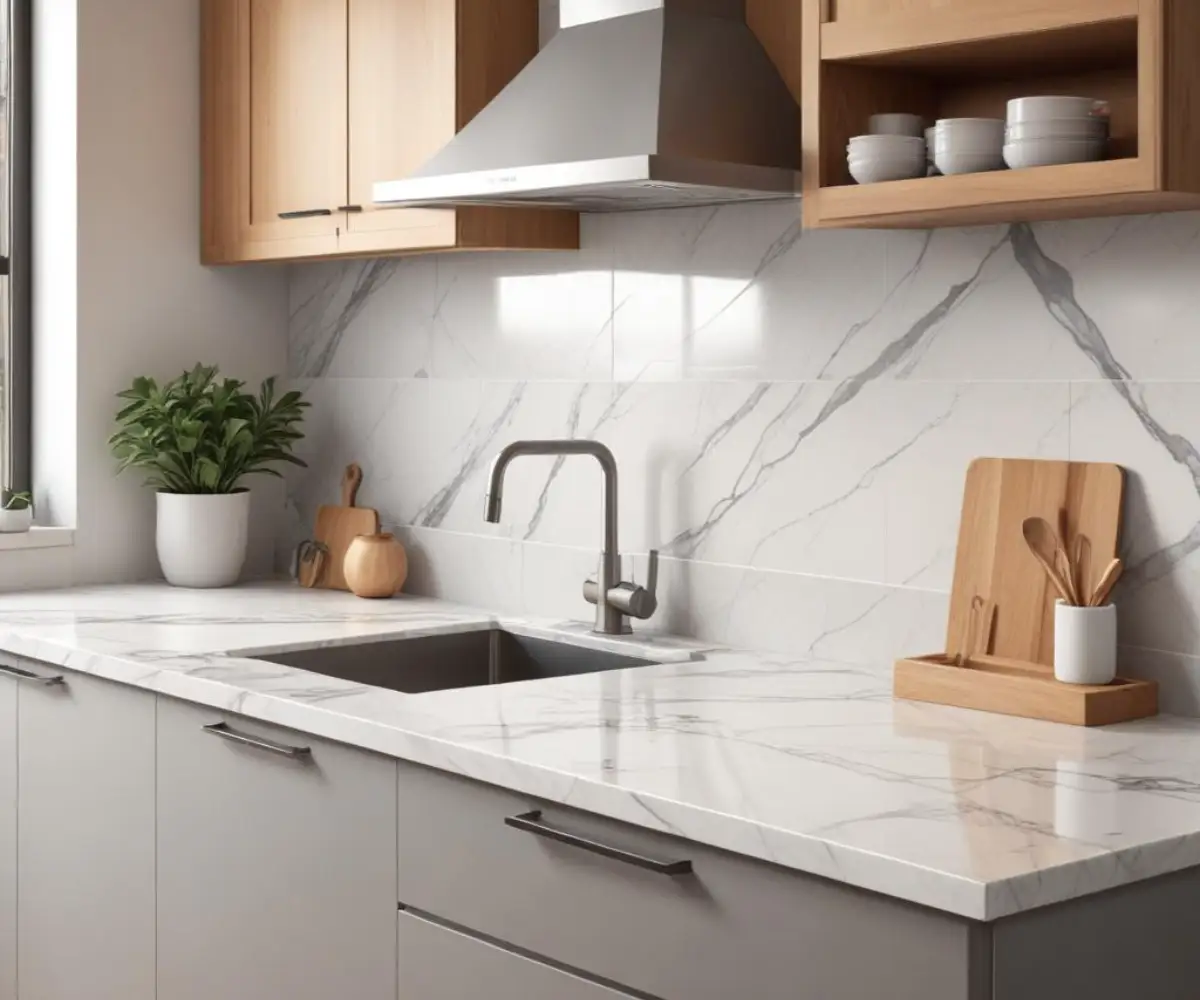
The Sheen Standoff: Polished vs. Honed Finishes
The finish of each surface dramatically affects how it reflects light. A highly polished marble backsplash will have a glossy, reflective quality, while a honed or matte finish will be much softer and more diffuse. The same is true for quartz countertops.
Pairing a polished backsplash with a honed countertop (or vice versa) can sometimes work, but it can also create an inconsistent look. For the most cohesive design, it is often best to match the sheen level between the two materials, ensuring a uniform play of light across your kitchen surfaces.
The Unspoken Challenge: Long-Term Maintenance Conflicts
Beyond aesthetics, there’s a practical problem that many overlook: marble and quartz have very different maintenance needs. Ignoring this can lead to permanent damage to your beautiful and expensive marble backsplash. The key difference lies in their porosity and chemical sensitivity.
Sealing and Staining: Marble’s Achilles’ Heel
Marble is a natural, porous stone, which means it can easily absorb liquids. Spills from tomato sauce, wine, or oil can quickly lead to permanent stains if the marble isn’t properly and regularly sealed. A marble backsplash must be sealed upon installation and typically re-sealed annually to protect it.
Quartz, being an engineered, non-porous material, requires no sealing whatsoever. This creates a maintenance disconnect. You must be diligent about the upkeep of the backsplash while the countertop remains virtually maintenance-free.
Chemical Sensitivity: The Cleaning Conundrum
Herein lies the most critical, and often ignored, issue. Cleaners that are perfectly safe for your quartz countertop can destroy your marble backsplash. Quartz is resilient against most household cleaners, but marble is highly sensitive to anything acidic. Vinegar, lemon juice, or any harsh, acidic cleaning products will etch the surface of the marble, leaving dull, permanent spots.
This means you cannot simply wipe down both surfaces with the same cleaner. You must use a pH-neutral, stone-safe cleaner for the backsplash, creating a two-step cleaning process that everyone in the household must follow to prevent accidental damage.
| Feature | Marble Backsplash | Quartz Countertop |
|---|---|---|
| Porosity | High (Porous) | Very Low (Non-Porous) |
| Sealing Required | Yes, annually | No |
| Stain Resistance | Low without sealer | High |
| Acid Sensitivity | High (will etch) | Low |
| Safe Cleaners | pH-Neutral, Stone-Safe | Most mild household cleaners |
The Foolproof Formula for a Flawless Marble and Quartz Pairing
Creating a stunning and harmonious kitchen with these two materials is entirely achievable with the right strategy. By following a clear, step-by-step process, you can eliminate guesswork and design a space that looks professionally curated.
Step 1: Start with Your “Hero” Surface
First, decide which surface will be the star of your kitchen. This is almost always the material with the most pattern or veining. If you’ve fallen in love with a dramatic Calacatta marble slab for your backsplash, that is your hero. All other decisions must now support that choice.
Conversely, if you’ve selected a quartz with bold, beautiful veins, then your backsplash must take a supporting role. Trying to have two heroes will only result in a design conflict.
Step 2: The Art of “Quiet” Quartz Selection
Once you’ve chosen your hero marble backsplash, the key is to select a “quiet” quartz countertop. Look for quartz options with minimal to no pattern. Solid white, soft gray, or beige quartz countertops are excellent choices.
If you want a hint of pattern, choose a quartz with extremely subtle, soft veining that picks up on a secondary color in your marble. The goal is complementarity, not competition.
Step 3: Bring Large Samples Home
Never make a final decision based on small samples viewed under showroom lighting. You must obtain the largest samples possible of both your chosen marble and quartz. Place them together in your kitchen, on the plane they will be installed (vertical for backsplash, horizontal for countertop).
Observe them at different times of the day—in the morning light, under artificial evening light, and on a cloudy day. This is the only way to truly see how their colors and undertones will interact in your specific environment.
Step 4: Mastering the Undertone Match
With your large samples in hand, critically analyze their undertones. Look for the subtle base colors within the whites and grays. Does the marble lean cool with blue or purple hints, or warm with yellow or creamy hints? Ensure your chosen quartz shares that same underlying temperature.
A simple trick is to place a piece of pure white paper next to the samples. This will often make the undertones more apparent. A successful match here is the foundation of a cohesive design.
Beyond the Basics: Advanced Design Strategies
To elevate your kitchen from simply “matching” to truly “designer,” consider the finer details that professionals use to unify a marble and quartz combination. These elements can make a significant difference in the final outcome.
Grout is Not an Afterthought
For a tiled marble backsplash, the grout color is a powerful design tool. A common mistake is choosing a high-contrast grout (like dark gray with white marble), which creates a busy grid pattern. This grid will compete with the veining in both the marble and the quartz.
To create a more seamless, monolithic look that allows the stone to shine, select a grout color that closely matches the primary color of your marble tile. This will help the individual tiles blend together, creating the illusion of a solid slab.
The Slab Backsplash Solution
For the ultimate in luxury and cohesion, consider using a solid slab of marble for the backsplash instead of tiles. This eliminates grout lines entirely, creating a seamless and dramatic statement wall. A full-height slab backsplash allows the natural beauty of the marble to be displayed as a piece of art.
While this is a more significant investment, it is the most effective way to create a high-impact, unified look. The clean, uninterrupted surface pairs beautifully with the sleek nature of a quartz countertop.
Considering Alternatives
While the marble and quartz pairing is stunning, it’s wise to know your options. For those who love the look of natural stone but desire more durability and less maintenance for their countertop, a honed porcelain countertop can offer a similar aesthetic with superior performance. Additionally, for projects with a different budget, exploring options like used granite countertops can provide a luxury feel for less.
Your Long-Term Care and Maintenance Plan
A beautiful kitchen must also be a functional one. Protecting your investment requires a clear and simple maintenance plan that addresses the different needs of both marble and quartz to prevent costly damage.
Creating a Unified Cleaning Kit
To avoid accidental etching of your marble, establish a single, safe cleaning routine for both surfaces. Keep a spray bottle of pH-neutral, stone-safe cleaner readily available. This type of cleaner is effective for daily wipe-downs on quartz and is essential for preserving the integrity of the marble.
Educate everyone in your home that this is the designated cleaner for all kitchen surfaces. Remove all acidic or abrasive cleaners from under the kitchen sink to eliminate the risk of someone grabbing the wrong bottle by mistake.
The Sealing Schedule You Must Follow
Mark your calendar for the annual or semi-annual sealing of your marble backsplash. The frequency will depend on the specific type of marble and the sealer used. This simple, half-hour task is the single most important thing you can do to protect your backsplash from stains and moisture.
Think of it as essential preventative maintenance. A consistent sealing schedule will keep your marble looking as pristine as the day it was installed, ensuring it remains a beautiful partner to your durable quartz countertop for years to come.
Conclusion:
When used thoughtfully, marble and quartz can elevate a kitchen from ordinary to extraordinary, blending natural beauty with modern resilience. The key lies in understanding how their colors, veining, and finishes work together—and in making intentional choices that support harmony rather than competition. By approaching the pairing with a designer’s eye and a clear vision, you can create a space that feels seamless, sophisticated, and truly timeless. With the right guidance, your investment becomes more than just a surface upgrade—it becomes a kitchen that continues to inspire for years to come.
