
Lamson vs Wüsthof: The Knife That Will Change Your Cooking Forever
Choosing a high-quality chef’s knife is one of the most critical decisions you can make for your kitchen. It’s not just a tool; it’s an extension of your hand, a daily partner in creating meals. Yet, the market is saturated with options, leaving many home cooks feeling overwhelmed and uncertain.
You want a knife that feels right, holds an edge, and will last a lifetime, but the choice often comes down to two titans of the industry: the German powerhouse, Wüsthof, and the American heritage brand, Lamson. Making the wrong choice can lead to buyer’s remorse, a drawer full of subpar knives, and a less enjoyable cooking experience. This guide will cut through the noise, comparing every critical aspect of these two brands to help you find the perfect blade for your home.
You'll Learn About
A Tale of Two Forges: Understanding the Legacy
Before we can compare the steel and the sharpness, it’s essential to understand the history forged into every blade. The philosophy and heritage of a company directly influence the final product that ends up on your cutting board. These aren’t just faceless corporations; they are multi-generational knife makers with distinct approaches to their craft.
Wüsthof: The German Precision Powerhouse
When you think of German cutlery, you likely picture Wüsthof. Operating from Solingen, the “City of Blades,” since 1814, Wüsthof has built a global reputation on a foundation of precision, consistency, and unwavering quality. For over two centuries, this family-owned company has perfected the art of knife making.
Their process involves a 40-step manufacturing sequence that combines modern robotics with time-honored techniques. The result is a knife that is famously robust, perfectly balanced, and engineered for performance. Holding a Wüsthof feels like holding a piece of culinary history, a tool trusted by professional chefs and serious home cooks worldwide.
Lamson: America’s Oldest Cutlery Craftsman
On the other side of the Atlantic, Lamson holds the distinguished title of the oldest cutlery manufacturer in the United States. Since 1837, from their factory in Massachusetts, Lamson has been crafting high-quality knives with a distinctly American spirit. While perhaps not as globally recognized as their German counterparts, their commitment to craftsmanship is second to none.
Lamson prides itself on using hardened and tempered high-carbon stainless steel forged by American artisans. Their focus has always been on creating functional, durable, and beautiful tools. Choosing a Lamson is an investment in a piece of American manufacturing heritage, a brand that has stood the test of time through dedication to its craft.
The Steel Story: Deconstructing the Blades
The heart of any knife is its steel. The specific alloy and the way it’s treated determine its ability to get sharp, stay sharp, resist corrosion, and withstand the daily rigors of a busy kitchen. Both Wüsthof and Lamson use high-quality materials, but their compositions and treatments have subtle differences that impact performance.
Wüsthof’s X50CrMoV15 Steel
Wüsthof forges its flagship lines, like the Classic series, from a single piece of high-carbon stainless steel known as X50CrMoV15. This is the gold standard for German knives. The “X” signifies a forged steel, “50” refers to the 0.5% carbon content for edge retention, while “Cr,” “Mo,” and “V” stand for chromium, molybdenum, and vanadium, which provide stain resistance and durability.
This steel is tempered to a Rockwell hardness of approximately 58 HRC. This creates a perfect trifecta for the home cook: it’s hard enough to hold an edge well, soft enough to be incredibly durable and resist chipping, and easy to sharpen at home.
Lamson’s High-Carbon 4116 Steel
Lamson also uses a German-made high-carbon stainless steel, 4116, which is very similar in composition to Wüsthof’s X50CrMoV15. It offers a comparable blend of carbon for hardness and chromium for corrosion resistance. Lamson forges, hardens, and tempers these blades in their Massachusetts facility, also achieving a Rockwell hardness of about 58 HRC.
The key difference often lies in the finishing and geometry of the blade itself. While the raw materials are nearly identical, the forging and grinding process, which is unique to each manufacturer, imparts a distinct character and feel to the final knife.
Design & Ergonomics: How Do They Feel in Hand?
A knife’s performance on paper means nothing if it doesn’t feel comfortable and secure in your hand. The weight, balance, handle shape, and bolster design are what truly define the user experience. This is where the German and American design philosophies become most apparent.
The Wüsthof Feel: Weight, Balance, and Bolster
Wüsthof knives are known for their substantial, confidence-inspiring feel. The Classic series features a traditional full bolster, which is the thick piece of metal between the blade and the handle. This bolster adds weight, provides excellent balance, and acts as a finger guard, preventing your hand from slipping onto the blade.
The handle, typically made of a highly durable synthetic material called Polyoxymethylene (POM), is triple-riveted to the full tang for maximum stability. The overall impression is one of a workhorse knife—sturdy, safe, and built to last for generations.
The Lamson Approach: Agility and Comfort
Lamson knives often feel slightly lighter and more nimble in the hand. Many of their forged lines, like the Signature series, feature a sloped or half-bolster. This design choice reduces weight and, more importantly, allows for the entire length of the blade to be sharpened, from heel to tip.
Where Lamson truly stands out is in its handle materials and design. They offer a wider variety of options, including beautiful and durable stabilized woods and vibrant acrylics, alongside classic synthetic handles. This allows for a more personalized aesthetic choice without sacrificing performance, making the knife a true centerpiece of your kitchen toolkit.
| Feature | Wüsthof (Classic Series) | Lamson (Signature Forged Series) |
|---|---|---|
| Country of Origin | Germany | USA |
| Steel Type | X50CrMoV15 High-Carbon Stainless | 4116 High-Carbon Stainless |
| Rockwell Hardness | ~58 HRC | ~58 HRC |
| Blade Angle | 14° per side (PEtec) | ~18° per side |
| Bolster | Full Bolster | Sloped Half-Bolster |
| Handle Material | Synthetic (POM) | Synthetic, Acrylic, Stabilized Wood |
| Price Point | Premium | Mid-to-Premium |
| Warranty | Lifetime | Lifetime |
Performance in the Kitchen: The Chop, Slice, and Dice Test
Ultimately, a knife must perform. We can talk about steel and handles all day, but the real test happens on the cutting board. Here, blade geometry and edge finishing come into play, creating two distinct cutting experiences.
Sharpness Out of the Box
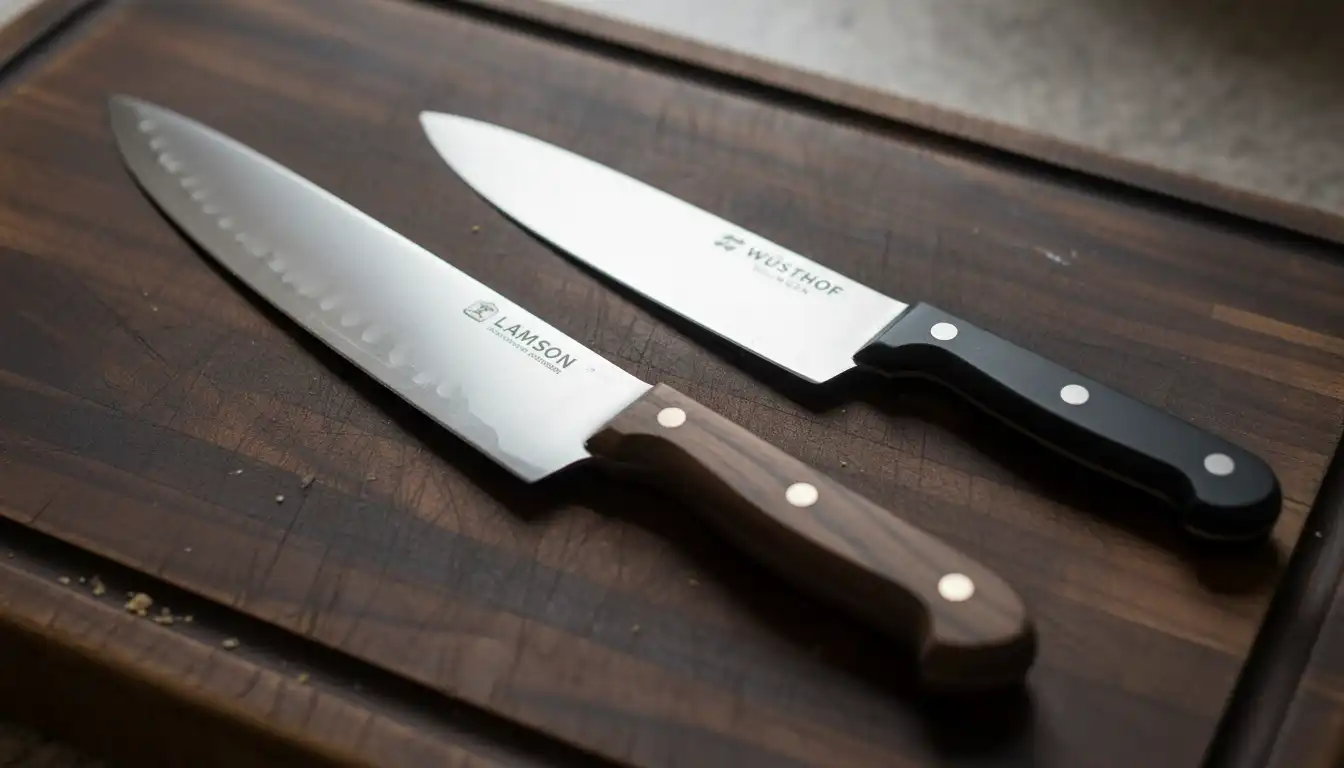
Wüsthof utilizes its proprietary PEtec (Precision Edge Technology) to put the final edge on its blades. A laser measures the blade before computer-controlled robots sharpen it to a razor-thin 14 degrees per side. This results in a breathtakingly sharp knife right out of the box, capable of gliding through vegetables and proteins with little to no effort.
Lamson sharpens their knives to a slightly wider, more robust angle, typically around 18 degrees per side. While still exceptionally sharp, the initial feel might be less “slippery” than the Wüsthof. However, this wider angle contributes to a more durable edge that is less prone to micro-chipping during heavy use.
Edge Retention & Maintenance
This is where the battle truly unfolds. Due to its more acute 14-degree angle, the Wüsthof edge may require more frequent honing to keep it perfectly aligned. However, because the X50CrMoV15 steel is so well-balanced, it responds beautifully to a honing steel and is not difficult to re-sharpen when the time comes.
The Lamson’s slightly broader edge angle often translates to superior edge durability. It can withstand more rugged tasks and may not need honing quite as often as the Wüsthof to feel sharp. For the home cook who wants a low-maintenance yet high-performance tool, this can be a significant advantage. Both knives, given their similar steel hardness, will require sharpening at similar intervals over the long term.
The Price Tag: Is German Engineering Worth the Premium?
There’s no getting around it: a high-quality forged knife is an investment. Wüsthof has positioned itself as a premium brand, and its prices reflect its centuries-old reputation and extensive manufacturing process. You are paying for the name, the German engineering, and the guarantee of a flawless product.
Lamson, while also a premium product, is often available at a more accessible price point. Because they are not as large of a global brand, you are often paying more for the materials and craftsmanship and less for the marketing budget. This can make Lamson an incredible value proposition for those seeking top-tier, American-made performance without the highest-end price tag.
The Deciding Factor: Which Knife Belongs on Your Magnetic Strip?
The “best” knife is deeply personal. It depends on your cooking style, what you value in a tool, and what feels right in your own hand. There is no single right answer, only the right answer for you. Making this choice is as crucial as deciding between countertop materials, a decision well-covered in our honed granite vs soapstone guide.
Who Should Buy a Wüsthof?
You should choose a Wüsthof if you value brand heritage and a proven track record. It’s the knife for someone who appreciates a heavier, more substantial feel and the added safety of a full bolster. If you want the undisputed industry standard that is recognized and respected in kitchens around the globe, Wüsthof is your brand. It’s a statement piece, a commitment to a certain standard of excellence.
Who Should Buy a Lamson?
You should choose a Lamson if you want to champion American manufacturing and prefer a lighter, more agile knife. It’s the perfect choice for the cook who appreciates the ability to sharpen the entire blade and desires a unique aesthetic with different handle options. If you are looking for exceptional quality and performance that flies a bit under the radar, offering tremendous value, Lamson is the clear winner. The unique appeal is similar to choosing Fantasy Lux Quartzite for its distinctive beauty.
Beyond the Chef’s Knife: A Look at Their Full Range
While the 8-inch chef’s knife is the cornerstone of any kitchen, both Wüsthof and Lamson offer extensive collections. From delicate paring knives to serrated bread knives and powerful cleavers, you can build a complete, matching set from either brand. Both companies stand behind their products with lifetime warranties, ensuring your investment is protected.
Ultimately, choosing between Lamson and Wüsthof is a fantastic problem to have. Both produce world-class knives that can elevate your cooking and bring joy to your kitchen for decades. The decision rests on your personal preference for balance, weight, design, and heritage. By understanding these key differences, you can make an informed choice and acquire a tool that will not only perform flawlessly but also become a cherished part of your home, just as important as any major kitchen fixture update like a kitchen sink reglaze.
