Kitchen Faucet Won’t Stay in Place? Your Ultimate Guide to a Rock-Solid Sink
There are few kitchen annoyances more persistent than a faucet that just won’t stay put. Whether the entire base wobbles every time you touch the handle or the pull-down sprayer droops sadly into the sink, a loose faucet disrupts the heart of your home and can lead to bigger problems down the line.
This isn’t just a minor inconvenience; a constantly shifting faucet can stress water lines, leading to potential leaks and water damage. Fortunately, this is a problem you can almost always fix yourself with a few basic tools and a little know-how. This guide will walk you through every step to restore stability to your kitchen sink.
You'll Learn About
Why Your Kitchen Faucet is Suddenly Loose
Understanding the root cause of the problem is the first step to a lasting fix. Constant swiveling, pulling on the hose, and even vibrations from a garbage disposal can conspire to loosen the hardware holding your faucet secure. Over time, what was once a rock-solid installation can become a wobbly mess.
In most cases, the culprit is simple: the mounting hardware underneath the sink has worked its way loose. However, other issues like a degraded gasket or a problem with the faucet body itself can also be to blame. We’ll explore how to diagnose the exact issue affecting your fixture.
The Two Types of “Loose” Faucets: Base vs. Spout
A faucet that “won’t stay in place” can mean two very different things. Pinpointing which issue you’re facing is crucial because the solutions are completely different. One requires getting under the sink, while the other is often a quick, tool-free adjustment.
Diagnosing a Loose Faucet Base
This is the most common issue. To check, grip the faucet at its base, right where it meets the countertop or sink deck, and try to wiggle it. If the entire fixture moves, even slightly, you have a loose faucet base.
The problem lies beneath the sink. A large mounting nut, or a set of smaller nuts on a mounting bracket, is responsible for clamping the faucet down. Over time, these nuts can back off, breaking the tight seal and allowing the faucet to wobble.
Diagnosing a Drooping Spout or Sprayer Head
If the faucet base is solid, but the pull-down or pull-out sprayer head hangs down instead of docking securely, the issue is with the retraction system. This is an incredibly common problem with modern faucets.
The fix is almost always related to a counterweight attached to the sprayer hose under the sink. This weight is designed to use gravity to pull the hose and sprayer head back into place. If it has slipped out of position, it can’t do its job effectively.
Your Step-by-Step Guide to a Rock-Solid Faucet
Now that you’ve diagnosed the problem, it’s time to fix it. We’ll start with the most frequent offender—the loose base—before moving on to the drooping sprayer. Arm yourself with a few key tools and prepare to reclaim your sturdy sink.
Tools and Preparation
For most of these fixes, you won’t need an extensive toolkit. Having the right tools on hand, however, can make the job significantly easier. Before you begin, gather the following:
- Flashlight or Headlamp: It’s dark under the sink, and good lighting is non-negotiable.
- Basin Wrench: This specialized tool is designed to reach the awkward nuts behind a deep sink basin. While not always necessary, it’s a lifesaver in tight spaces.
- Adjustable Wrench or Channel-Lock Pliers: For nuts that are easier to access.
- Bucket and Old Towels: A good practice for any plumbing work, just in case of drips.
While you typically don’t need to shut off the water for a simple tightening job, it’s a wise safety measure, especially if you’re not experienced with plumbing repairs. The shut-off valves are usually located directly under the sink.
Fixing a Loose Faucet Base (The #1 Culprit)
This is where you’ll need to get up close and personal with your under-sink cabinet. First, clear everything out to give yourself as much room as possible. Then, lie on your back and use your flashlight to look up at the point where the faucet’s water lines pass through the countertop.
You will see a large nut or a bracket held in place by two or three screws. This is the mounting hardware. Your goal is to tighten this hardware to clamp the faucet down.
Step 1: Hand-Tighten First. Reach up and try to tighten the mounting nut by hand. Often, it’s loose enough that you can get a few good turns in before needing a tool.
Step 2: Use Your Wrench. This is where a basin wrench proves its worth. Latch the wrench’s jaw onto the nut and turn it clockwise. It may only move a quarter-turn at a time, but this is enough. Have a helper hold the faucet in the correct alignment from above as you tighten from below.
Step 3: Snug is Enough. Be careful not to overtighten. Applying too much force can crack your countertop, especially if it’s made of a composite material or stone. The goal is to make it snug enough to eliminate the wobble, not to torque it down with maximum force.
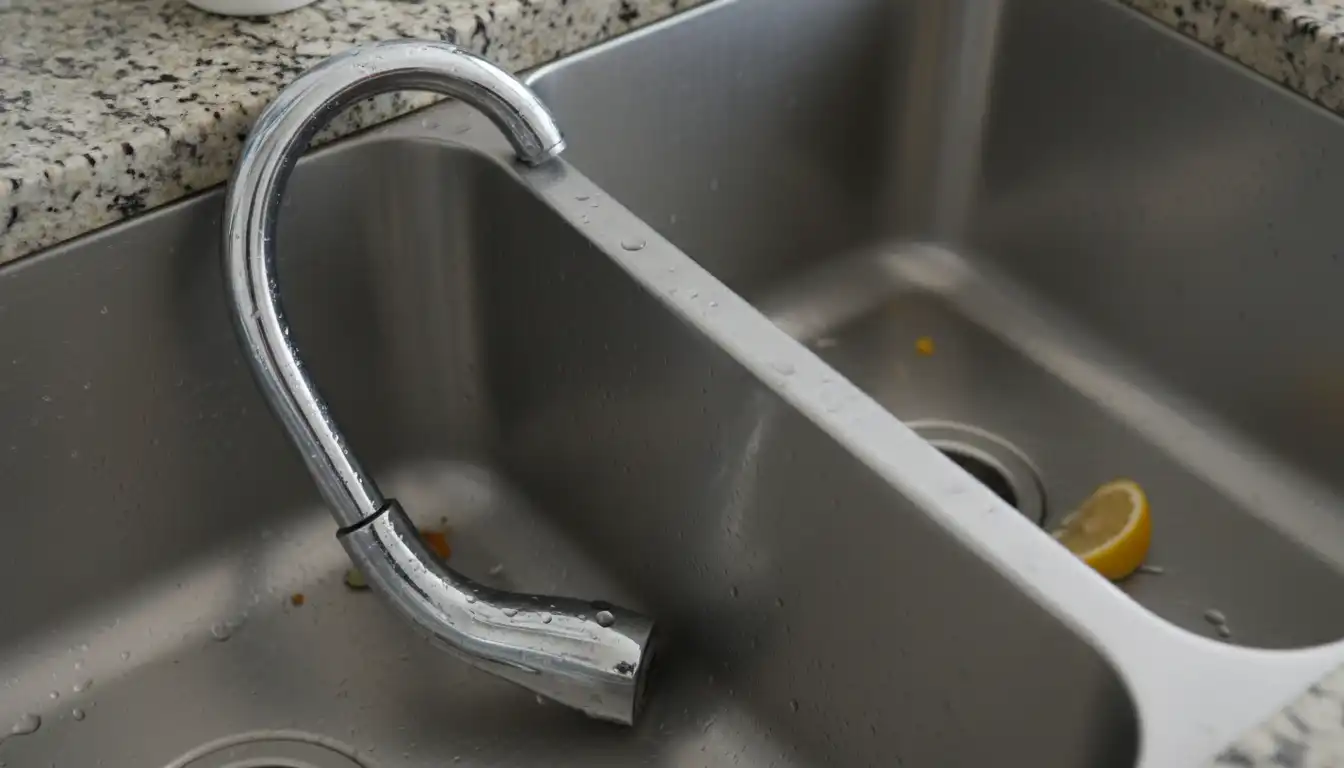
Curing a Drooping Pull-Down Sprayer
If your sprayer is the problem, you can likely put the basin wrench away. The fix is usually much simpler and involves adjusting the hose’s counterweight.
Look under your sink and locate the pull-down hose; it’s the only hose that isn’t connected to a water supply valve. You’ll find a weight, usually a black, heavy plastic block, clamped around it.
Step 1: Check for Obstructions. First, ensure the hose and weight can move freely. Sometimes, cleaning supplies, a wastebasket, or plumbing pipes can block the weight’s path, preventing it from retracting the hose fully.
Step 2: Adjust the Counterweight. If the path is clear, the weight is likely in the wrong position. It may have slipped down over time. Most weights are split in two and held by screws or a simple clip. Loosen the screws or undo the clip, slide the weight up the hose several inches closer to the faucet body, and re-secure it. The ideal spot is often marked with a piece of tape from the factory.
Step 3: Test and Readjust. Pull the sprayer head out and let it go. It should now retract smoothly and dock securely. If it’s still drooping, you may need to move the weight a little higher. If it doesn’t pull out far enough, you’ve moved the weight too high.
Advanced Troubleshooting: When Tightening Isn’t Enough
What if you’ve tightened the mounting nut, but the faucet still feels wobbly? Or what if the hardware itself seems damaged? In some cases, a simple tightening isn’t the complete solution, and you may need to investigate further.
A persistent wobble could indicate that a rubber or plastic gasket between the faucet base and the countertop has worn out or become compressed. In more severe cases, a faucet can fail more dramatically, such as when the kitchen faucet spout comes off entirely. If you encounter stripped threads or cracked mounting hardware, it may be time to replace the faucet.
| Problem | Common Cause | Primary Solution | Secondary Action |
|---|---|---|---|
| Entire faucet wobbles | Loose mounting nut(s) | Tighten nut under sink with a basin wrench | Check for a degraded gasket or seal |
| Sprayer head droops | Counterweight has slipped | Reposition weight higher on the hose | Clear any obstructions in the hose’s path |
| Handle is loose | Loose set screw in handle | Tighten the set screw with an Allen key | Inspect the valve cartridge for damage |
| Faucet still wobbles after tightening | Compressed gasket or flexing countertop | Apply plumber’s putty under the base | Consider adding a faucet stabilizer plate |
The Hidden Cause: Countertop Material Integrity
One critical factor often overlooked in online guides is the role of the countertop material itself. A faucet can only be as stable as the surface it’s mounted on. This is especially true for certain types of countertops.
Thin stainless steel sinks, for example, can flex under the weight and torque of a heavy, tall gooseneck faucet. No amount of tightening will prevent that flex. Similarly, older laminate countertops with a particleboard core can suffer from water damage around the faucet hole. The wood composite can soften and crumble over time, making a secure installation impossible.
If you suspect this is your issue, you might need a faucet stabilizer or a broader deck plate. These accessories help distribute the clamping force over a wider area, providing much-needed reinforcement and preventing the faucet from flexing the countertop material.
Preventive Maintenance: Keep Your Faucet Secure for Years
Once you’ve secured your faucet, you can take a few simple steps to prevent it from coming loose again. Prevention is key to avoiding future under-sink gymnastics.
Perform a quick “wobble check” every few months. It only takes a second to see if any loosening has begun. Also, try to be gentle when using the faucet. Avoid using the spout as a lever to turn the faucet and don’t aggressively yank on the pull-down hose.
When to Call a Professional Plumber
While fixing a loose faucet is a very manageable DIY task, there are times when calling a professional is the smartest choice. If you encounter stripped threads, heavily corroded nuts that won’t budge, or persistent leaks after your repair, it’s best to let an expert take over.
Furthermore, complex modern faucets, like those with touchless sensors or intricate designs such as stylish black and gold hardware, can have unique mounting systems. A professional will also have a better understanding of issues that go beyond the faucet itself, like water pressure problems that can affect things like a slow-filling tub, a topic you can explore further in our guide to GPM tub faucet problems.
Final Thoughts: Reclaim Your Stable Sink
A loose, wobbly, or drooping kitchen faucet is a common household frustration, but it doesn’t have to be a permanent one. By correctly diagnosing whether the issue lies with the base or the sprayer, you can apply a targeted, simple fix.
With just a few tools and a bit of patience, you can restore your faucet to a perfectly stable and functional state, ensuring the central hub of your kitchen works exactly as it should.