James Hardie Wrap vs. Tyvek: The Ultimate Showdown for Your Home’s Armor
Protecting your home from the elements is one of the most critical aspects of construction. The exterior siding is the first line of defense, but the silent hero working behind the scenes is the house wrap, or Weather Resistive Barrier (WRB). This layer is your home’s last defense against moisture and air intrusion, which can lead to devastating rot, mold, and skyrocketing energy bills.
Choosing the right house wrap often comes down to two industry giants: James Hardie HardieWrap and DuPont Tyvek HomeWrap. While both serve the same primary function, they are not created equal. Making the wrong choice can compromise the integrity of your home’s entire wall system. This guide will break down the critical differences to ensure you select the perfect armor for your investment.
You'll Learn About
What is House Wrap and Why is it Non-Negotiable?
Think of house wrap as a modern, high-tech evolution of the tar paper used on older homes. It’s a synthetic material that is installed over the sheathing of a house, directly beneath the siding. Its primary job is to create a barrier that stops liquid water and air from penetrating the wall cavity, while still allowing water vapor to escape from the inside.
This “breathability” is crucial. Without it, moisture from daily activities like showering and cooking could get trapped within your walls, leading to mold, mildew, and structural decay. A properly installed house wrap is an essential component of a high-performance building envelope, safeguarding your home’s health and your comfort.
Meet the Contenders: A Quick Introduction
In the world of house wraps, two names consistently rise to the top. They represent different technologies and philosophies in building protection, making the choice between them a significant one for any homeowner or builder.
James Hardie HardieWrap Weather Barrier
James Hardie is a name synonymous with high-quality fiber cement siding. It’s no surprise that they developed a house wrap engineered to work as part of a complete system with their cladding products. HardieWrap is a non-woven polyolefin material with a unique Micro-Tech Coating that provides a superior balance of water resistance and breathability.
DuPont Tyvek HomeWrap
DuPont Tyvek is arguably the most recognized brand name in the house wrap market. It has been the industry standard for decades, trusted by builders worldwide. Its unique flash-spun high-density polyethylene (HDPE) fibers create a tough, durable material that has become the benchmark for performance in the category.
The Head-to-Head Battle: HardieWrap vs. Tyvek
When you put these two products side-by-side, the differences become clear. Understanding these nuances in material, performance, and compatibility is key to making the right decision for your specific project.
Material Composition and Durability
The fundamental difference between these two products lies in their construction. Tyvek is made from flash-spinning continuous, high-density polyethylene fibers that are then bonded together with heat and pressure. This creates a famously tough, tear-resistant material that feels almost like a fabric. Its high tear strength makes it very durable on a busy job site, resisting rips and punctures during construction.
HardieWrap, on the other hand, is a non-woven polyolefin sheet that features a proprietary Micro-Tech Coating. This coating is the key to its performance, creating microscopic pores that are large enough to let water vapor out but small enough to block liquid water. While still durable, it may not have the same brute tear strength as Tyvek, but it offers a different kind of performance advantage related to breathability.
Water and Air Resistance: The Core Function
Both HardieWrap and Tyvek excel at their primary jobs: stopping bulk water and air infiltration. They both pass the industry-standard tests for water resistance with flying colors. Whether it’s a driving rain or melting snow, both wraps will effectively drain water away and keep your home’s sheathing dry.
They are also both excellent air barriers. A properly taped house wrap can significantly reduce drafts and air leakage, which in turn lowers your heating and cooling costs. Reducing air infiltration makes your home more comfortable and energy-efficient year-round.
Permeability (Breathability): The Drying Game
Here is where one of the most significant performance differences emerges. Permeability, or “perm,” measures how much water vapor can pass through a material. A higher perm rating means the material is more “breathable.” This is vital for allowing your wall system to dry out if any moisture gets in.
Tyvek HomeWrap has a perm rating of 58, which is highly breathable and has been the industry standard for years. However, James Hardie HardieWrap boasts a significantly higher perm rating, often cited as being even more breathable. This superior breathability can provide an extra margin of safety, especially in damp or humid climates, allowing the wall cavity to dry more quickly and efficiently. This proactive drying potential is a cornerstone of modern building science.
UV Resistance: The Pre-Siding Window
Construction projects can face delays. A crucial factor for any house wrap is its ability to withstand sun exposure before the siding is installed. Ultraviolet (UV) radiation can degrade the material over time, compromising its performance.
DuPont Tyvek HomeWrap has a UV exposure rating of 120 days. James Hardie HardieWrap is rated for 90 days of UV exposure. For most residential projects, 90 days is more than sufficient, but for larger or more complex jobs that might face extended delays, Tyvek’s longer UV rating could be a deciding factor.
Installation and System Compatibility
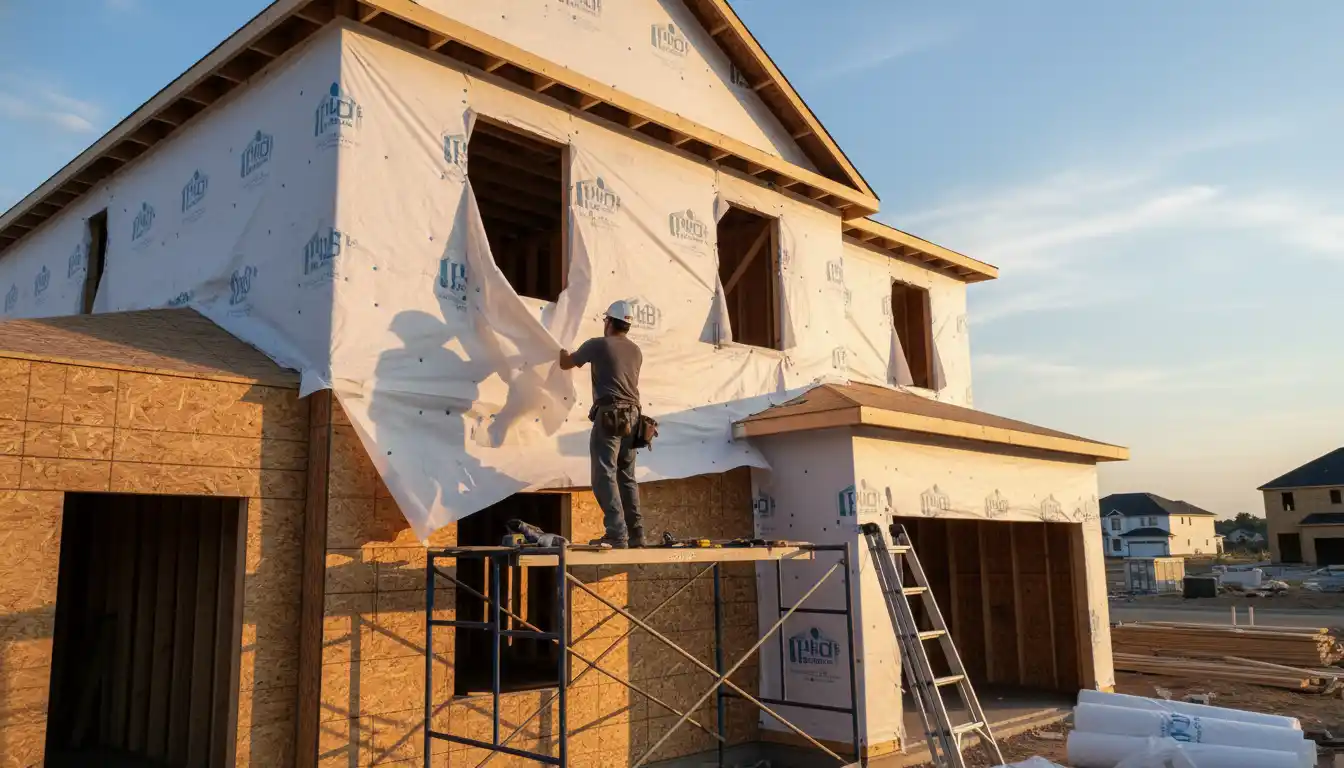
Both products install in a similar fashion, using cap fasteners and seam tape. However, the real advantage for James Hardie lies in its “system” approach. When you are resheathing a house and installing a new exterior, using products designed to work together is a massive benefit. James Hardie offers a complete suite of products, including HardieWrap, Pro-Flashing, Flex Flashing, and Seam Tape, all engineered to integrate seamlessly with their siding.
Using the complete James Hardie system can provide peace of mind and, more importantly, a more robust warranty. When one manufacturer is responsible for the entire exterior cladding system, from the wrap to the siding, there is less room for error or blame-shifting if a problem arises.
The Spec Sheet Showdown
Seeing the key metrics side-by-side can help clarify the choice. This table breaks down the essential performance characteristics of each product, offering a clear, at-a-glance comparison for homeowners and builders.
| Feature | James Hardie HardieWrap | DuPont Tyvek HomeWrap |
|---|---|---|
| Material | Non-woven polyolefin with Micro-Tech Coating | Flash-spun high-density polyethylene (HDPE) |
| Perm Rating (Breathability) | Very High (Excellent drying potential) | High (58 US perms) |
| Water Resistance | Excellent | Excellent |
| UV Exposure Limit | 90 Days | 120 Days |
| Tear Resistance | Good | Excellent |
| System Warranty | Strongest when used with full James Hardie system | Strong standalone product warranty |
The Cost Factor: Is More Expensive Always Better?
On a square-foot basis, the cost of Tyvek and HardieWrap is often very competitive. Prices can fluctuate based on location and supplier, but they are generally in the same ballpark. Therefore, the decision should rarely be made on material cost alone.
Instead, consider the total installed cost and the long-term value. The real investment is not in the roll of house wrap but in the longevity and health of your home. A failure in the building envelope can lead to repairs costing tens of thousands of dollars, making the initial price difference between two high-quality wraps negligible in the grand scheme.
The “Secret” Factor: Siding Compatibility
A little-discussed but critical factor in house wrap performance is its compatibility with the chosen siding. Certain types of wood siding contain oils and tannins, and some composite sidings contain surfactants (soap-like chemicals). Over time, these substances can “leach” onto the house wrap, breaking down its water-repellent properties.
This is where the James Hardie system shines with an unmatched advantage. HardieWrap is specifically formulated to be chemically inert and resistant to the surfactants present in their own fiber cement siding products. By pairing HardieWrap with Hardie siding, you eliminate the risk of chemical incompatibility that could compromise your weather barrier over time. This synergy ensures that both the wrap and the siding perform at their peak for the life of the home, a guarantee that is harder to make when mixing and matching brands.
What About Other Options?
While HardieWrap and Tyvek are dominant players, it’s worth noting there are many other products on the market. Some builders opt for different systems entirely. Exploring a house wrap alternative might lead you to options like integrated sheathing panels (e.g., ZIP System) or fluid-applied membranes. These systems have their own sets of pros and cons related to cost, labor, and performance, but for traditional builds, Hardie and Tyvek remain the top contenders.
James Hardie Wrap vs. Tyvek: The Ultimate Showdown for Your Home’s Armor
Protecting your home from the elements is one of the most critical aspects of construction. The exterior siding is the first line of defense, but the silent hero working behind the scenes is the house wrap, or Weather Resistive Barrier (WRB). This layer is your home’s last defense against moisture and air intrusion, which can lead to devastating rot, mold, and skyrocketing energy bills.
Choosing the right house wrap often comes down to two industry giants: James Hardie HardieWrap and DuPont Tyvek HomeWrap. While both serve the same primary function, they are not created equal. Making the wrong choice can compromise the integrity of your home’s entire wall system. This guide will break down the critical differences to ensure you select the perfect armor for your investment.
What is House Wrap and Why is it Non-Negotiable?
Think of house wrap as a modern, high-tech evolution of the tar paper used on older homes. It’s a synthetic material that is installed over the sheathing of a house, directly beneath the siding. Its primary job is to create a barrier that stops liquid water and air from penetrating the wall cavity, while still allowing water vapor to escape from the inside.
This “breathability” is crucial. Without it, moisture from daily activities like showering and cooking could get trapped within your walls, leading to mold, mildew, and structural decay. A properly installed house wrap is an essential component of a high-performance building envelope, safeguarding your home’s health and your comfort.
Meet the Contenders: A Quick Introduction
In the world of house wraps, two names consistently rise to the top. They represent different technologies and philosophies in building protection, making the choice between them a significant one for any homeowner or builder.
James Hardie HardieWrap Weather Barrier
James Hardie is a name synonymous with high-quality fiber cement siding. It’s no surprise that they developed a house wrap engineered to work as part of a complete system with their cladding products. HardieWrap is a non-woven polyolefin material with a unique Micro-Tech Coating that provides a superior balance of water resistance and breathability.
DuPont Tyvek HomeWrap
DuPont Tyvek is arguably the most recognized brand name in the house wrap market. It has been the industry standard for decades, trusted by builders worldwide. Its unique flash-spun high-density polyethylene (HDPE) fibers create a tough, durable material that has become the benchmark for performance in the category.
The Head-to-Head Battle: HardieWrap vs. Tyvek
When you put these two products side-by-side, the differences become clear. Understanding these nuances in material, performance, and compatibility is key to making the right decision for your specific project.
Material Composition and Durability
The fundamental difference between these two products lies in their construction. Tyvek is made from flash-spinning continuous, high-density polyethylene fibers that are then bonded together with heat and pressure. This creates a famously tough, tear-resistant material that feels almost like a fabric. Its high tear strength makes it very durable on a busy job site, resisting rips and punctures during construction.
HardieWrap, on the other hand, is a non-woven polyolefin sheet that features a proprietary Micro-Tech Coating. This coating is the key to its performance, creating microscopic pores that are large enough to let water vapor out but small enough to block liquid water. While still durable, it may not have the same brute tear strength as Tyvek, but it offers a different kind of performance advantage related to breathability.
Water and Air Resistance: The Core Function
Both HardieWrap and Tyvek excel at their primary jobs: stopping bulk water and air infiltration. They both pass the industry-standard tests for water resistance with flying colors. Whether it’s a driving rain or melting snow, both wraps will effectively drain water away and keep your home’s sheathing dry.
They are also both excellent air barriers. A properly taped house wrap can significantly reduce drafts and air leakage, which in turn lowers your heating and cooling costs. Reducing air infiltration makes your home more comfortable and energy-efficient year-round.
Permeability (Breathability): The Drying Game
Here is where one of the most significant performance differences emerges. Permeability, or “perm,” measures how much water vapor can pass through a material. A higher perm rating means the material is more “breathable.” This is vital for allowing your wall system to dry out if any moisture gets in.
Tyvek HomeWrap has a perm rating of 58, which is highly breathable and has been the industry standard for years. However, James Hardie HardieWrap boasts a significantly higher perm rating, often cited as being even more breathable. This superior breathability can provide an extra margin of safety, especially in damp or humid climates, allowing the wall cavity to dry more quickly and efficiently. This proactive drying potential is a cornerstone of modern building science.
UV Resistance: The Pre-Siding Window
Construction projects can face delays. A crucial factor for any house wrap is its ability to withstand sun exposure before the siding is installed. Ultraviolet (UV) radiation can degrade the material over time, compromising its performance.
DuPont Tyvek HomeWrap has a UV exposure rating of 120 days. James Hardie HardieWrap is rated for 90 days of UV exposure. For most residential projects, 90 days is more than sufficient, but for larger or more complex jobs that might face extended delays, Tyvek’s longer UV rating could be a deciding factor.
Installation and System Compatibility
Both products install in a similar fashion, using cap fasteners and seam tape. However, the real advantage for James Hardie lies in its “system” approach. James Hardie offers a complete suite of products, including HardieWrap, Pro-Flashing, Flex Flashing, and Seam Tape, all engineered to integrate seamlessly with their siding.
Using the complete James Hardie system can provide peace of mind and, more importantly, a more robust warranty. When one manufacturer is responsible for the entire exterior cladding system, from the wrap to the siding, there is less room for error or blame-shifting if a problem arises.
The Spec Sheet Showdown
Seeing the key metrics side-by-side can help clarify the choice. This table breaks down the essential performance characteristics of each product, offering a clear, at-a-glance comparison for homeowners and builders.
| Feature | James Hardie HardieWrap | DuPont Tyvek HomeWrap |
|---|---|---|
| Material | Non-woven polyolefin with Micro-Tech Coating | Flash-spun high-density polyethylene (HDPE) |
| Perm Rating (Breathability) | Very High (Excellent drying potential) | High (58 US perms) |
| Water Resistance | Excellent | Excellent |
| UV Exposure Limit | 90 Days | 120 Days |
| Tear Resistance | Good | Excellent |
| System Warranty | Strongest when used with full James Hardie system | Strong standalone product warranty |
The Cost Factor: Is More Expensive Always Better?
On a square-foot basis, the cost of Tyvek and HardieWrap is often very competitive. Prices can fluctuate based on location and supplier, but they are generally in the same ballpark. Therefore, the decision should rarely be made on material cost alone.
Instead, consider the total installed cost and the long-term value. The real investment is not in the roll of house wrap but in the longevity and health of your home. A failure in the building envelope can lead to repairs costing tens of thousands of dollars, making the initial price difference between two high-quality wraps negligible in the grand scheme.
The “Secret” Factor: Siding Compatibility
A little-discussed but critical factor in house wrap performance is its compatibility with the chosen siding. Certain types of wood siding contain oils and tannins, and some composite sidings contain surfactants (soap-like chemicals). Over time, these substances can “leach” onto the house wrap, breaking down its water-repellent properties.
This is where the James Hardie system shines with an unmatched advantage. HardieWrap is specifically formulated to be chemically inert and resistant to the surfactants present in their own fiber cement siding products. By pairing HardieWrap with Hardie siding, you eliminate the risk of chemical incompatibility that could compromise your weather barrier over time. This synergy ensures that both the wrap and the siding perform at their peak for the life of the home, a guarantee that is harder to make when mixing and matching brands.
What About Other Options?
While HardieWrap and Tyvek are dominant players, it’s worth noting there are many other products on the market. Some builders opt for different systems entirely. Exploring a house wrap alternative might lead you to options like integrated sheathing panels (e.g., ZIP System) or fluid-applied membranes. These systems have their own sets of pros and cons related to cost, labor, and performance, but for traditional builds, Hardie and Tyvek remain the top contenders.
Your Home’s Best Defense
Ultimately, the battle between James Hardie HardieWrap and DuPont Tyvek is a matchup of two champions. One offers the power of an integrated, chemically compatible system, while the other provides time-tested, rugged durability. By evaluating your siding choice, climate, and project timeline, you can confidently choose the right house wrap.
This decision is a long-term investment in your home’s structural integrity, air quality, and energy efficiency. By making an informed choice now, you ensure your home’s armor will perform flawlessly for decades to come, protecting your family and your peace of mind.
The Final Verdict: Which Wrap Should You Choose?
The truth is, you cannot go wrong with either HardieWrap or Tyvek. Both are premium products that will protect your home effectively when installed correctly. The best choice depends entirely on your project’s specific needs and priorities.
Choose James Hardie HardieWrap if…
You are installing James Hardie fiber cement siding. The system synergy, integrated warranty, and chemical compatibility are too significant to ignore. The peace of mind that comes from a single-manufacturer system is invaluable. You should also choose it if you live in a particularly damp climate where its superior breathability provides an extra layer of drying protection for the wall assembly.
Choose DuPont Tyvek HomeWrap if…
Tear resistance and job site durability are your absolute top priorities. If your construction site is exposed to high winds or rough handling, Tyvek’s legendary toughness is a major asset. Furthermore, if your project is facing potential long-term delays, its longer 120-day UV exposure rating provides a more forgiving installation window.