
I Hate My Marble Countertops: The #1 Survival Guide for Regretful Homeowners
You fell in love with the timeless elegance of marble. The soft, veined beauty seen in magazines and showrooms promised a luxurious kitchen. Now, the reality has set in: a daily battle against stains, mysterious dull spots, and a constant fear of ruining your expensive investment.
Living with marble countertops can feel less like a dream and more like a high-maintenance nightmare. Every drop of lemon juice, every coffee spill, feels like a potential disaster. But before you consider the costly process of replacement, understand that you can reclaim your kitchen from the tyranny of delicate stone.
You'll Learn About
Why Your Marble Dream Became a High-Maintenance Reality
The frustration you feel isn’t your fault; it’s rooted in the very nature of the stone. Understanding the science behind marble’s flaws is the first step toward managing them. Unlike granite or quartz, marble is a metamorphic rock formed from limestone, composed primarily of calcium carbonate.
The Enemy Within: Understanding Porosity and Softness
Marble is fundamentally porous and soft. This means it has microscopic pores that can absorb liquids, leading to stubborn stains. Its relative softness on the Mohs hardness scale makes it susceptible to scratches from knives, pans, and even ceramic dishes being dragged across the surface.
This is the core reason why liquids like oil, coffee, and wine can leave permanent marks if not addressed immediately. The stone literally drinks the spill, pulling the pigment deep below the surface where it becomes incredibly difficult to remove.
Etching: The Ghostly Damage You Can’t Wipe Away
Perhaps the most maddening issue for marble owners is etching. An etch is not a stain; it is a chemical reaction that corrodes the stone. When an acidic substance like vinegar, citrus juice, or tomato sauce comes into contact with the calcium carbonate in the marble, it eats away a microscopic layer of the surface, leaving a dull, whitish mark.
These “ghost stains” are most noticeable on polished marble because the dull spot contrasts sharply with the glossy finish. No amount of scrubbing will remove an etch mark because it is physical damage to the stone itself.
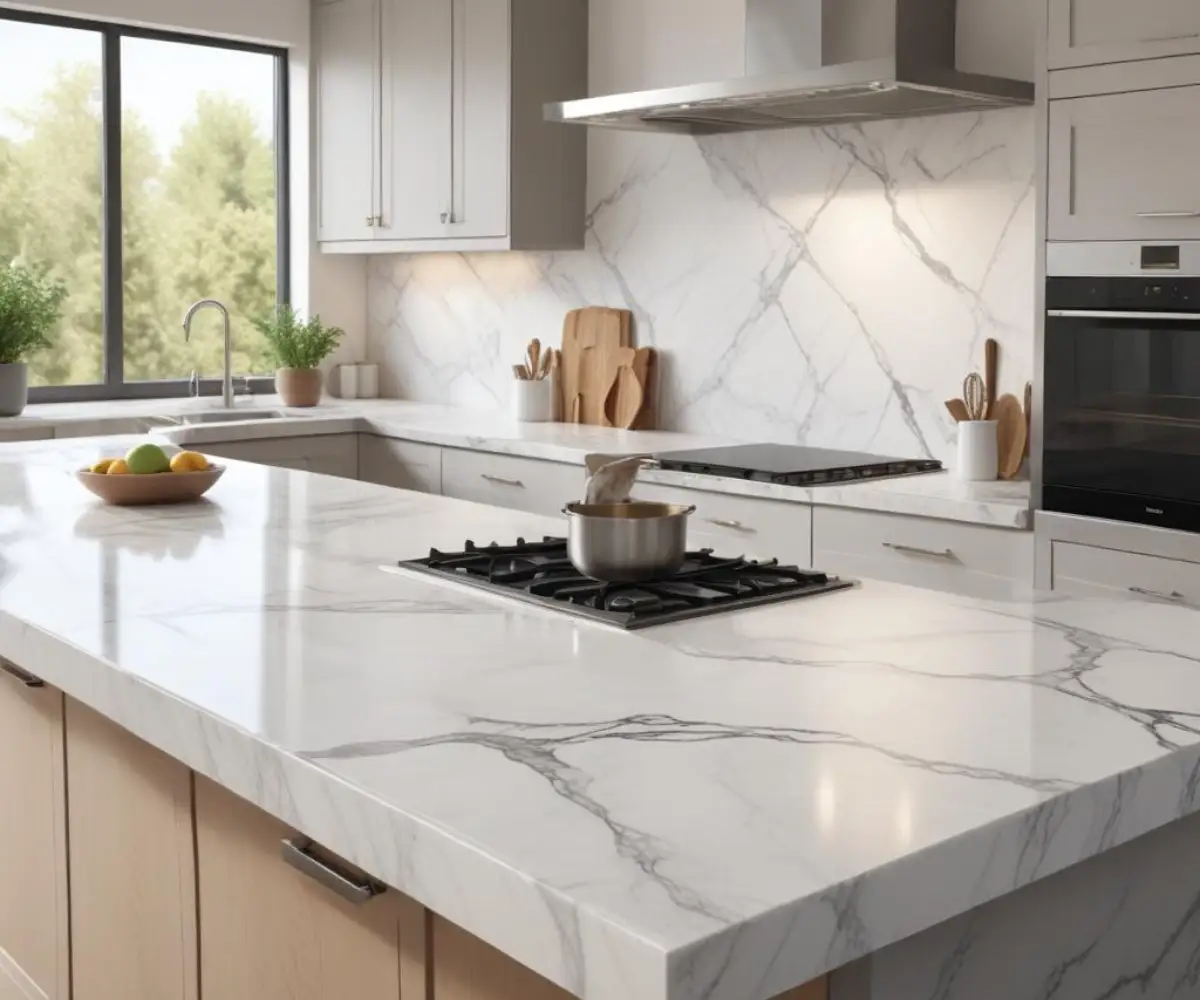
Your Action Plan: Fixing, Protecting, and Living With Marble
Regret doesn’t have to be permanent. With the right techniques and a shift in mindset, you can manage, repair, and protect your countertops. The goal is to move from a state of constant worry to one of confident maintenance.
Step 1: Damage Triage – Identifying Etches vs. Stains
First, determine the type of damage you’re dealing with. Pour a small amount of water on the mark. If the spot darkens, it is likely a stain that has penetrated the stone. If the mark becomes less visible when wet or looks like a dull spot, it is an etch.
Knowing the difference is critical because the solutions are completely different. Trying to scrub an etch will only make it worse, while a stain remover won’t do anything for an etch.
Step 2: DIY Solutions for Minor Blemishes
For minor issues, you can often achieve significant improvement without calling a professional. For light, superficial etches on a polished surface, a marble polishing powder can work wonders. This is a mildly abrasive compound that essentially re-polishes the damaged spot by hand, blending it with the surrounding surface.
For stains, a poultice is your best weapon. A poultice is a thick, paste-like substance that pulls the stain out of the stone as it dries. You can create effective poultices at home for specific stain types.
| Issue Type | DIY Solution | Key Steps & Cautions |
|---|---|---|
| Organic Stain (Coffee, Tea, Wine) | Hydrogen Peroxide Poultice | Mix baking soda and hydrogen peroxide into a paste. Apply, cover with plastic wrap, and let sit for 24 hours before removing. |
| Oil-Based Stain (Grease, Cooking Oil) | Baking Soda & Water Poultice | Create a thick paste of baking soda and water. Apply, cover, and let sit for 24 hours to draw the oil out. |
| Minor Etch Mark (Polished Finish) | Marble Polishing Powder | Clean the area, apply the powder with a damp cloth, and buff vigorously in a circular motion. Test on an inconspicuous spot first. |
| Water Spots / Rings | Buff with #0000 Steel Wool | Gently buff the dry water spot with super-fine steel wool. Use light pressure; this is for hard water mineral deposits, not etches. |
Step 3: The Secret Weapon – Changing The Finish
One of the most effective, yet least discussed, long-term solutions for frustration with polished marble is to change the finish. A honed, or matte, finish is significantly better at hiding etches. Since the entire surface is non-reflective, the dull spots caused by acids don’t stand out.
A stone restoration professional can grind down the polished surface to create a beautiful, soft matte finish. While a honed surface can be slightly more susceptible to absorbing stains, this is easily managed with proper sealing. For a busy kitchen, the trade-off is often well worth it for the peace of mind it brings.
The Ultimate Defense: A Better Approach to Sealing and Daily Care
Prevention is the most powerful tool in your arsenal. Proper sealing and daily habits are non-negotiable for preserving the beauty of your marble countertops.
Sealing Isn’t a Force Field, But It’s Your Best Defense
Think of a sealer not as a plastic shell, but as a treatment that fills the pores of the marble. This slows down the rate at which liquids can be absorbed, giving you more time to clean up spills. Crucially, a standard sealer does not prevent etching. Acid will still damage the surface.
It is vital to use a high-quality impregnating sealer and reapply it regularly, typically every 6-12 months. A simple test to see if your sealer is working is to sprinkle some water on the surface. If it beads up, the seal is strong. If it soaks in and darkens the stone, it’s time to reseal.
The Unspoken Rule of Marble Care
Many homeowners inadvertently sabotage their own efforts by using the wrong cleaning products. Using anything other than a pH-neutral cleaner will slowly degrade the sealer and can even etch the marble itself.
Avoid all-purpose cleaners, vinegar solutions, and anything with bleach or ammonia. A simple solution of mild dish soap and warm water, or a dedicated stone cleaner, is all you need for daily wipedowns. This simple change is one of the most effective ways to protect your investment.
When to Call a Professional Stone Restorer
Sometimes, the damage is too significant for a DIY approach. Deep etches, widespread scratching, or stubborn stains may require professional intervention. Know when to hand the problem over to an expert.
What Can a Professional Do?
A stone restoration specialist has the equipment and expertise to perform services that are impossible to do yourself. They can grind down the surface to remove a thin layer of damaged stone, effectively erasing scratches and etches. They can then re-hone or re-polish the surface to a like-new condition.
Professionals can also repair chips and cracks using color-matched epoxy that makes the damage nearly invisible. While this service comes at a cost, it is far less expensive than completely replacing your countertops.
Long-Term Strategies: Alternatives and Adaptations
If you’ve tried everything and still find the maintenance overwhelming, it may be time to consider other options. This doesn’t always mean a full replacement. Exploring alternatives can give you the look you love without the stress.
Learning to Live with Patina
Many design professionals and homeowners in historic European homes embrace the “patina” of marble. They view the etches and faint marks not as flaws, but as signs of a well-loved and well-used kitchen. Adopting this mindset can relieve the pressure of maintaining a flawless surface.
If the idea of a pristine surface is causing you stress, perhaps the answer is to accept and even appreciate the natural aging process of the stone. A countertop that tells the story of many meals can have its own unique charm.
When It’s Time for a Change: Marble-Look Counterparts
If you truly cannot live with the upkeep, modern technology offers stunning alternatives. Materials like quartz and porcelain now come in designs that convincingly mimic the look of natural marble. These engineered surfaces are non-porous and highly resistant to staining and etching. High-end quartz brands offer beautiful, subtle veining similar to popular marbles. For a direct comparison, you might want to see how options like Cambria Torquay vs Swanbridge stack up.
While some people feel nothing can replace real stone, the peace of mind offered by a low-maintenance alternative can be a welcome relief. Even other natural stones can be a better fit; if you’re unhappy with one type of stone, don’t rule out the entire category. Sometimes the issue is specific, like with color, which is a common complaint even for durable stones. If that sounds familiar, you might find solutions in our guide for those who hate their granite color. When planning a replacement, be sure to consider all structural factors, especially if you have unique dimensions like extra wide countertops.
Ultimately, your marble countertops don’t have to be a source of regret. By understanding the material’s inherent properties, implementing a consistent care routine, and knowing how to address damage, you can manage your surfaces effectively. Whether you choose to restore, refinish, or simply embrace the patina, you can make your beautiful marble work for your home and lifestyle.
