
Relaminate Rounded Countertops & Erase Years of Wear: Your Pro Guide
Dull, damaged, or hopelessly dated countertops can make an entire kitchen feel tired and unwelcoming. For many homeowners, the dream of a kitchen refresh is dashed by the high cost of replacement. But what if there was a way to achieve a dramatic transformation for a fraction of the price? Relaminating offers a budget-friendly solution, yet many DIY enthusiasts are intimidated by one common feature: the rounded edge.
Those smooth, curved corners are often seen as a barrier to a successful project, a challenge reserved only for seasoned professionals. The fear of cracking the laminate, creating unsightly bubbles, or ending up with a crooked, unprofessional finish is a significant hurdle. This guide is here to dismantle that barrier, providing a clear, step-by-step blueprint for conquering curved edges and achieving a flawless, durable new countertop surface.
You'll Learn About
Why Relaminating Rounded Countertops is a Smart Upgrade
Opting to relaminate is more than just a cost-saving measure; it’s a strategic home improvement choice. It allows for a complete aesthetic overhaul, replacing dated patterns or colors with a modern look that can redefine your kitchen’s style. It’s an empowering project that builds skills and delivers an immense sense of satisfaction upon completion.
Compared to the demolition, plumbing work, and significant expense of a full countertop replacement, relaminating is a clean, efficient, and highly impactful alternative. It’s a project that revitalizes your space without turning your home into a construction zone for weeks on end.
Understanding the Core Challenge: The Curve
The primary difficulty with rounded edges lies in the nature of laminate itself. Standard laminate sheets are rigid. Forcing this stiff material around a curve without the proper technique and knowledge is a recipe for disaster. The most common failures—cracking, poor adhesion, and visible seams—all stem from misunderstanding how to work with the material’s properties.
Success hinges on a few key factors: selecting the right type of laminate, using the correct adhesive and application method, and employing a bit of heat to make the material more pliable. Many guides gloss over these crucial details, but they are the very secrets to a professional-grade finish.
The Secret Weapon: Post-Forming Grade Laminate
One of the most valuable pieces of information often omitted from basic tutorials is the distinction between laminate grades. While standard laminate can sometimes be coaxed around very wide curves, post-forming grade laminate is specifically designed for this purpose. It’s slightly thinner and more flexible, engineered to be heated and bent without cracking.
Choosing post-forming laminate significantly reduces the risk of failure and makes the entire process more manageable. While it might cost slightly more, it is a worthwhile investment for achieving a seamless, durable result on any countertop with rounded edges. Insisting on this grade at your supplier will set you up for success from the very beginning.
Gathering Your Arsenal: Tools and Materials
Having the right tools and materials is non-negotiable for a successful outcome. Attempting to cut corners with inadequate supplies will lead to frustration and a subpar finish. This table outlines everything you’ll need to get the job done right.
| Category | Item | Purpose & Key Considerations |
|---|---|---|
| Materials | Post-Forming Laminate Sheets | Specifically designed for bending. Measure your countertops and add several inches to each dimension for overhang. |
| Solvent-Based Contact Cement | Provides a stronger, more heat-resistant bond ideal for kitchen environments. Ensure proper ventilation during use. | |
| Acetone or Denatured Alcohol | Essential for cleaning surfaces before applying adhesive and for cleaning up any excess cement. | |
| Sandpaper (80-120 grit) | Used to scuff the old countertop surface to create a mechanical bond for the new adhesive. | |
| Wood Filler | To repair any deep scratches or gouges in the existing countertop for a perfectly smooth substrate. | |
| Tools | J-Roller | A small, hard rubber roller critical for applying firm, even pressure to bond the laminate and eliminate air bubbles. |
| Laminate Trimmer (or Router) | Essential for a clean, precise cut. Must be equipped with a flush-trim bit. | |
| Mill Bastard File | Used at a slight angle to gently smooth the trimmed edge of the laminate, removing sharpness without causing chips. | |
| Heat Gun | Carefully used to gently warm the laminate, making it more pliable as you bend it around the rounded edge. | |
| Paint Roller with Foam Sleeve | The best tool for applying a thin, even coat of contact cement. | |
| Wooden Dowels or Slip Sticks | Used to position the new laminate sheet over the countertop without it touching the adhesive prematurely. | |
| Safety Gear | Respirator Mask & Safety Glasses | Protects against fumes from contact cement and dust from sanding and routing. |
The Blueprint for Success: A Step-by-Step Guide
Patience and precision are your best allies in this project. Follow these steps methodically, and you will be rewarded with a countertop that looks professionally installed.
Step 1: Meticulous Preparation is Everything
The final quality of your countertop is directly proportional to the quality of your prep work. Do not rush this stage. Start by thoroughly cleaning the existing countertop with a degreasing cleaner to remove all oils, waxes, and residues.
Next, fill any significant gouges or chips with wood filler and sand them smooth once cured. Finally, scuff the entire surface, including the rounded edges, with 80-grit sandpaper. The goal is to remove the gloss and create a textured surface that the contact cement can grip firmly. Vacuum all dust and wipe the surface with denatured alcohol for a perfectly clean substrate. A flawlessly prepared surface is as crucial here as it is when you finish exposed drywall edge; imperfections will show through.
Step 2: Measuring and Cutting Your New Laminate
Measure the length and width of each countertop section and add at least one inch of overhang to all sides. This excess material will be trimmed off later for a perfect fit. Cut your edge strips first, ensuring they are wider than the edge profile. Then, cut the main top pieces.
A circular saw with a fine-tooth blade, cutting from the back side of the laminate, can work well. However, for maximum precision and minimal risk of chipping, scoring the laminate with a utility knife and snapping it along a straightedge is a reliable method.
Step 3: The Art of Applying Contact Cement
Proper ventilation is absolutely critical when working with solvent-based contact cement. Open windows and use fans to create cross-ventilation. Wearing a respirator is highly recommended. Using a foam roller, apply a thin, even coat of contact cement to both the back of the laminate piece and the countertop surface you are working on.
The most common mistake is not letting the cement dry long enough. It must be dry to the touch, not sticky or wet. This “tack time” can vary based on temperature and humidity, but it typically takes 15-20 minutes. When touched with a knuckle, it should feel tacky but not transfer to your skin.
Step 4: Conquering the Curve: Applying the Laminate
Always start with the edges. Applying the edge strips first ensures a clean seam that is covered by the top piece, making it less visible and less likely to catch on things. Apply the glued edge strip to the straight portion of the counter first, leaving the curved section unattached.
Now, gently warm the section of the laminate that will wrap the curve with a heat gun. Keep the gun moving constantly to avoid scorching or bubbling the laminate. As it becomes pliable, slowly and firmly press it around the curve, using your hand to mold it to the shape of the edge. Then, use the J-roller to apply firm pressure along the entire strip.
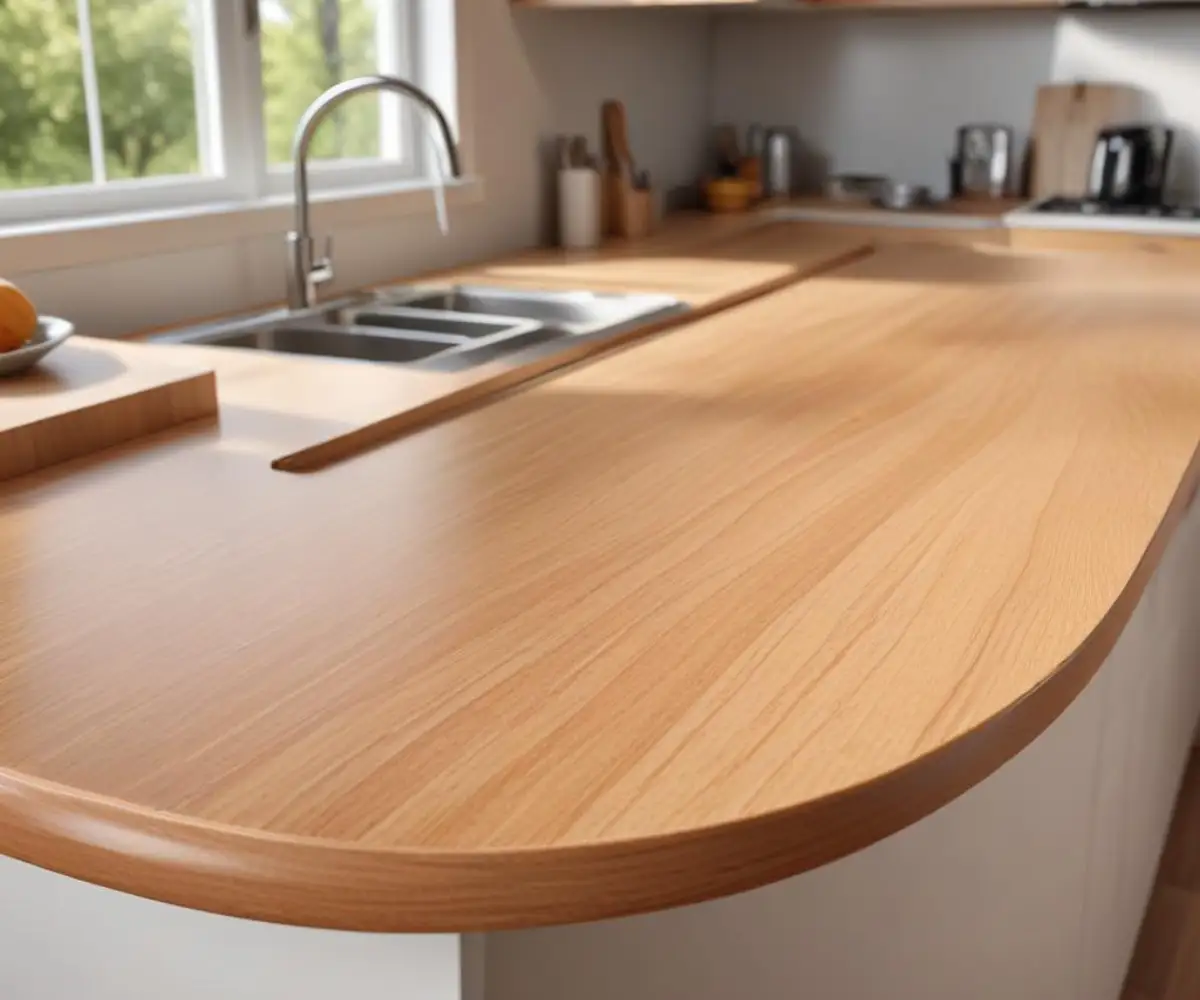
For the large top piece, lay wooden dowels every 12-18 inches across the countertop. Carefully position the new laminate sheet on top of the dowels. Starting from one end, remove the first dowel and press the laminate down, working your way to the other end, removing dowels as you go. This method prevents the surfaces from bonding before you have them perfectly aligned.
Step 5: Securing the Bond with a J-Roller
Once the laminate sheet is in place, the J-roller becomes the most important tool in your kit. Roll over every square inch of the surface with firm, overlapping strokes. Start from the center and work your way out to the edges to push out any trapped air bubbles. Pay special attention to the seams and the rounded edges, applying significant pressure to ensure a permanent bond.
Step 6: The Finishing Touches: Trimming and Filing
The final step is trimming the overhanging excess laminate. A laminate trimmer or a router with a flush-trim bit is the only way to get a perfectly clean, professional edge. Let the bearing of the bit ride along the finished edge of the countertop to guide the cut. Move the router in a steady, controlled motion.
After routing, the edge will be extremely sharp. Take your mill file and, holding it at a slight downward angle (around 20-30 degrees), gently push it along the edge in one direction. This action, known as chamfering, will ease the sharp corner and leave a smooth, durable finish that is resistant to chipping.
Pro-Level Secrets for Flawless Rounded Edges
To elevate your project from good to great, incorporate techniques that professional fabricators use. For extremely tight curves, apply a second thin coat of contact cement to both surfaces after the first has tacked up. This “two-coat” method provides superior grabbing power on high-stress areas.
Understanding the substrate is also key. If you were comparing different mortars for tile, you might read up on Versabond vs. Mapei to understand their properties. Similarly, knowing that your particleboard or MDF substrate is smooth and solid is vital for laminate adhesion. Any flaws in the base will be magnified once the laminate is applied.
Avoiding Common Pitfalls
Many DIY projects go wrong due to a few common, avoidable errors. Be mindful of these potential issues:
- Poor Alignment: Remember that once the two surfaces with contact cement touch, the bond is instant and permanent. The dowel rod method is your safety net against misalignment.
- Insufficient Pressure: Simply pressing the laminate down with your hands is not enough. A J-roller is essential for achieving the uniform pressure required for a lasting bond.
- Incorrect Filing: Never use a back-and-forth sawing motion with the file. This will lift and chip the decorative top layer of the laminate. Always file in a smooth, downward motion away from the finished surface.
- Router Mishaps: Ensure your router bit bearing is clean and spins freely. A stuck bearing can mar or burn the new edge. Let the tool do the work and don’t force it.
Beyond the Countertop: Elevating Your Kitchen’s Style
A newly relaminated countertop can be the catalyst for a broader kitchen refresh. The fresh, modern surface can highlight dated cabinet doors or hardware. Consider this an opportunity for further updates. Sometimes, a project’s success can inspire a deeper dive into design choices, much like reading detailed Door Design Lab reviews can help you choose the perfect new cabinet fronts to complement your new counters.
Even small changes, like new drawer pulls or a new backsplash, can amplify the impact of your work and create a cohesive, professionally designed look for your kitchen.
A Rewarding Transformation
Relaminating countertops with rounded edges is not the insurmountable challenge it’s often made out to be. It’s a project that demands precision, patience, and the right techniques. By understanding the unique properties of post-forming laminate, mastering the application of contact cement, and using the correct tools for trimming and finishing, you can achieve a stunning and durable transformation.
This project proves that a high-impact kitchen makeover doesn’t always require a high budget. With this expert guide, you have the knowledge and confidence to tackle those curves and give your countertops a new lease on life.
