
How Far Apart Are Sinks on a 72 Inch Vanity? The Ultimate Guide
You’ve chosen the perfect 72-inch vanity—a statement piece destined to be the centerpiece of your bathroom. Yet, a critical question can bring the entire project to a halt: how far apart should the sinks be? This single measurement can make the difference between a functional, harmonious space and a cramped, awkward daily experience.
Getting this spacing wrong is a costly and frustrating mistake. It’s about more than just cutting two holes in a countertop; it’s about crafting a space that works for the people using it every single day. This guide provides the definitive answer, moving beyond simple numbers to explore the crucial factors of functionality, aesthetics, and plumbing that lead to a perfect double vanity layout.
You'll Learn About
Why Sink Spacing is a Critical Design Decision
The placement of your sinks on a 72-inch vanity is a foundational choice that impacts the room’s entire dynamic. It’s a decision that balances personal space with visual symmetry and the practical realities of what lies beneath the counter.
The Functional Impact: Daily Use and User Comfort
The primary goal of a double vanity is to allow two people to use the space simultaneously without interference. If sinks are too close, you create an environment of constant elbow-bumping and jostling for position during morning and evening routines. Proper spacing ensures each person has adequate personal territory.
Consider the daily actions: brushing teeth, washing your face, applying makeup, or shaving. Each activity requires a certain amount of “elbow room.” Well-spaced sinks provide this buffer, transforming a shared space from a point of conflict into one of comfortable coexistence.
The Aesthetic Balance: Creating Visual Harmony
Your bathroom vanity is a major visual anchor. The spacing of the sinks plays a huge role in whether it looks balanced and intentional or haphazard and poorly planned. Symmetry is key to creating a high-end, professionally designed look.
Properly spaced sinks create a pleasing visual rhythm across the 72-inch span. This balance extends upwards, influencing the placement of mirrors, lighting fixtures, and even wall decor. A miscalculation here can throw off the entire aesthetic of the room.
The Practical Constraints: Plumbing and Cabinetry
Beneath the beautiful countertop lies the hardworking core of the vanity: the plumbing and cabinet structure. Each sink requires a p-trap and both hot and cold water supply lines, all of which occupy significant space within the vanity cabinet.
Placing sinks too close together can create a tangled mess of pipes, making installation and future repairs difficult. Furthermore, the internal structure of the vanity—the support braces, drawers, and cabinet walls—will dictate where the sinks can physically be installed. Ignoring these constraints is a recipe for disaster.
The “Golden Rule” for Spacing Sinks on a 72-Inch Vanity
While every project has unique variables, industry standards provide an excellent starting point for achieving optimal spacing. These guidelines have been developed over years of experience to maximize both function and form.
The most crucial measurement is the distance from the center of one sink drain to the center of the other. For a 72-inch vanity, the standard recommendation is a center-to-center distance of 36 inches. This effectively places each sink in the middle of its own 36-inch section, providing ample room for each user.
Understanding the Measurements: Centerline to Centerline
When discussing sink placement, all measurements should be taken from the central point of the sink drain hole. This “centerline” provides a consistent reference point, regardless of the sink’s overall size or shape.
A 36-inch center-to-center spacing on a 72-inch vanity is the most common and often ideal layout. It creates three distinct zones: a personal space around each sink and a generous shared space in the middle for toiletries and decor.
From the Edge: How Far from the Sides?
Just as important as the distance between the sinks is the distance from the outer edge of the vanity to the center of each sink. This negative space is crucial for preventing a cramped feeling and minimizing water splashing onto the floor.
To achieve the 36-inch center-to-center spacing, each sink’s centerline would be 18 inches from its nearest vanity edge (72 inches total width / 2 = 36 inches per section; 36 inches / 2 = 18 inches to the center). A minimum of 4-6 inches from the edge of the sink bowl to the edge of the countertop is recommended.
A Step-by-Step Guide to Perfect Sink Placement
Achieving the perfect layout requires careful planning and precise measurement. Follow these steps to ensure your vanity is both beautiful and perfectly functional.
Step 1: Measure Your Vanity and Sinks
Before making any marks, confirm the exact dimensions of your vanity top. Then, measure the full width of your chosen sinks. Knowing the sink dimensions is critical, as a wider sink will leave less counter space than a narrower one, which might influence your final placement decision.
Step 2: Mark the Centerline of the Vanity
Use a tape measure to find the exact center of your 72-inch vanity. This will be at the 36-inch mark. Make a small, clear pencil mark on the wall behind the vanity or on a piece of painter’s tape on the countertop. This is your primary reference point.
Step 3: Determine Your Ideal Center-to-Center Spacing
While 36 inches is standard, you can adjust this slightly. A spacing of 34 inches will increase the shared central counter space, while a spacing of up to 40 inches can provide a more luxurious, expansive feel for each user, though it reduces the central area. Use the table below to understand the trade-offs.
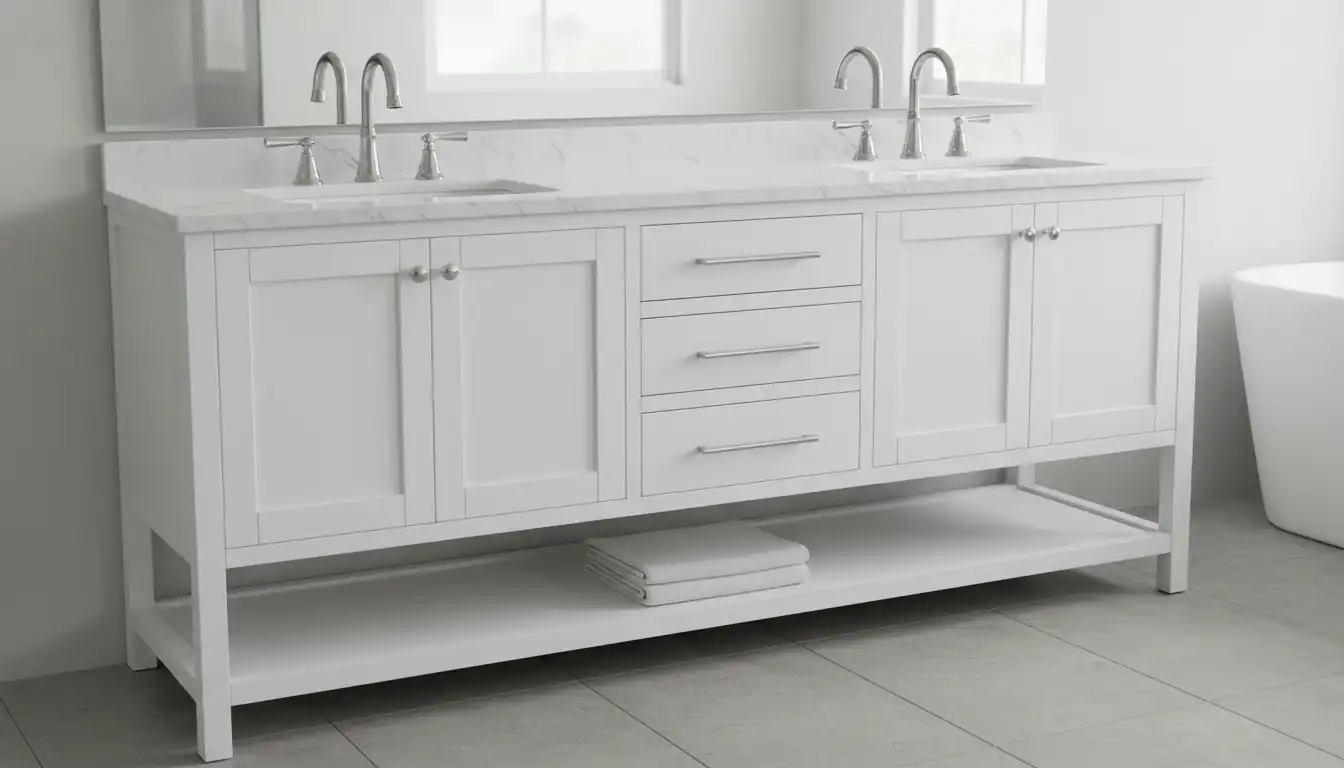
Step 4: Mark the Sink Centerlines
Based on your chosen center-to-center distance, measure out from the vanity’s central mark. For a 36-inch spacing, you would measure 18 inches to the left and 18 inches to the right of your center mark. These two new marks represent the exact centerlines for your two sinks.
Step 5: Create a Template and Visualize
This is the most critical step to avoid regret. Use the cardboard box your sink came in to trace and cut out a template of the sink’s top profile. Place these templates on the vanity, centered on your pencil marks.
Stand in front of the mock-up. Go through the motions of your daily routine. Does it feel comfortable? Is there enough room? This real-world visualization allows you to catch any potential issues before the countertop is irreversibly cut.
Factors That Can Change the “Standard” Spacing
The 36-inch guideline is a fantastic starting point, but it’s not a universal law. Several factors can and should influence your final decision to create a truly custom and optimized space.
The Size and Shape of Your Sinks
The physical dimensions of your sinks are a major consideration. Large, rectangular undermount sinks take up more space than smaller, oval drop-in models. With oversized sinks, you may need to slightly reduce the center-to-center distance to 32 or 34 inches to ensure there is enough counter space at the vanity’s edges.
Always leave at least 4-5 inches from the side of the sink bowl to the edge of the vanity top. This prevents water from easily splashing over the side and gives you a usable sliver of counter space.
| Spacing Profile | Center-to-Center | Shared Middle Space | Pros & Cons |
|---|---|---|---|
| Minimum Clearance | 30-32 inches | Maximum | Pro: Maximizes shared counter space for trays, decor. Con: Can feel cramped for two users simultaneously. |
| Industry Standard | 36 inches | Balanced | Pro: The ideal balance of personal and shared space. Con: May not be optimal for unusually large or small sinks. |
| Maximum Comfort | 38-40 inches | Minimum | Pro: Provides a luxurious amount of personal space. Con: Reduces the central shared area significantly. |
Your Choice of Faucets: Deck-Mounted vs. Wall-Mounted
Your faucet selection has a direct impact on sink placement. Standard deck-mounted faucets, especially widespread models with separate handles, require significant space on the countertop behind the sink.
If you are tight on space or want a cleaner look, consider wall-mounted faucets. By moving the fixtures off the counter and onto the wall, you free up valuable real estate, potentially allowing for larger sinks or more flexible placement. Just ensure your plumbing plan accounts for this from the start of the project.
Cabinet and Drawer Configuration Below
Never approve a countertop cut without first inspecting the cabinet below. The sink basin and its plumbing must fit without obstruction. A central stack of drawers in your vanity will almost certainly dictate that the sinks be pushed further apart.
Open the cabinet doors and look for vertical supports or drawer boxes that will interfere with the sink bowls and p-traps. Your sink placement must work in harmony with the vanity’s structure. Getting small details like this right is as important as ensuring your Whirlpool fridge doors are not flush; precision is key in home maintenance.
Maximizing Usable Counter Space
Think of your 72-inch vanity not as one long surface, but as three functional zones. You have two primary “user zones” around the sinks and one shared “central zone” in the middle. The goal of proper spacing is to optimize all three.
The user zones need to be large enough for personal items currently in use (toothbrush, soap, etc.). The central zone is perfect for items that are shared or need to be accessible to both people, like a soap dispenser, a decorative tray, or a vase of flowers. Adjusting the sink spacing by even a few inches can dramatically alter the utility of these zones.
Common Mistakes to Avoid When Spacing Vanity Sinks
A successful installation is as much about avoiding errors as it is about following guidelines. Be mindful of these common pitfalls.
Placing Sinks Too Close to the Edges
This is a frequent mistake made to maximize the central counter area. However, it makes the user feel hemmed in against a wall and dramatically increases the likelihood of water splashing onto the floor and surrounding surfaces. It can also make cleaning the sides of the vanity top difficult.
Placing Sinks Too Close Together
While this maximizes space on the outer edges, it defeats the primary purpose of a double vanity. It creates the “elbow-bumping” scenario and functionally turns the large vanity into a slightly oversized single-user space. Two people simply cannot use it comfortably at the same time.
Ignoring the Plumbing Layout
Remember that each sink needs its own drain assembly. When sinks are too close, their plumbing can interfere with each other, making installation a nightmare for your plumber. It is wise to consider the entire home’s systems, just as you would if you found your Liftmaster gate opening by itself; understanding the mechanics prevents problems.
Forgetting About Mirrors and Lighting
The sinks are just one part of the overall vignette. Their placement must align with the mirrors and vanity lights above them. A sink that is off-center to its corresponding mirror or light fixture will create a jarring visual imbalance that detracts from the entire bathroom’s design. Plan these elements together as a cohesive system.
Final Spacing Recommendations for Your 72-Inch Vanity
For the vast majority of bathrooms, placing the sink centerlines 36 inches apart on a 72-inch vanity is the gold standard. This layout provides an 18-inch clearance from each side to the sink’s center, creating a perfectly balanced and highly functional space.
However, the most important takeaway is to plan and visualize. Use templates to mock up the layout on your actual vanity top before any cuts are made. Consider your specific sinks, faucets, and cabinetry. This final check ensures that the result of your project is a space that is not only beautiful but perfectly tailored to your daily life. Taking time for these details is part of good home stewardship, much like knowing how to clean yellowed plastic bathtub jets to keep fixtures looking their best.
