
Freezer Stopped Working in Cold? The Surprising Reason & Fix
It’s a frustrating and seemingly illogical problem. You walk into your cold garage during a winter snap, open your freezer expecting solidly frozen goods, and are met with soft ice cream and thawing meat. It defies common sense: how can a freezer stop working when it’s already surrounded by cold air?
This situation is more common than you might think, and it leaves many homeowners confused and worried about hundreds of dollars in spoiled food. The answer isn’t a faulty freezer but a fundamental misunderstanding of how these appliances are designed to operate.
You'll Learn About
Why Your Freezer Hates the Cold: The Ambient Temperature Problem
A freezer’s primary job is not to create cold but to move heat. It pulls warmth from its insulated interior and transfers it to the outside air. This process relies on a component that most people are unaware of: the ambient air temperature sensor.
Most standard freezers, especially those that are part of a refrigerator-freezer combination, have a single thermostat located in the refrigerator section. This thermostat measures the surrounding air temperature to decide when to turn on the compressor—the heart of the cooling system. When the garage or basement temperature drops below a certain point, often around 40°F (4°C), the thermostat is tricked into thinking the appliance is already cool enough and doesn’t signal the compressor to run.
The Domino Effect on Your Frozen Goods
While the refrigerator compartment might stay at a safe temperature due to the cold garage air, the freezer suffers. Without the compressor running, the freezer compartment slowly warms up to the same temperature as the garage. If the garage is 35°F, your freezer will also be 35°F—far too warm to keep food safely frozen.
This is the central paradox: the very cold that you think should help your freezer is actually preventing it from doing its job. It’s a design feature intended for the stable environment inside your home, not the fluctuating temperatures of an unheated outbuilding.
The Science Behind the Shutdown: Compressor and Lubricant Issues
Beyond the thermostat confusion, there’s another critical mechanical issue at play. The compressor requires a special oil to keep its moving parts lubricated. In extremely cold temperatures, this oil can thicken and become viscous, much like molasses in winter.
When the compressor tries to start with thick, sluggish oil, it strains the motor. This can lead to overheating and cause the compressor’s overload protector to trip, shutting the unit down to prevent damage. In the worst-case scenario, repeated attempts to start under these conditions can lead to permanent compressor failure.
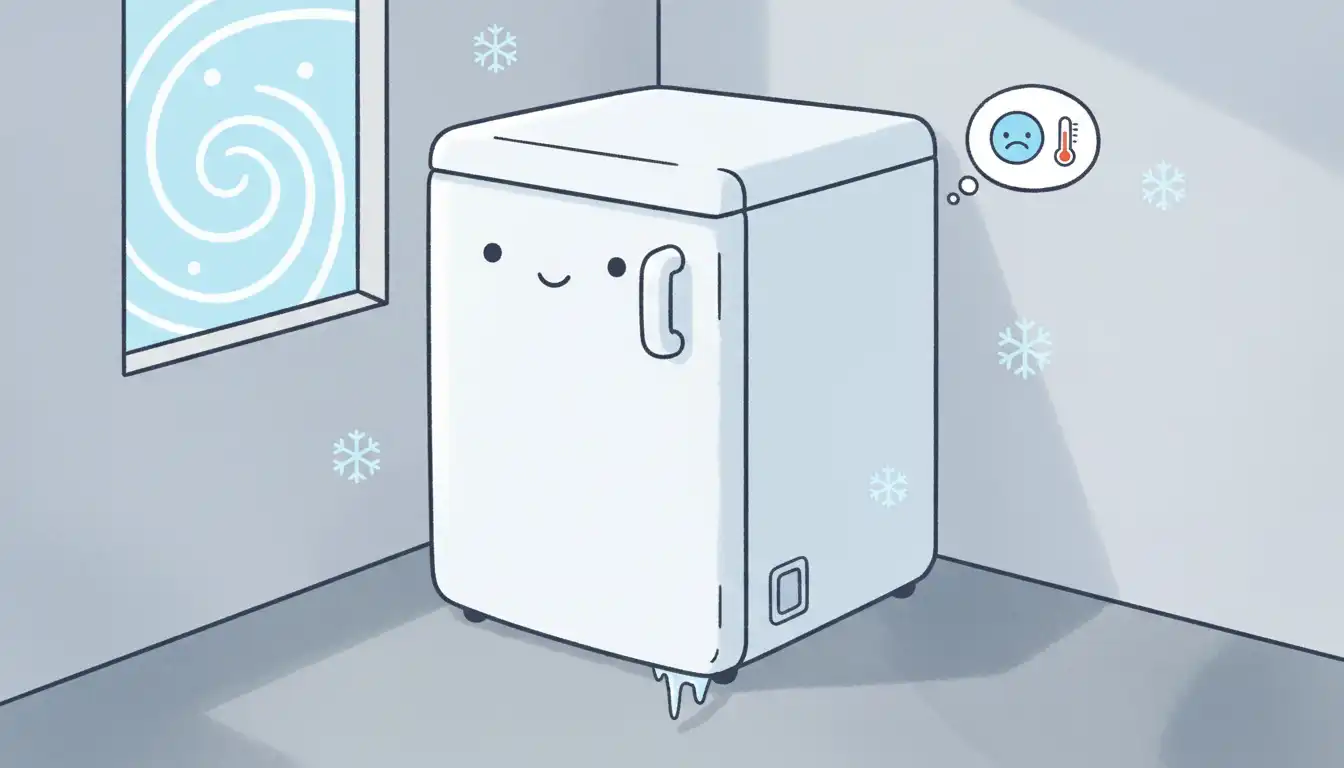
Is Your “Garage-Ready” Freezer Actually Ready?
Appliance manufacturers are aware of this cold-weather problem. In response, they have developed “garage-ready” freezers. These models are specifically engineered to function in a much wider range of ambient temperatures, typically from 0°F to 110°F (-18°C to 43°C).
These specialized freezers often include built-in heaters for the thermostat or compressor oil, more robust insulation, and advanced sensors that ensure the compressor runs when needed, regardless of the external cold. If you plan to keep a freezer in an unheated space, investing in a model explicitly labeled “garage-ready” is the most reliable long-term solution.
Step-by-Step Troubleshooting: What to Do When Your Freezer Quits
If you find your garage freezer has stopped working, don’t panic. Follow these logical steps to diagnose the problem and find a solution before your food thaws completely.
Step 1: Check the Obvious. Before assuming the cold is the culprit, ensure the freezer is plugged in and the outlet has power. Check your home’s circuit breaker to make sure it hasn’t tripped.
Step 2: Assess the Ambient Temperature. Use a simple thermometer to measure the air temperature in your garage or basement. If it’s below 40°F (4°C), the ambient cold is the likely cause of the shutdown.
Step 3: Listen for the Compressor. Get close to the back of the freezer and listen. Do you hear a faint hum or a click every few minutes? A clicking sound may indicate the compressor is trying to start but can’t due to thickened oil.
A Temporary Fix: The Light Bulb Trick
For refrigerator-freezer combination units, there’s a well-known temporary solution. Placing a low-wattage incandescent light bulb inside the refrigerator section can generate just enough warmth to trick the thermostat into thinking it needs to cool down. This, in turn, will activate the compressor and cool the freezer. However, this is an emergency measure and not a safe or efficient long-term fix.
Long-Term Solutions for a Freezer in a Cold Space
To prevent your freezer from failing every winter, you need a more permanent strategy. Depending on your situation and budget, several effective options are available.
Solution 1: Relocate the Freezer. The simplest, though not always most practical, solution is to move the appliance to a heated area of your home, like a basement or utility room, where the temperature remains stable.
Solution 2: Insulate the Space. Improving the insulation in your garage can help keep the ambient temperature above the critical 40°F threshold. This also provides the added benefit of making your garage more comfortable and energy-efficient year-round.
Solution 3: Install a Garage Kit. For some freezer models, manufacturers sell a “garage kit.” This is essentially a small, purpose-built heater that attaches to the thermostat, warming it just enough to ensure the compressor cycles correctly in cold weather. Check your freezer’s manual or the manufacturer’s website for compatibility.
Choosing the Right Garage-Ready Freezer
If you’re buying a new freezer for your garage, selecting a garage-ready model is essential. These units provide peace of mind and are built to handle the job. Here are some features to compare.
| Feature | Standard Freezer | Garage-Ready Freezer | Why It Matters |
|---|---|---|---|
| Operating Temperature Range | Typically 50°F to 100°F | Typically 0°F to 110°F | Ensures the freezer functions correctly in unheated spaces during all seasons. |
| Thermostat Design | Single sensor (often in fridge) | Dual sensors or internal heater | Prevents the thermostat from being tricked by cold ambient air. |
| Compressor Lubricant | Standard oil | Cold-weather formula | Prevents oil from thickening and allows the compressor to start reliably in the cold. |
| Insulation | Standard | Often thicker and more robust | Helps maintain a stable internal temperature against extreme external heat or cold. |
Beyond the Freezer: Other Cold-Weather Appliance Woes
Your freezer isn’t the only appliance that can struggle in the cold. The same principles apply to other machinery you might keep in the garage. For instance, even a robust piece of equipment like a snowblower requires proper maintenance and the correct fuel mixture to start reliably in frigid temperatures. You can learn more about preparing your John Deere snowblower for winter to avoid startup issues.
Inside your home, components of sophisticated appliances can also be sensitive. If your refrigerator’s ice maker suddenly stops working, it could be due to a variety of issues, from a frozen water line to a faulty sensor. If you have a Liebherr model, this guide on a Liebherr refrigerator ice maker not working can help you troubleshoot. Furthermore, extreme temperature fluctuations can even impact home finishes; for example, protective coatings on hardwood floors can sometimes fail, an issue similar to Bona Traffic HD peeling, where environmental factors play a key role.
Preventative Maintenance: Keeping Your Freezer Happy All Winter
A little bit of care goes a long way in ensuring your freezer operates efficiently, regardless of its location. Regularly clean the condenser coils on the back or bottom of the unit to allow for proper heat exchange. Check the door seals to ensure they are tight and not letting cold air escape.
Finally, keep an eye on the freezer’s contents. If you notice food items are softer than usual or covered in excessive ice crystals, it could be an early warning sign of a temperature regulation problem. Addressing it early can save you from a major food loss event.
The Final Word on Cold-Weather Freezer Failure
The mystery of a freezer failing in the cold is ultimately a problem of design meeting an unintended environment. Standard freezers are built for the climate-controlled comfort of a modern home. When placed in an unheated garage, their thermostats get confused, and their mechanical parts can struggle.
By understanding why this happens, you can take the right steps—whether it’s a temporary fix, a long-term relocation, or an upgrade to a garage-ready model. With the right knowledge and the right appliance, you can confidently store your frozen goods all year long, no matter how cold it gets outside.
