
Bosch Warming Drawer Problems Solved: Your Ultimate Fix-It Guide
A Bosch warming drawer is a touch of luxury in any modern kitchen. It’s the secret weapon for effortless entertaining, keeping dishes at the perfect temperature until the moment they’re served. But when this convenient appliance stops working, it can quickly disrupt the harmony of your culinary space.
That feeling of frustration is common. You expect seamless performance, and instead, you’re faced with a drawer that won’t heat, a light that blinks mysteriously, or a mechanism that’s stubbornly stuck. This guide is designed to walk you through the most common Bosch warming drawer problems, providing clear, actionable solutions to restore this essential appliance to its full glory.
You'll Learn About
Is Your Bosch Warming Drawer Failing to Heat?
The most fundamental issue is a warming drawer that doesn’t warm. When your plates remain cold and your carefully prepared meals lose their heat, it’s time to investigate. The cause is often simpler than you might think.
Before diving into complex components, always start with the most basic potential points of failure. This systematic approach saves time and can often lead to a quick resolution without needing to disassemble the unit.
The Power Supply: A Simple First Check
The first step in any appliance troubleshooting is confirming it has power. It may seem obvious, but a tripped breaker is a frequent culprit behind a non-functional warming drawer. Locate your home’s main electrical panel and check if the circuit breaker connected to the kitchen has tripped.
If the breaker is in the “on” position, the next step is to verify the outlet itself. If possible and safe to do so, unplug the warming drawer and test the outlet with another small appliance, like a lamp or a phone charger, to confirm it is supplying electricity.
Decoding the Thermostat and High-Limit Switch
If power is flowing to the unit but it still won’t heat, the problem often lies within its temperature regulation system. The two key components here are the thermostat and the high-limit switch. The thermostat is responsible for cycling the heat on and off to maintain your desired temperature.
The high-limit switch, on the other hand, is a safety device. It’s designed to shut off power to the heating element if the drawer gets dangerously hot, preventing overheating. If either of these components fails, the heating element will not receive the power it needs to operate.
The Hidden Culprit: The Heating Element
At the core of your appliance is the heating element itself. This component is a resistor that glows hot when electricity passes through it, generating the warmth needed to keep food ready to serve. Over time, these elements can burn out or develop a break in their internal wiring.
A visual inspection may sometimes reveal a blister or a visible crack on the element’s surface. For a definitive diagnosis, you can test the element for continuity using a multimeter. A lack of continuity indicates that the element is broken and must be replaced.
The Mystery of the Blinking Indicator Light
A blinking indicator light on your Bosch warming drawer is more than just an annoyance; it’s a diagnostic signal. The specific pattern or color of the light can often tell you exactly what is wrong with the appliance, pointing you in the direction of the faulty component.
Ignoring this signal or simply assuming the bulb is bad can lead to overlooking the root cause of the problem. Understanding these codes is essential for efficient and accurate troubleshooting.
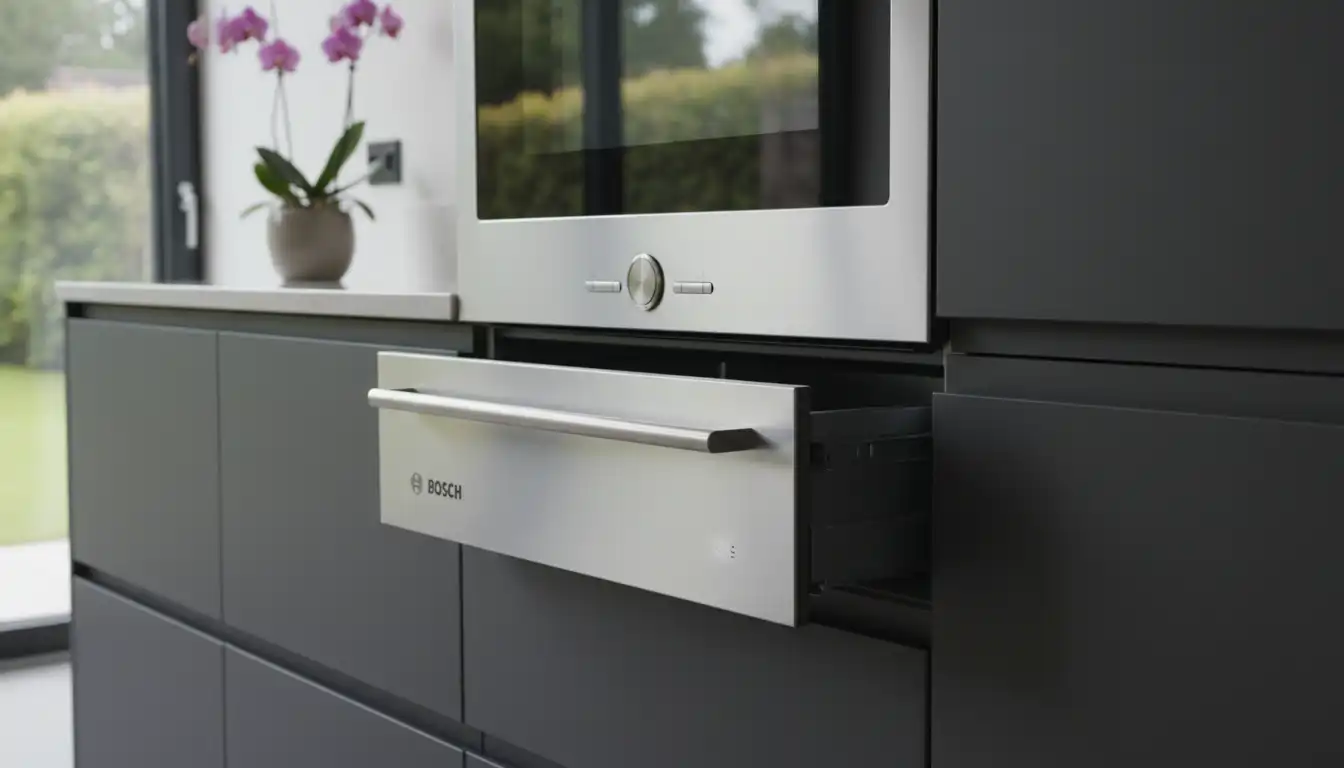
What Different Light Patterns Mean
Bosch engineers its appliances to communicate with the user. While error codes can vary slightly between models, certain patterns are common. A light that fails to illuminate at all often points back to a primary power issue or a faulty control board.
Conversely, a light that stays on but is accompanied by a lack of heat typically points toward a failed heating element or thermostat. A blinking light is often an alert for a more specific error, such as a faulty sensor or a control board malfunction. Consulting your owner’s manual can provide model-specific information.
| Indicator Light Behavior | Potential Problem | Recommended Action |
|---|---|---|
| No Light | No power to the unit or faulty control board. | Check circuit breaker and outlet; inspect the main control board for signs of damage. |
| Light is On, No Heat | Failed heating element, thermostat, or high-limit switch. | Test the heating element and thermal switches for continuity with a multimeter. |
| Light is Blinking | Control board error, faulty temperature sensor, or door latch issue. | Perform a hard reset by turning off power for 5 minutes. If blinking persists, check sensor and latch connections. |
| Light Works Intermittently | Loose wiring connection or failing control board. | Disconnect power and inspect all wiring harnesses for secure connections. |
When to Suspect the Control Board
The electronic control board is the brain of your warming drawer. It processes inputs from the thermostat and sensors and sends commands to the heating element and indicator lights. When you experience erratic behavior, such as flickering lights, inaccurate temperatures, or a complete lack of response, the control board is a prime suspect.
Inspecting the board for visible signs of damage, like burn marks or blown capacitors, can confirm a failure. Replacing a control board is a more advanced repair that requires careful handling of electronic components.
Tackling Mechanical Failures: When the Drawer Sticks or Won’t Close
Not all Bosch warming drawer problems are electrical. Sometimes, the issue is purely mechanical. A drawer that refuses to open smoothly, gets stuck, or won’t close properly can be just as frustrating as a unit that doesn’t heat.
These issues are typically caused by problems with the drawer slides, the latch assembly, or even the surrounding cabinetry. A careful inspection is usually all that is needed to identify the source of the friction.
Inspecting the Drawer Slides and Rails
The drawer operates on a set of telescoping slides or rails. Over time, these can become clogged with crumbs and spilled food, or they can be knocked out of alignment. This debris can cause the drawer to stick or become difficult to operate.
Fully extend the drawer and carefully lift it off its rails according to your model’s instructions. Thoroughly clean the slides with a degreaser and a cloth, removing any obstructions. Applying a small amount of food-grade lubricant to the ball bearings can restore smooth operation.
The Latch Assembly: A Common Point of Failure
The latch mechanism is what holds the warming drawer securely closed. This assembly can become misaligned or worn out from repeated use, preventing the drawer from shutting properly or from opening when commanded. Check to see if the latch is bent or if any screws have come loose.
In many cases, simply tightening the mounting screws can resolve the issue. If parts of the plastic or metal latch are visibly broken, the entire assembly will need to be replaced to ensure the drawer stays closed and maintains the correct temperature.
Beyond the Obvious: Cabinetry and Installation Issues
One of the most overlooked causes of a sticking warming drawer is the installation environment itself. For the drawer to function correctly, the unit must be perfectly level and square within its cutout in your cabinetry. Over time, a house can settle, or the cabinetry can shift slightly, putting pressure on the warming drawer’s frame.
This external pressure, known as torsion, can warp the chassis just enough to cause the drawer glides to bind. Use a level to check that the unit is still installed correctly, both front-to-back and side-to-side. Shimming the unit to make it level can often instantly solve a persistent sticking problem.
Advanced Troubleshooting: Temperature and Calibration Secrets
Sometimes the warming drawer technically works, but not correctly. You may find that the “low” setting is too hot, drying out your bread rolls, or the “high” setting isn’t warm enough to keep soup piping hot. This indicates a temperature accuracy and calibration problem.
This issue can be more subtle than a complete failure but is critical for the appliance’s core function. Restoring accurate temperature control is key to getting the most out of your Bosch warming drawer.
How to Test Your Warming Drawer’s True Temperature
To address a temperature problem, you first need to quantify it. Do not rely on feel alone. Place a reliable, oven-safe thermometer in the center of the empty warming drawer, being careful not to let it touch the metal surfaces.
Set the drawer to a medium temperature setting. Let it preheat for at least 20 minutes, allowing the temperature to stabilize. Compare the reading on your thermometer to the setting you selected. A significant discrepancy of more than 15-20 degrees Fahrenheit indicates a calibration issue.
Calibrating Your Bosch Warming Drawer Thermostat
Many Bosch models have a hidden feature that allows for thermostat calibration. This process allows you to offset the temperature to match the actual performance. The adjustment is typically made via a small screw on the thermostat’s control shaft, located behind the temperature control knob.
After removing the knob, you may see a small screw that can be turned. A clockwise turn usually increases the temperature, while a counter-clockwise turn decreases it. Make very small adjustments at a time—no more than a 1/8 turn—and re-test the temperature until it is accurate.
Proactive Care: Preventing Bosch Warming Drawer Problems Before They Start
The best way to deal with appliance problems is to prevent them from happening in the first place. A routine of simple maintenance and proper use will extend the life of your Bosch warming drawer and ensure it is always ready when you need it.
Taking a proactive approach not only saves you from the inconvenience of a breakdown but also protects your investment. A few minutes of care every month can prevent a costly repair bill down the road.
The Importance of Regular Cleaning
Regular cleaning is the most effective form of preventative maintenance. Spilled food and grease can build up, not only creating an unsanitary environment but also interfering with the mechanical components. Wipe down the interior of the drawer after each use once it has cooled.
Pay special attention to the drawer glides and the gasket around the drawer opening. A clean gasket ensures a proper seal, which is critical for maintaining consistent temperature and efficiency.
Understanding Proper Usage and Load
While robust, a warming drawer has its limits. Avoid overloading the drawer with too many heavy dishes, as this can put a strain on the drawer slides and cause them to fail prematurely. It’s also important to ensure proper airflow around the dishes.
Do not stack plates or containers so tightly that air cannot circulate. This can create hot and cold spots within the drawer, leading to uneven warming. Using the provided rack can help improve circulation and performance.
Recognizing When to Call a Professional
DIY repairs can be empowering, but it is crucial to know your limits. If you encounter issues involving complex wiring, see sparks, smell burning plastic, or are simply uncomfortable with any step of the troubleshooting process, it is time to call a qualified service technician.
Your safety is the top priority. A professional has the tools, training, and experience to safely diagnose and repair complex electrical and control board issues, ensuring the job is done correctly.
Keeping Your Kitchen in Perfect Harmony
A functional Bosch warming drawer is a cornerstone of a well-equipped and efficient kitchen. While encountering problems can be disheartening, most issues are readily solvable with a bit of systematic investigation and basic maintenance. From simple power checks to cleaning mechanical slides, you now have the knowledge to tackle the most common failures.
Maintaining all your appliances ensures a seamless culinary experience. A well-kept warming drawer complements a high-performance kitchen, whether you’re using a state-of-the-art range or deciding between leading appliance brands. If you’re currently upgrading, you might find our Fisher Paykel induction range review helpful. Ultimately, understanding the nuances of your appliances is key, much like the considerations in the great Dacor vs Thermador debate.
