
Bathroom Off Kitchen: Smart Design Solutions for Privacy, Hygiene, and Value
One of the most controversial floor plan features in modern and historic homes alike is the bathroom located directly off the kitchen. Homeowners often struggle with the awkwardness of having a powder room just steps away from where food is prepared and consumed. This layout raises valid concerns about hygiene, privacy, and social comfort during gatherings.
The proximity can make guests feel self-conscious and can dampen the appetite of those dining nearby. However, structural changes are not always feasible due to budget or load-bearing wall constraints. Fortunately, there are effective ways to mitigate these issues without tearing down walls.
A bathroom located directly off the kitchen presents unique challenges regarding privacy and hygiene, but these can be effectively managed by installing solid-core doors, upgrading ventilation to create negative air pressure, and utilizing sound-dampening materials to isolate the two spaces.
By addressing sightlines, sound transmission, and air quality, you can transform this awkward arrangement into a functional and discreet part of your home. This guide explores the root causes of the discomfort and provides actionable, expert-level solutions to reclaim your kitchen’s ambiance.
You'll Learn About
The Core Issues: Why This Layout Feels Wrong
Understanding why a bathroom off the kitchen feels uncomfortable is the first step toward fixing it. The discomfort stems primarily from a clash of functions: one space is for sanitation and waste, while the other is for cooking and eating. Evolutionarily, humans are wired to separate these activities to prevent contamination and disease.
The “yuck” factor is often psychological, but it is grounded in the reality of the “toilet plume.” When a toilet is flushed without the lid down, microscopic particles can become airborne. If the bathroom door opens directly into the cooking area, the fear of germs migrating is a genuine concern for many homeowners.
Auditory privacy is another significant pain point. Thin, hollow-core doors often used in construction do little to block sounds. Hearing bathroom noises while chopping vegetables or eating dinner destroys the atmosphere and creates embarrassment for both the user and the listener.
Finally, visual lines of sight play a crucial role. If the toilet is visible from the kitchen island or dining table when the door is ajar, it creates a visual intrusion. Improving this layout requires a multi-faceted approach that tackles sound, sight, and smell simultaneously.
Soundproofing Strategies for Maximum Privacy
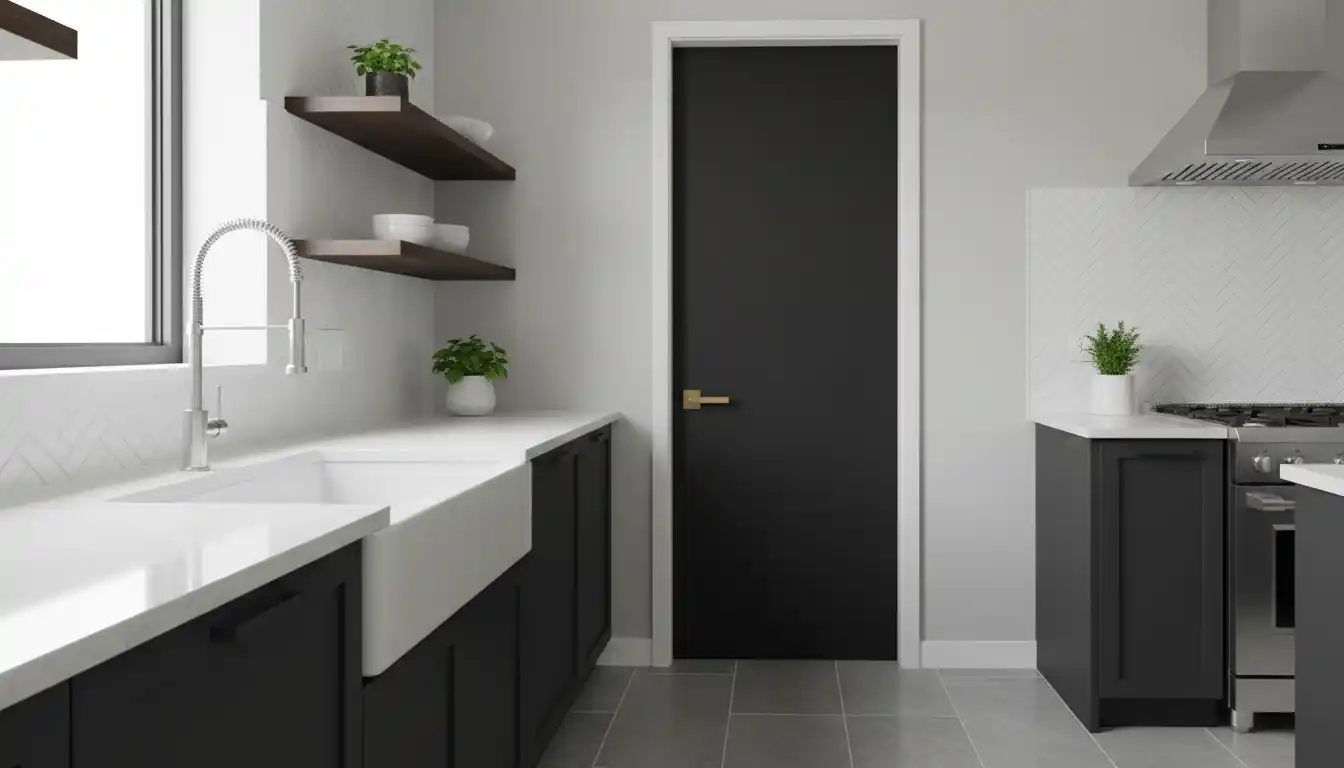
The most immediate and effective upgrade for a bathroom off the kitchen is addressing the door. Most standard interior doors are hollow-core, meaning they are essentially cardboard honeycombs sandwiched between thin wood veneer. These doors act like drums, amplifying rather than blocking sound.
Replacing a hollow-core door with a solid-core wood door is a game-changer. Solid doors have mass, which is the primary requirement for stopping sound waves. This single upgrade can reduce sound transmission by up to 50 percent, providing immediate relief for guests and family members.
However, the door itself is only part of the equation. Sound behaves like water; it will find the smallest gap to escape. The gap at the bottom of the door is the biggest culprit for sound leakage. To fix this, you should install a specialized automatic door bottom.
Unlike a standard sweep that drags on the floor, an automatic door bottom features a mechanism that drops a seal down when the door closes and lifts it when the door opens. This creates an airtight seal that blocks noise effectively. It is a detail often found in hotels but rarely used in residential homes.
Another overlooked aspect of soundproofing is mechanical noise. Just as outdoor equipment requires tuning—like when addressing an Ariens snowblower surging—your bathroom exhaust fan needs to be tuned to the right specifications. A loud fan can actually be beneficial here, acting as a “white noise” generator that masks more embarrassing sounds.
Visual Barriers and Layout Adjustments
If you cannot move the bathroom, you must trick the eye. The goal is to ensure that even when the bathroom door is open, the toilet is not the focal point. If the current swing of the door reveals the toilet immediately, consider changing the hinges so the door swings the opposite way, shielding the view until one is fully inside.
Self-closing hinges are another excellent low-cost investment. These ensure the door never remains invitingly ajar during a dinner party. By keeping the door closed by default, you establish a firm visual boundary between the culinary and sanitary zones.
Creating a transition zone or “vestibule” effect can also help. If space permits, placing a small console table, a tall bookshelf, or a decorative screen between the kitchen work area and the bathroom door creates a psychological buffer. This signals to the brain that one is entering a different zone.
Barn doors have become trendy, but they are often terrible for bathrooms off the kitchen. Because they slide over the opening rather than fitting inside it, they leave large gaps for sound and smells to escape. If you desire privacy, stick to traditional swinging doors or high-end pocket doors with proper sealing hardware.
Ventilation Engineering: Creating Negative Pressure
Smell is the strongest trigger for memory and emotion, and it is the enemy of a kitchen environment. Standard bathroom fans are often underpowered and poorly positioned. To truly isolate a kitchen bathroom, you need to establish negative air pressure.
Negative pressure ensures that when the bathroom door is opened, air is pulled into the bathroom from the kitchen, rather than bathroom air drifting out into the kitchen. This is achieved by installing a high-CFM (Cubic Feet per Minute) exhaust fan that vents directly outdoors.
To test your current fan, hold a piece of toilet paper up to the vent while it is running. If the paper does not stick firmly to the grille, your fan is too weak to protect your kitchen air quality. Upgrading to a fan with at least 80-110 CFM is recommended for powder rooms near living areas.
Furthermore, consider wiring the fan to the light switch or installing a motion sensor. This guarantees that the ventilation system is active whenever the room is in use, removing human error from the equation. A timer switch that keeps the fan running for 10 minutes after the occupant leaves is the gold standard for odor control.
Decor and Psychological Distraction
Design choices can also influence how the proximity of the bathroom is perceived. Use distinct flooring transitions to visually separate the spaces. If the kitchen hardwood flows seamlessly into the bathroom, the two rooms feel like one. A threshold made of stone or tile creates a subconscious “stop” line.
Incorporating greenery is another effective tactic. Plants not only soften the transition but can improve air quality. While avid gardeners might debate questions like is Livingston Seed owned by Monsanto, the focus here is simply choosing robust species like Pothos or Snake Plants that thrive in bathroom humidity and act as visual air cleaners.
Acoustic dampening materials inside the bathroom prevent echoes. A small powder room with tile floors and drywall is an echo chamber. add a plush rug, canvas wall art, and heavy window treatments to absorb sound waves before they can bounce out into the kitchen.
Comparative Solutions: Cost vs. Effectiveness
When deciding how to tackle this problem, it helps to weigh the investment against the potential privacy gain. The following table outlines common solutions, ranging from simple DIY fixes to professional renovations.
| Solution Strategy | Estimated Cost | DIY Difficulty | Privacy Impact |
|---|---|---|---|
| Solid Core Door Upgrade | $150 – $400 | Moderate | High |
| Automatic Door Bottom Seal | $40 – $100 | Moderate | High |
| High-CFM Exhaust Fan | $100 – $300 | High (Electrical) | Medium |
| Self-Closing Hinges | $20 – $50 | Low | Low (Visual only) |
| Relocating Doorway | $1,000 – $3,000 | Professional | Very High |
Resale Value and Real Estate Perception
Homeowners often worry that a bathroom off the kitchen will hurt resale value. While it is true that this is a “functional obsolescence” in real estate terms, it is rarely a deal-breaker if the bathroom is well-appointed and private. A powder room is better than no bathroom on the main floor.
When selling, staging is key. Ensure the door remains closed during showings. Keep the bathroom impeccably clean and free of personal items. The goal is to make the room feel like a high-end boutique hotel amenity rather than a utility closet.
If you have the budget for a remodel, creating a small hallway or moving the door to open into a mudroom or adjacent living area can significantly increase home value. However, if the footprint is fixed, the high-end finishes and soundproofing discussed above can neutralize buyer objections.
Advanced Acoustic Isolation Techniques
Beyond the door, you can address the walls themselves. If you are renovating, consider decoupling the shared wall between the kitchen and bathroom. This involves using staggered studs or resilient channels behind the drywall to break the path of sound vibration.
Adding mass-loaded vinyl (MLV) behind the drywall is another professional recording studio technique that can be applied to your powder room. This dense, flexible material acts as a sound barrier that is far superior to standard insulation.
Even wrapping plumbing pipes in sound-dampening insulation can help. The “whoosh” of water rushing through pipes in the kitchen wall is a tell-tale sign of bathroom usage. Cast iron pipes are quieter than PVC, but wrapping existing PVC pipes can muffle the noise significantly.
The Role of Kitchen Layout
Sometimes the solution lies in the kitchen itself. If possible, orient the active zones of the kitchen away from the bathroom door. Place the pantry or the refrigerator on the wall shared with the bathroom. These large, dense appliances and storage areas act as excellent additional sound buffers.
Avoid placing the main dining table directly in front of the bathroom door. If space is tight, orient the seating so that guests face away from the bathroom. Keeping the bathroom out of the direct line of sight reduces the psychological discomfort for seated guests.
Final Thoughts on Improving Flow
A bathroom off the kitchen does not have to be a design disaster. By treating it as an engineering challenge rather than just a layout flaw, you can dramatically improve the comfort of your home. The secret lies in redundancy: do not rely on just one solution.
Combine a heavy door with a great seal. Pair a loud fan with sound-absorbent decor. Use visual tricks to divert the eye. When you layer these strategies, the proximity of the bathroom becomes a non-issue, allowing you and your guests to enjoy the heart of the home without distraction.
