
60/40 Sink Faucet Placement: The #1 Mistake You Can’t Afford to Make
Choosing a 60/40 split sink seems like a straightforward decision for enhancing kitchen functionality. Yet, this popular choice hides a critical design challenge that many homeowners overlook: proper faucet placement. An incorrectly positioned faucet can turn your dream sink into a daily source of frustration, causing workflow issues, constant splashing, and aesthetic imbalance.
The core problem lies in the sink’s asymmetry. Unlike a standard 50/50 or single-basin sink, the 60/40 design’s offset divider demands a thoughtful approach to where the faucet should be drilled. This single decision impacts ergonomics, cleaning efficiency, and the overall look of your kitchen’s most-used feature.
You'll Learn About
The 60/40 Dilemma: Why Faucet Placement is So Critical
The allure of a 60/40 sink is its versatility. The larger basin is perfect for washing bulky pots and pans, while the smaller one is ideal for food prep or housing the garbage disposal. However, this functional divide creates a placement puzzle. Do you center the faucet on the entire sink, align it with the divider, or position it over one of the basins?
Each option carries significant consequences. Centering it on the overall sink might look symmetrical with the window or cabinets above but can make reaching the smaller basin awkward. Aligning it with the divider is a popular choice, but it can still lead to reach issues depending on your faucet’s spout length. This guide will demystify the options and provide a clear path to the perfect placement for your specific needs.
The Three Primary Faucet Placement Options for a 60/40 Sink
When deciding where to drill the hole in your countertop, you are faced with three main choices. Understanding the pros and cons of each is the key to avoiding costly installation mistakes.
Option 1: Centered on the Divider (The Classic Choice)
Placing the faucet directly in line with the divider between the two basins is the most common and often recommended solution. This position is intended to provide equal access to both the large and small bowls. It’s a functional compromise that serves the dual nature of the sink.
Pros: It offers the most intuitive access to both sinks, allowing the spout to swing easily from one basin to the other. Functionally, it’s often the most practical choice for a balanced workflow.
Cons: This placement is inherently asymmetrical to the overall sink unit and the cabinet below. For those who prioritize visual symmetry, an off-center faucet can be unsettling and appear as a mistake.
Option 2: Centered on the Overall Sink (The Symmetrical Approach)
For homeowners who value visual harmony, centering the faucet on the total width of the sink (from the far-left edge to the far-right edge) is a compelling option. This aligns the faucet perfectly with the center of the sink cabinet and any windows or light fixtures above.
Pros: It delivers a clean, balanced, and aesthetically pleasing look. This is often the preferred choice for kitchens where symmetry is a key design element.
Cons: Functionality can be compromised. With this placement, the faucet spout may struggle to adequately reach the corners of both basins, particularly the smaller one. A faucet with a long pull-down hose becomes almost mandatory.
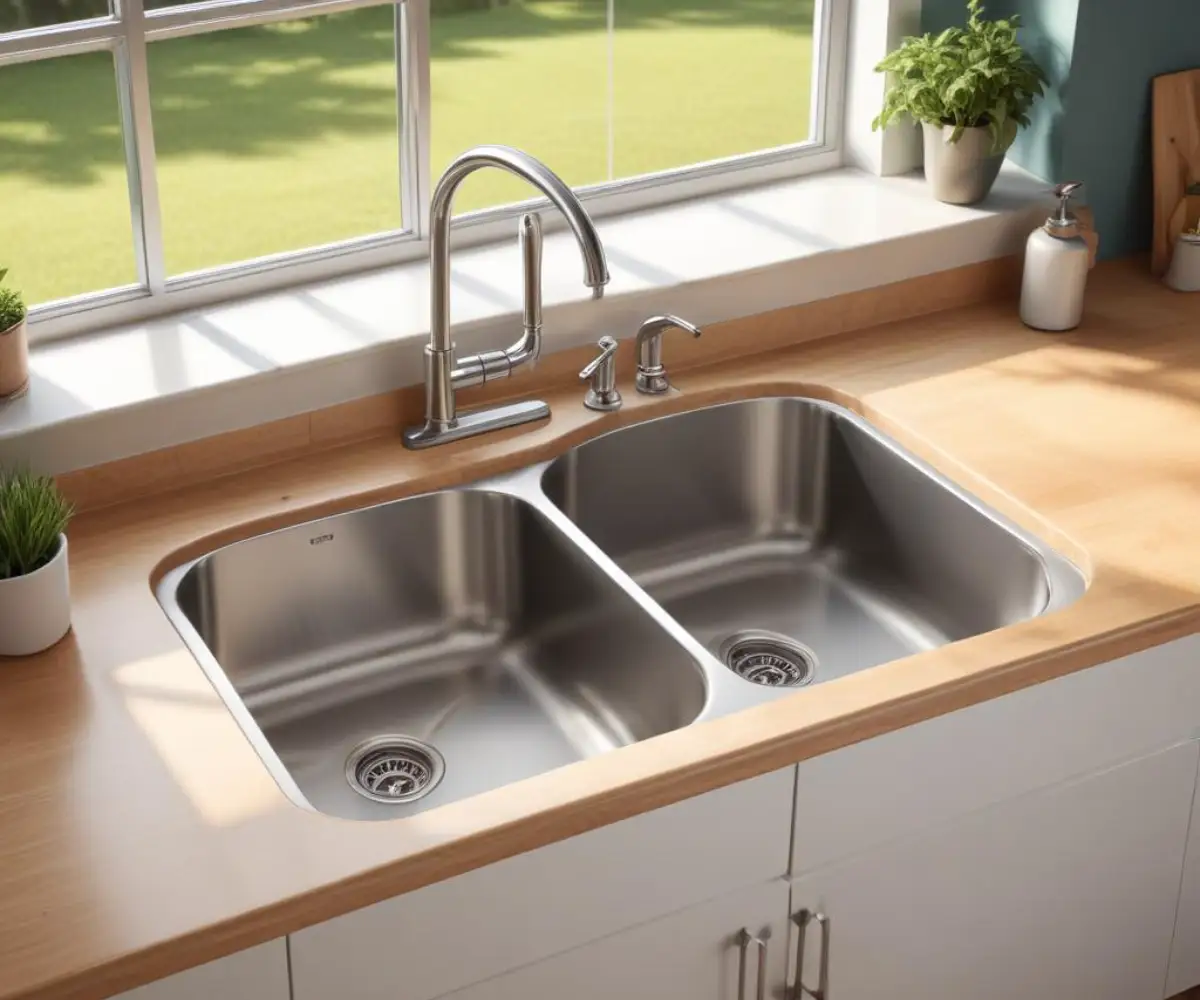
Option 3: Centered Over the Large Basin (The Power-User Placement)
A less common but highly practical option is to align the faucet with the center of the larger (60%) basin. This placement prioritizes the primary workspace, where most of the heavy-duty cleaning and pot-filling will occur.
Pros: This provides optimal access and maneuverability within the larger, most-used basin. It can improve workflow for those who primarily use the large side and treat the smaller side for secondary tasks.
Cons: This is the most functionally limited option for the smaller basin. It almost always requires a faucet with a long pull-down sprayer to service the smaller sink effectively, and aesthetically it is the most asymmetrical choice.
Key Factors You MUST Consider Before Drilling
Your final decision should not be based on aesthetics alone. Several practical factors will determine the most successful placement for your kitchen habits and hardware.
Faucet Type and Spout Reach
The single most important factor is the design of your faucet. A high-arc, gooseneck faucet with a pull-down sprayer offers the most placement flexibility. Its height and extendable hose can compensate for placements that are not perfectly centered over the divider.
Conversely, a faucet with a shorter spout reach severely limits your options. If you have a faucet with limited swivel or no pull-down feature, placing it anywhere other than directly over the divider could render one of the basins difficult to use. Always check your faucet’s spec sheet for its “spout reach” measurement before finalizing placement.
Your Dominant Hand and Workflow
Think about how you naturally work at the sink. Are you right-handed or left-handed? Where is your dishwasher located? Most people develop a workflow, often moving dishes from one side to the other for rinsing and loading.
Typically, the smaller basin is used for food prep and the garbage disposal. Placing the faucet in a way that supports this flow without requiring awkward reaching is crucial for ergonomic comfort. For instance, if your dishwasher is to the right of the sink, you might prefer a setup that makes rinsing in the large basin and scraping into the small basin on the right seamless.
The Hidden Factor: Water Splashing and Containment
One of the most overlooked aspects of faucet placement is its direct impact on splashing. The asymmetrical nature of a 60/40 sink creates unique water dynamics. A faucet placed incorrectly can cause water to hit the sink walls or the divider at an angle that sends splashes all over your countertop and backsplash.
Positioning the faucet so the stream is directed towards the drain in each basin is the goal. Test this by holding the faucet head over the sink before the hole is drilled. Ensure that when it’s pointed at each drain, the handle has full clearance to operate without hitting the backsplash.
Aesthetics and Visual Balance
While function should be the priority, you cannot ignore how the faucet looks. Step back and consider the entire “sink wall.” Does the sink align with a window? Is there a pendant light centered above it? An off-center faucet that is perfectly functional might still look wrong if it breaks a strong visual line.
This is where a compromise might be necessary. Perhaps centering the faucet with the window is paramount, in which case you must select a high-reach, pull-down faucet to ensure it still functions properly.
Comparison of Faucet Placement Options
| Placement Location | Primary Advantage | Primary Disadvantage | Best For |
|---|---|---|---|
| On the Divider | Best overall functionality and reach to both basins. | Creates visual asymmetry with the sink and cabinet. | Users who prioritize function and a balanced workflow. |
| Center of Entire Sink | Aesthetically pleasing and symmetrical. | Can compromise faucet reach into the smaller basin. | Design-focused kitchens with a high-reach, pull-down faucet. |
| Center of Large Basin | Maximizes workspace and control in the primary basin. | Poor accessibility to the smaller basin without a sprayer. | Homeowners who almost exclusively use the large basin for cleaning. |
A Step-by-Step Guide to Marking Your Faucet Position
Once you’ve weighed the options, it’s time to mark the spot. Precision is key, as this is a permanent decision for your countertop.
1. Position the Sink: Place the sink in its final position within the cabinet to ensure all measurements are accurate.
2. Use a Template: Your sink or faucet may have come with a paper template. Use this as your starting guide.
3. Measure and Mark: Using a measuring tape and a pencil, mark your desired centerline—whether it’s the divider, the sink’s overall center, or the large basin’s center.
4. Check Backsplash Clearance: Place the faucet base on your marked spot. Operate the handle fully to ensure it doesn’t hit the backsplash. A minimum of 3 inches of clearance is typically recommended.
5. Confirm Spout Reach: Hold the faucet and swing the spout to all four corners of both basins. If it’s a pull-down model, extend the hose to confirm it reaches everywhere you need it to. Sometimes a minor problem like a kitchen faucet spout that came off can be traced back to the strain of over-extending the hose repeatedly.
Common Mistakes to Avoid
Even with careful planning, errors can occur. Be mindful of these common pitfalls that can lead to regret.
Forgetting Accessories: Are you installing a soap dispenser, water filter tap, or an air switch for the garbage disposal? All these items need their own holes and must be planned in relation to the main faucet. Ensure there is adequate spacing between each element to avoid a cluttered look and allow for easy cleaning.
Ignoring Sink Material: The material of your sink can influence your decision. With some materials, like those found in a Corian sink replacement, you have more flexibility in drilling. However, certain sinks may come with pre-drilled holes, limiting your placement options from the start.
Drilling Too Close to the Sink Edge: There must be enough countertop material between the faucet hole and the sink cutout to ensure structural integrity, especially with heavy stone countertops. Follow the recommendations from your countertop fabricator, which is typically a minimum of 2 inches.
Conclusion: Making the Final Decision for Your Kitchen
The ideal 60/40 sink faucet placement is a balance between function, ergonomics, and aesthetics. There is no single “correct” answer, only the best answer for your specific kitchen, hardware, and habits. The most successful installations come from physically testing the faucet’s reach and operation before any permanent holes are drilled.
By prioritizing spout reach, considering your daily workflow, and being mindful of the visual lines in your kitchen, you can avoid the common mistake of a poorly placed faucet. This thoughtful approach ensures your versatile 60/40 sink lives up to its full potential as a hardworking and harmonious centerpiece of your kitchen. Don’t let a small oversight lead to bigger issues down the line, such as a frustrating leak.
