
4-Inch Mitered Edge Countertop: The #1 Mistake You Can’t Afford
You envision a kitchen anchored by a stunning, substantial island—a thick, luxurious slab of stone that exudes quality and permanence. It’s the centerpiece, the focal point where family gathers and design dreams are realized. The problem arises when you discover the reality of a solid 4-inch stone slab: immense weight requiring reinforced cabinetry, astronomical costs, and limited availability.
This single realization can bring a high-end kitchen renovation to a grinding halt, forcing a compromise on the very feature meant to define the space. Fortunately, there is a fabrication technique designed to solve this exact problem, delivering that coveted, robust aesthetic without the crippling drawbacks. The solution is the 4-inch mitered edge countertop.
You'll Learn About
What Is a Mitered Edge, and Why Is It a Game-Changer?
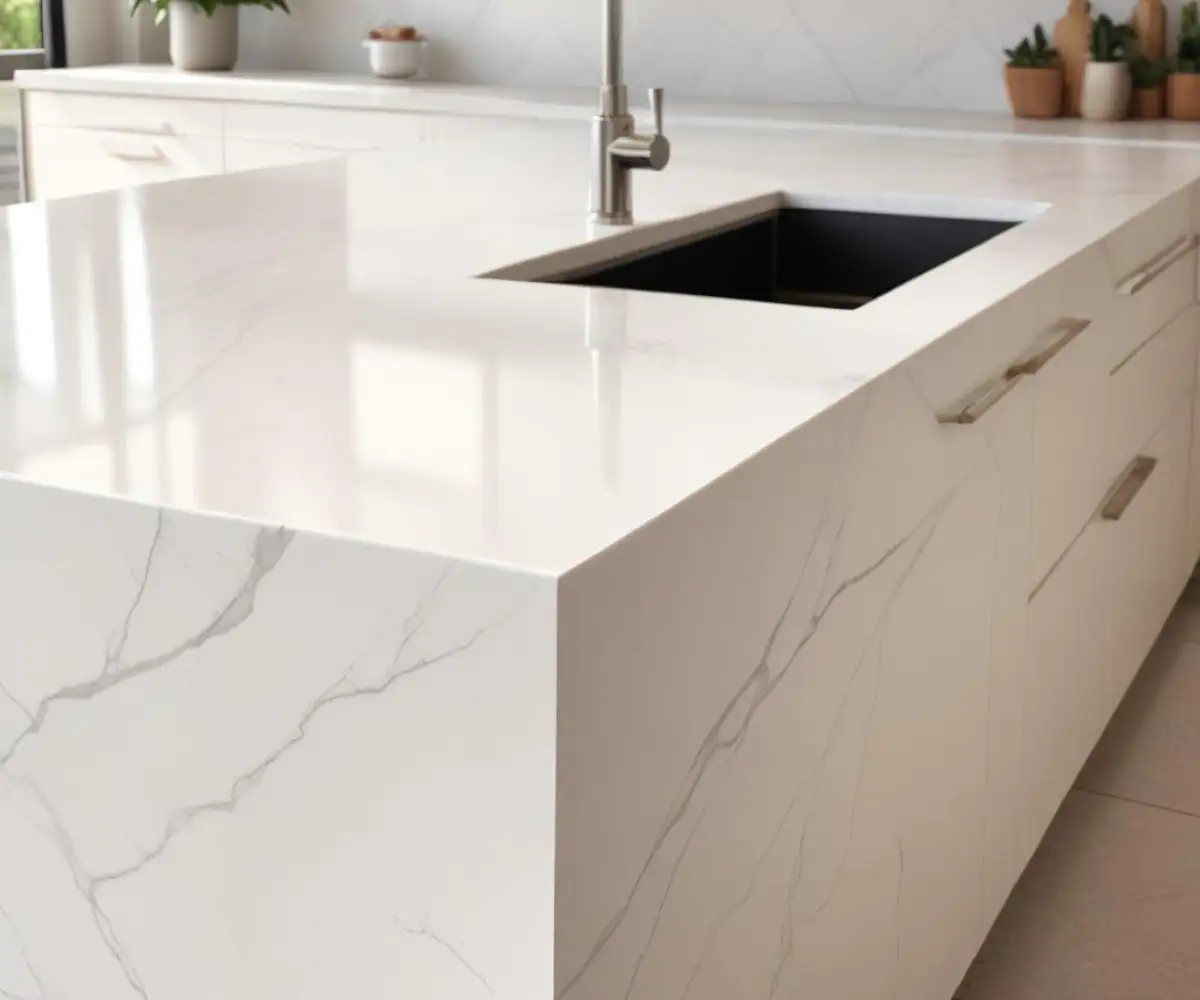
A mitered edge is a sophisticated fabrication method used to create the illusion of a thick, solid slab of stone. It involves cutting the top countertop piece and a separate front “apron” piece at precise 45-degree angles. These two pieces are then joined together with a strong adhesive to form a perfect 90-degree corner.
When executed by a skilled professional, the seam is nearly invisible, making the countertop appear as if it were carved from a single, massive block. This technique is a stark contrast to a simpler “laminated edge,” where a second strip of stone is glued underneath the main slab, leaving a visible horizontal seam that disrupts the flow of the material. The mitered edge preserves the continuity of the stone’s pattern, creating a far more premium and seamless finish.
The Allure of the 4-Inch Profile
While mitered edges can be created at various thicknesses, the 4-inch profile makes a particularly bold statement. It provides a strong, architectural presence that can anchor a large kitchen island or create a dramatic waterfall effect, where the countertop surface appears to flow seamlessly down the sides to the floor. A thick island countertop transforms from a mere work surface into a sculptural element within the room.
This substantial look has become a hallmark of modern luxury design. It conveys a sense of durability, craftsmanship, and high-end quality that a standard-thickness countertop simply cannot match. For homeowners aiming to create a true focal point, the 4-inch depth delivers unmatched visual impact.
The Critical Mistake: Underestimating the Fabricator’s Skill
The single most catastrophic mistake you can make with a 4-inch mitered edge countertop is choosing the wrong fabricator. This is not a standard job. The precision required to cut perfect 45-degree angles, align complex veining, and create a strong, invisible seam is the domain of master craftspeople with specialized equipment. A poor mitered edge is worse than no mitered edge at all.
A flawed execution results in obvious, discolored seams, mismatched patterns, and weak joints that are prone to chipping or separating over time. The entire illusion of a solid slab is shattered, leaving you with an expensive countertop that looks cheap and poorly planned. This is where the dream of a luxury kitchen can turn into a costly nightmare.
How to Vet Your Fabricator Like a Pro
To avoid this critical error, you must become an informed client. Treat the selection of your fabricator with the same importance as the selection of the stone itself. Here are the non-negotiable questions you must ask:
- “Can I see physical examples of your mitered edge work?” Digital photos can be deceiving. Ask to see and touch samples in their showroom or view photos of recently completed projects. Pay close attention to the corner seams.
- “How do you ensure vein matching on the seam?” This is a crucial question for materials like marble, granite, or heavily veined quartz. A top-tier fabricator will use advanced software to map out the cuts on the slab to ensure the pattern flows logically over the edge.
- “What type of adhesive do you use, and how do you color-match it?” The adhesive (epoxy) should be specially formulated for stone and tinted on-site to perfectly match the color and tone of your specific slab. A poorly matched epoxy will create a visible line, no matter how tight the seam.
- “What is your process for reinforcing the mitered joint?” A quality fabricator will often embed support rods and use specialized clamps during the curing process to ensure the joint is as strong as the stone itself.
Do not compromise on this. An experienced fabricator will be proud to explain their process and show off their work. Hesitation or vague answers are major red flags. This edge style demands perfection, and only a dedicated expert can deliver it.
Choosing the Right Material for a Flawless Mitered Edge
While fabricator skill is paramount, the material you choose also plays a significant role in the final outcome. Some materials are inherently better suited for creating invisible seams than others.
Engineered Quartz: Often the best choice for a truly seamless mitered edge. Quartz with fine, consistent patterns or a solid color makes it much easier to hide the seam. The material’s uniformity is a major advantage.
Granite: Can be challenging but spectacular when done right. A skilled fabricator can match the grain and flow of a granite slab, but it requires careful planning. Stones with smaller, more uniform speckles are easier to work with than those with large, unpredictable waves of color.
Marble: Like granite, marble requires an expert hand to match its distinctive veining. When the veins are matched perfectly, the result is breathtaking, as the pattern appears to wrap around the stone. However, any misalignment is immediately obvious.
Ultimately, the cleaner and more consistent the pattern, the easier it is to create an invisible joint. If you have selected a stone with dramatic, sweeping veins, it is absolutely essential that you discuss the seam layout with your fabricator before they make the first cut.
Mitered Edge vs. Other Edge Profiles
Understanding how a mitered edge compares to other options can solidify your decision. While a clean mitered edge offers a sharp, modern aesthetic, other styles create different feelings. For instance, a chiseled edge quartz provides a rustic, organic look that is the complete opposite of the sleek mitered profile. It’s a matter of aligning the countertop’s character with the overall design of your kitchen.
Here is a direct comparison to help you weigh your options:
| Edge Profile | Aesthetic | Cost | Key Feature |
|---|---|---|---|
| 4-Inch Mitered | Modern, Luxurious, Seamless | High | Creates the illusion of a thick, solid slab. |
| Laminated (Built-Up) | Thick Look | Medium | Visible horizontal seam line on the edge. |
| Standard Square/Eased | Simple, Clean | Low | Shows the true thickness of the slab (typically 1.25 inches). |
| Bullnose/Rounded | Traditional, Soft | Low-Medium | Rounded edges that are safer for homes with children. |
Installation and Integration: The Final Steps
The perfect 4-inch mitered edge countertop deserves a flawless installation. The added vertical dimension of the apron means that coordination with your cabinetry is key. The goal is often to have the countertop flush with cabinet doors and drawers for a clean, integrated look.
Discuss the final height and overhang with your cabinet maker and countertop installer beforehand. Proper support is essential. While a mitered edge countertop is lighter than a solid slab, the underlying cabinetry and, in some cases, plywood sub-top must be perfectly level and capable of supporting the weight without sagging over time. Any instability can put stress on the mitered seams, leading to potential failure.
Long-Term Care and Durability
A well-fabricated mitered edge is incredibly durable for everyday use. The primary point of vulnerability is the corner seam, which can be susceptible to chipping from a severe, direct impact. This is another reason why the fabricator’s skill in creating a tight, strong bond is so crucial.
Clean your countertops with pH-neutral cleaners and avoid harsh, abrasive chemicals. While the edge is strong, it’s wise to be mindful of heavy cast iron pots or other hard objects around the sharp corners. With proper care, your 4-inch mitered edge countertop will remain a stunning and durable centerpiece in your home for decades.
Is a 4-Inch Mitered Edge Worth the Investment?
A mitered edge is a premium detail that comes with a higher price tag than standard edges due to the extra material and intensive labor involved. However, it is an investment in high-impact design. It elevates the entire aesthetic of a kitchen, adds significant perceived value, and delivers the luxurious look of a thick slab for a fraction of the cost and weight.
For anyone looking to make their kitchen island a true showpiece, the answer is a resounding yes. By avoiding the critical mistake of choosing an unqualified fabricator and instead investing in true craftsmanship, you ensure that your countertop will be a source of pride and a testament to quality design for years to come.
