
3 Inch Quartz Countertop: The Luxury Look That Can Trap Your Dishwasher
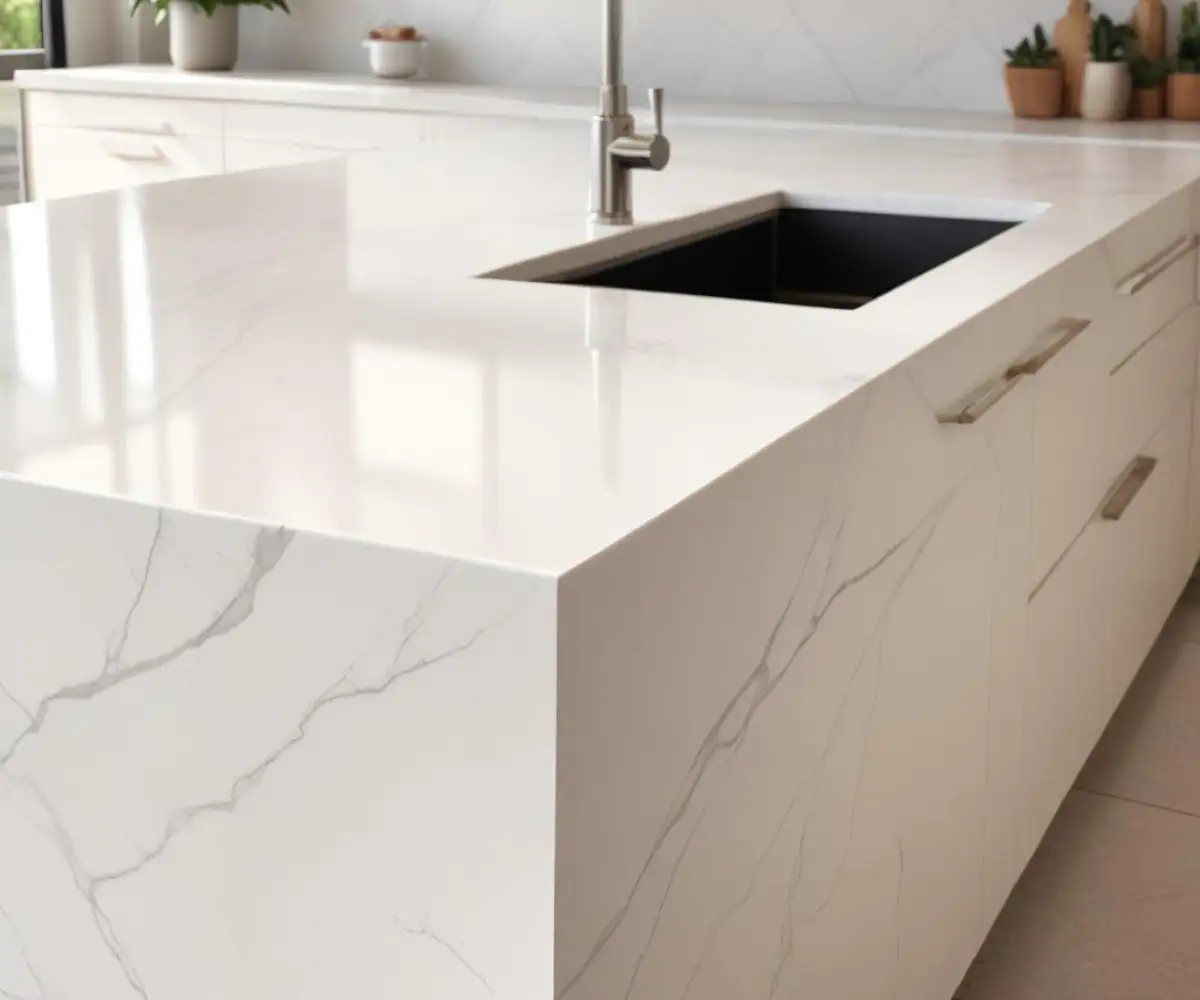
You have seen them in high-end design magazines. Those massive, chunky stone islands that look like they were carved from a single block of granite. This is the 3 inch quartz countertop aesthetic. It screams luxury, modern minimalism, and high budget. But here is the secret: it is almost never a solid slab. It is a masterful optical illusion created by a mitered edge.
While this design choice creates a stunning focal point, it brings a unique set of structural and functional headaches that most homeowners never see coming until it is too late. From dishwashers that no longer fit to cabinet drawers that will not open, the “thick countertop” look requires precise planning that goes far beyond just picking a color.
Before you sign off on that expensive fabrication bid, you need to understand exactly what you are building. This guide breaks down the mechanics, the hidden costs, and the critical clearance issues that can turn your dream kitchen into a renovation nightmare.
You'll Learn About
The Mitered Edge Illusion: What Is It?
Quartz slabs do not come in 3-inch thicknesses. The industry standard is 2cm (approx. 3/4 inch) or 3cm (approx. 1 1/4 inch). To achieve the 3-inch profile, fabricators use a technique called a mitered edge.
They take a standard slab and cut the edge at a precise 45-degree angle. They then cut a second strip of the same stone—called the “apron”—also at 45 degrees. When these two pieces are glued together, the grain wraps seamlessly around the corner, creating the appearance of a solid, heavy block of stone.
This is not just for looks; it hides the plywood underlayment required to support the stone. However, because it is a “fake” thickness, the stone drops down 3 inches on the front face. This drop is where the problems begin.

The #1 Disaster: The Dishwasher Trap
The most common and expensive mistake with 3 inch quartz countertops involves your dishwasher. This is the “new value” insight that many contractors overlook until the stone is already glued down.
Standard base cabinets are 34 1/2 inches tall. A standard dishwasher requires a clearance of roughly 34 inches to slide into its cavity. When you install a standard 3cm countertop, it sits on top of the cabinet, leaving the full opening clear.
However, a 3 inch mitered edge has a “drop apron” that hangs down 3 inches from the top surface. If you simply place this on a standard cabinet, the front edge of the countertop will hang down into the space where your dishwasher door needs to be.
Why This Ruins Kitchens
If the apron hangs down, you effectively lower the clearance height to roughly 31.5 or 32 inches. A standard dishwasher will not fit. You are left with three terrible options:
1. Cut the apron: You cut the beautiful thick edge around the dishwasher, which ruins the seamless “block” look you paid thousands for.
2. Lower the dishwasher: This is often impossible because the dishwasher sits on the subfloor. You cannot lower it into the basement.
3. Raise the countertops: This is the correct solution, but it must be done before fabrication. You must build up the entire plywood sub-top so the bottom of the 3-inch apron sits flush with the top of the cabinet doors, not over them.
For more on how appliance choices impact your stone, read our guide on cooktop decisions, which faces similar clearance issues.
The Hidden Cost of Labor
Many homeowners assume that a 3 inch quartz countertop costs double the price of a standard one because it looks twice as thick. This is incorrect. The material cost is relatively similar because you are essentially using a standard slab plus a small strip for the edge.
The massive price hike comes from labor. A standard polished edge is done by a machine in minutes. A mitered edge requires:
Precision Cutting: The 45-degree cuts must be perfect. If they are off by a fraction of a degree, the seam will be visible or “open,” collecting dirt.
Clamping and Gluing: Fabricators must manually clamp the apron to the deck, apply color-matched epoxy, and wait for it to cure. This slows down production significantly.
Pattern Matching: If you choose a stone with heavy veining, like Quartzmaster Calcutta Grey, the veins must flow from the top surface down the side. This requires the fabricator to cut the slab in a specific way, often wasting material to get the perfect match.
Cabinet and Faucet Conflicts
The dishwasher is not the only victim of the 3-inch drop. Your drawers and faucets are also at risk.
The Top Drawer Problem
If you have “full overlay” cabinets (where the drawer fronts almost touch the top of the cabinet box), a thick drop-edge can block the top drawers from opening. The solution is to install a plywood substrate (usually 3/4 inch or 1 inch thick) on top of your cabinets before the stone arrives.
This lifts the entire stone assembly up. The 3-inch apron then covers the plywood and barely touches the top of the cabinet box, allowing drawers to function freely.
The Short Faucet Shank
When you build up a countertop to look 3 inches thick, the actual deck thickness (where the faucet hole is drilled) might still be 2cm or 3cm, but it often sits on top of plywood.
Some cheap faucets have short threaded shanks designed for stainless steel sinks. They may not be long enough to pass through 3cm of quartz plus 3/4 inch of plywood. Always check your faucet specs to ensure the shank is at least 2.5 to 3 inches long.
Is a 3 Inch Profile Right for You?
To help you decide, here is a comparison of the three most common quartz thickness options.
| Feature | 2cm (Standard Prefab) | 3cm (Standard Slab) | 3 Inch Mitered (Custom) |
|---|---|---|---|
| Visual Weight | Thin, sleek, modern | Substantial, standard | Massive, luxury, block-like |
| Fabrication Cost | Low (often prefab) | Moderate | High (labor intensive) |
| Seam Visibility | Minimal | Minimal | High risk at edge if poor work |
| Support Needed | Plywood required | None (usually) | Plywood buildup essential |
| Appliance Risk | Low | Low | High (Dishwashers/Drawers) |
Structural Support and Overhangs
Even though the 3 inch quartz countertop is hollow in the middle (it is just a skirt), it is still heavy. More importantly, the psychological effect of a thick slab makes people want to lean or sit on it.
If you are planning a large overhang for an island seating area, do not rely on the “thickness” for strength. A mitered edge adds zero structural integrity to the span. It is just glued on. You still need steel support brackets hidden under the countertop if your overhang exceeds 12-14 inches, just like you would with a standard slab.
Be aware that some stones are more prone to issues than others. While quartz is durable, lighter colors can show resin pooling at the mitered seam. If you are considering natural stone alternatives, be sure to read about quartzite discoloration issues that can occur near glued edges.
Frequently Asked Questions About 3 Inch Quartz Countertops
Are 3 inch quartz countertops solid stone?
No, they are rarely solid. Fabricators use a standard 2cm or 3cm slab and attach a mitered “apron” strip to the edge at a 45-degree angle. This creates a hollow box structure that gives the illusion of a solid, 3-inch thick block without the extreme weight or material cost.
How much more does a mitered edge cost?
Expect to pay a premium for labor. While you do not pay for a solid 3-inch slab, the fabrication process is tedious. Cutting precise 45-degree angles, color-matching the epoxy, and clamping the seams can add $1,000 to $2,000+ to your project cost depending on the size of the kitchen.
Will a 3 inch edge chip easily?
Yes, there is a higher risk. To maintain the seamless “block” look, mitered edges are usually kept fairly sharp (an “eased” edge). Sharp corners are more susceptible to chipping from belt buckles or heavy pots than rounded bullnose edges. You must be careful with impact around the sink area.
Do I need to reinforce my cabinets?
Standard cabinets can usually hold the weight because the center is hollow. However, you must install a plywood sub-top (buildup). This is not for weight, but for height. Without this plywood lift, the 3-inch drop apron will hang down over your cabinet doors and prevent them from opening.
Can I use any quartz color for a mitered edge?
Technically yes, but patterns matter. Stones with “movement” or large veins (like Calacatta styles) require vein matching. The fabricator must cut the edge strip from the exact same part of the slab so the vein flows over the edge like a waterfall. Solid colors or fine grains are much easier and cheaper to hide seams.
The Final Verdict
A 3 inch quartz countertop is a stunning design statement that can elevate a kitchen from “builder grade” to “architectural masterpiece.” However, it is not a simple swap. It requires a skilled fabricator, a plywood sub-top plan, and careful calculation of cabinet heights.
Do not let your contractor install the cabinets at standard height without discussing the edge profile first. If you catch the clearance issue early, you can shim the cabinets or adjust the design. If you wait until the stone is installed, you might be washing dishes by hand for a long time.
