
3 Blade Mower Leaving Strips? Fix Your Lawn With These Pro Tips
There is nothing quite as satisfying as looking back at a perfectly manicured lawn, only to have that satisfaction shattered by the sight of thin, uncut strips of grass standing tall in your wake. These “mohawks” or “stingers” are the bane of any homeowner with a large cutting deck. For owners of 3-blade mowers, this issue is particularly frustrating because the complex airflow dynamics of three spinning blades can make troubleshooting feel like a guessing game. You might have sharpened your blades and leveled your deck, yet the strips persist.
The most common cause of a 3-blade mower leaving strips is an incorrect deck pitch (rake), where the front of the deck is not pitched lower than the rear, destroying the vacuum seal needed to lift the grass. However, the issue can also stem from worn blade tips that have lost their overlap length, a warped deck shell causing “dog tracking,” or insufficient engine RPMs failing to generate the necessary air vortex. Solving this requires a systematic approach that goes beyond just checking if the blades are sharp.
You'll Learn About
The Hidden Mechanics of a 3-Blade Deck
To fix the problem, you first need to understand why it happens specifically on 3-blade systems. Unlike a simple push mower, a triple-blade deck relies on precise geometric overlap and orchestrated airflow. The three blades are positioned in a triangular formation, with the center blade usually set slightly forward of the two outer blades. This offset is designed to ensure that as you drive forward, the cutting paths overlap significantly, leaving no grass uncut.
When strips appear, it is almost always a failure of this overlap or the “lift” generated by the blades. If the grass isn’t being sucked up vertically before the metal edge hits it, it will simply be pushed over by the deck’s front lip and pop back up after the mower passes. On a 3-blade deck, the turbulence created by three separate vortexes fighting for air can exacerbate this issue if the deck isn’t perfectly tuned.
The “Phantom” Strip vs. The Uncut Strip
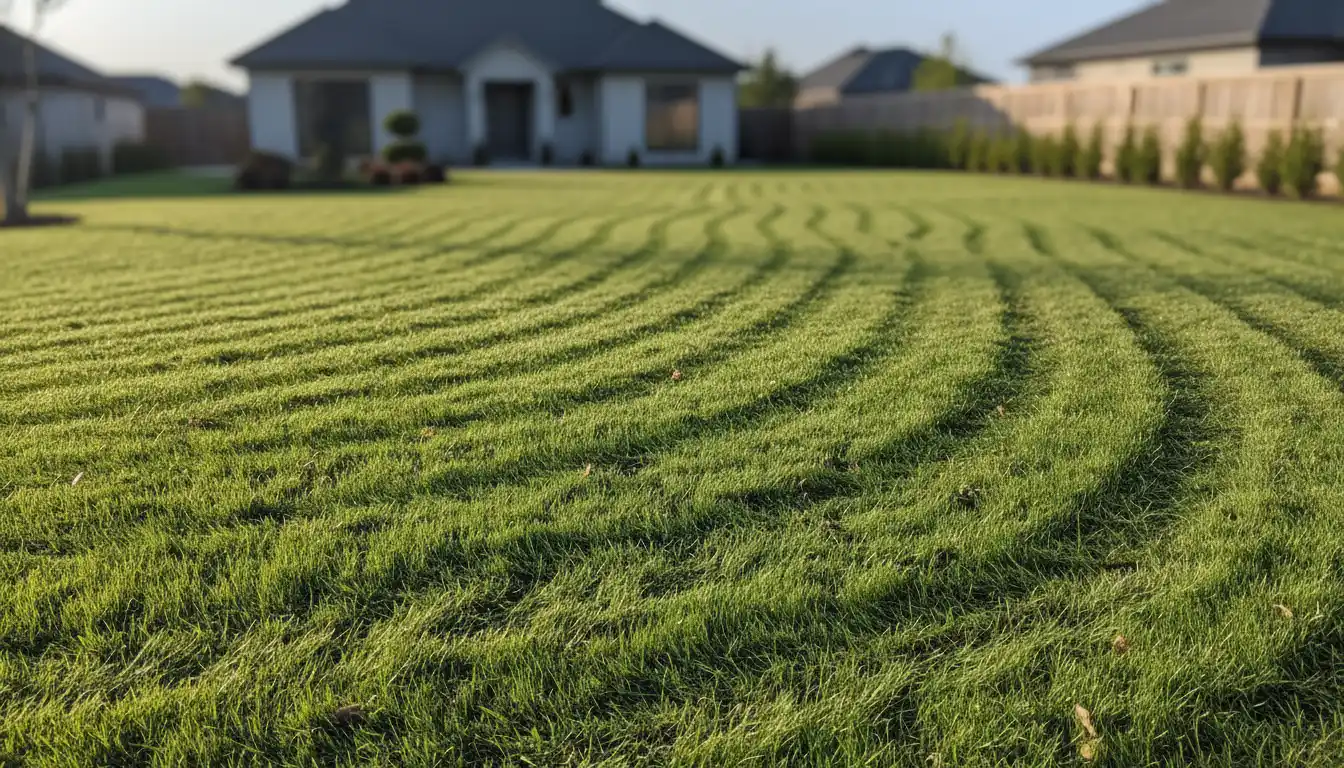
Before grabbing your wrenches, distinguish between two types of strips. A true “uncut strip” is grass that the blade completely missed or folded over. It looks like a thin line of tall grass. A “tire strip” or “phantom strip” is simply grass matted down by the mower’s wheels that didn’t stand back up. If the strip lines up perfectly with your tires, the issue might be ground speed or grass moisture. If the strip appears between the center and outer blades (the “overlap zone”), you have a mechanical or calibration issue.
Critical Adjustment: The Deck Pitch (Rake)
The single most overlooked factor in cut quality is the deck pitch. Many homeowners mistakenly believe their mower deck should be perfectly level from front to back. This is incorrect for 90% of modern mowing decks. A deck that is level—or worse, pitched higher in the front—cannot create a vacuum.
Think of your mower deck as a hovercraft in reverse. You want to seal the air intake at the front so the blades pull air (and grass) upwards from the bottom. If the front is too high, air escapes, and the vacuum seal is broken. The grass is blown flat rather than stood up.
Setting the Correct Pitch
Your deck should have a “forward rake,” meaning the front blade tip is lower than the rear blade tip. The standard specification for most residential and commercial zero-turn mowers is a difference of 1/8 inch to 1/4 inch. To measure this, park on a flat surface (concrete is best) and spin the blades so they point front-to-back. Measure the distance from the ground to the front tip, and then the ground to the rear tip.
If your front measurement is 3 inches, your rear measurement should be roughly 3.25 inches. This slight angle ensures the grass is cut once cleanly at the front, and the rear of the deck provides clearance for the clippings to exit without interfering with the airflow. If you are noticing strips, try increasing this pitch slightly to increase the vacuum effect, which pulls the grass blades taut before cutting.
Blade Wear: The Invisible Overlap Killer
You might look at your blades and think, “They still feel sharp,” but sharpness isn’t the only metric that matters. As blades wear down, they don’t just get dull; they get shorter and rounder. The outer corners of the cutting edge—the “sails” or “wings”—take the most abuse from sand and friction.
Over time, the square corner of the blade tip becomes rounded off. In a 3-blade system, the overlap between the center blade and the side blades might only be a fraction of an inch to begin with. If you wear off 1/4 inch from the tips of adjacent blades, you have effectively created a 1/2 inch gap where the blades no longer overlap geometrically. This results in a thin, uncut strip of grass exactly where the blades meet.
Choosing the Right Blade Type
If you are cutting standard turf and struggling with strips, consider switching to “High Lift” blades. Mulching blades generally produce less upward airflow because they are designed to recirculate clippings inside the deck. While great for feeding the lawn, they often lack the suction power to lift tired or wet grass. High lift blades have larger wings that act like powerful fans, generating the maximum vacuum needed to stand the grass up for a flawless finish.
Mechanical Culprits: Inspecting the Hardware
If your pitch is perfect and your blades are new, but the strips remain, it is time to inspect the mower’s skeleton. A 3-blade deck is a precise piece of engineering, and minor damage can throw off the geometry.
Spindle and Bearing Checks
Wiggle the ends of your blades up and down. Is there any play? Worn spindle bearings can allow a blade to wobble or tilt while spinning at 3,000 RPM. Even a slight tilt can raise the cutting height of one blade relative to its neighbor, causing a stepped cut or a strip. If a spindle is bent—perhaps from hitting a tree root years ago—that blade will spin on an angled plane, permanently ruining the overlap.
Deck Shell Warping
Inspect the deck shell itself. If you have hit a curb or dropped the deck hard, the metal shell might be twisted. This condition is sometimes called “dog walking,” where the deck is no longer parallel to the rear axle. If the deck is twisted, the center blade is no longer perfectly centered in front of the outer blades relative to your forward motion, effectively opening a gap in the cut path.
Operational Adjustments: How You Mow Matters
Sometimes the machine is fine, but the operator is asking too much of it. Cutting grass is a violent physical process, and the laws of physics apply. If you drive too fast, you are outpacing the blade’s ability to recover and lift the grass. This is especially true in dense or tall turf.
Engine RPM and Ground Speed
Mower decks are designed to operate at “High Idle” or full throttle. This isn’t just for power; it is for blade tip speed. The vacuum effect is exponential relative to blade speed. Dropping your throttle to 75% might reduce noise, but it can cut your lift vacuum in half. Always mow at full throttle.
Conversely, your ground speed needs to match the conditions. If you are leaving strips, slow down. This gives the deck more time to generate the vacuum, lift the grass, and discharge the clippings. It is similar to how you might carefully plan the cost to run plumbing to a shed; rushing the planning phase leads to leaks later, and rushing your mow leads to strips now.
Troubleshooting Matrix
Use this table to quickly diagnose the specific type of striping issue you are facing.
| Symptom | Likely Cause | Recommended Fix |
|---|---|---|
| Uncut strip between blades | Worn blade tips (rounded corners) | Replace with new, standard, or high-lift blades. |
| Uncut strip between blades | Low tire pressure on one side | Inflate tires to factory PSI to level the deck. |
| Grass pushed down (tire tracks) | Ground speed too fast | Slow down to allow vacuum lift to work. |
| Uneven “stepped” cut | Deck not level side-to-side | Level the deck on a flat concrete surface. |
| Poor cut quality overall | Deck pitch flat or backward | Adjust pitch so front is 1/4″ lower than rear. |
| Strips in heavy/wet grass | Clogged deck underside | Scrape deck clean to restore airflow dynamics. |
Advanced Airflow Issues
The underside of your deck is an aerodynamic tunnel. If it is caked with dried mud and old grass, the air cannot flow smoothly. This turbulence disrupts the vacuum. “Baffles”—the metal walls welded inside the deck—are critical for directing this air. If a baffle is bent or rusted out, the air seal is lost. Just as you might use foam board instead of drywall to create a specific barrier in a utility space, the baffles create barriers that force air (and grass) where it needs to go. Ensure they are intact and clean.
Additionally, check your belt tension. A loose belt can slip under load (thick grass), causing the blade tip speed to drop momentarily without the engine RPM changing. You won’t hear the engine bog down, but the blades will slow enough to leave a strip. This phantom slippage is a common headache that is easy to fix with a new belt or tensioner spring.
Conclusion
A 3-blade mower leaving strips is rarely a sign of a “bad mower.” It is almost always a sign of a mower that has drifted out of calibration. By focusing on the “Triangle of Cut Quality”—Deck Pitch, Blade Sharpness/Length, and Engine Speed—you can eliminate those unsightly mohawks. Start by checking your tire pressure, then verify the forward pitch of the deck. Replace blades that have rounded tips, even if they seem sharp. Finally, slow down and let the machine do the work. A little patience in diagnosis will save you hours of double-cutting your lawn.
Remember, maintaining your equipment is just part of the home improvement journey. Whether you are fixing a mower or figuring out how to stop rain noise on a chimney cap, the key is understanding the mechanics behind the problem.
