
27 vs 30 Inch Wall Oven: Don’t Ruin Your Kitchen Renovation With the Wrong Size
Choosing between a 27 and 30-inch wall oven often feels like a minor detail until you measure your cabinet cutouts. If you are replacing an existing unit without modifying cabinetry, you generally must stick to the same width you currently have; however, if you are remodeling or building new, the 30-inch oven is the superior choice for resale value, capacity, and future-proofing.
This guide breaks down the critical differences, installation risks, and “hidden” costs that most appliance salespeople won’t mention. We explore why those three inches make a massive difference in your daily cooking and the long-term value of your home.
You'll Learn About
The Core Difference: Dimensions and Real-World Capacity
The external width is the most obvious difference, but the internal usable space tells the real story. Manufacturers often thicken the insulation on smaller models to meet safety standards, which disproportionately eats into the cavity size of 27-inch units.
Interior Cavity and the Cookie Sheet Test
A standard 30-inch wall oven typically offers between 4.7 and 5.1 cubic feet of space. In contrast, a 27-inch model usually maxes out around 4.0 to 4.3 cubic feet. While this sounds like a small drop, it critically affects bakeware compatibility.
The “Half-Sheet” Dilemma
Professional “half-sheet” baking pans measure 13 x 18 inches. In a 30-inch oven, these slide in effortlessly with room for airflow, which is essential for convection cooking. In many 27-inch ovens, the rack supports protrude just enough to make this a tight squeeze. You may scrape the enamel on the oven walls or block the airflow, leading to uneven baking.
Exterior Cutout Requirements
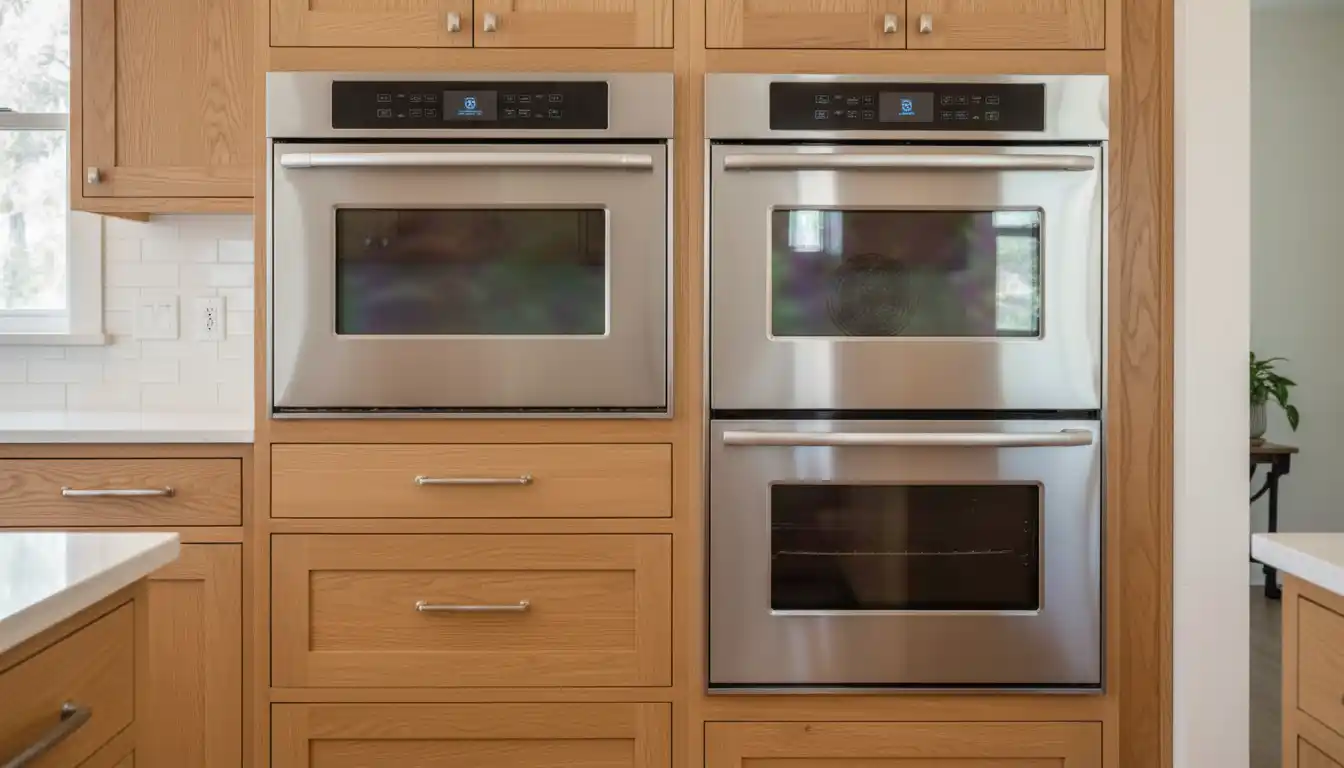
Never assume a 30-inch oven fits in a 30-inch cabinet. A 30-inch oven typically requires a cabinet width of 33 inches to allow for proper structural support and face frame clearance. A 27-inch oven fits comfortably in a standard 30-inch cabinet but requires specific filler strips to look built-in.
The Renovation Reality: Retrofitting vs. New Install
The decision often comes down to the “Sawdust Factor.” How much of your kitchen are you willing to cut, sand, or replace?
Replacing Like for Like
If you have a broken 27-inch oven, the path of least resistance is buying another 27-inch model. It minimizes the risk of damage to surrounding cabinetry. Just as you wouldn’t ignore aspen tree transplant shock when moving a tree, you shouldn’t underestimate the structural “shock” of cutting into established cabinetry. Older cabinets may crack or lose integrity if you aggressively trim the face frames to wedge in a larger unit.
Upgrading from 27 to 30 Inches
Moving up to a 30-inch unit often requires a full cabinet replacement. Most 27-inch ovens are installed in cabinets that are only 27 or 30 inches wide externally. To fit a modern 30-inch appliance, the internal cutout must be roughly 28.5 inches wide. If your existing cabinet box is only 28 inches wide, no amount of trimming will make it work.
Structural Integrity Warnings
Some homeowners attempt to shave the face frame of a 30-inch cabinet to squeeze in a 30-inch oven. This is risky. It can weaken the support needed to hold a 200-pound appliance. Always consult a carpenter before modifying load-bearing cabinet stiles.
Market Availability and “Endangered” Models
The appliance market has shifted decisively toward the 30-inch standard. This affects everything from price to parts availability.
The Niche Status of 27-Inch Ovens
Walk into a big-box store, and you will see rows of 30-inch models but perhaps only one or two 27-inch display units. Manufacturers are slowly phasing out 27-inch tooling. This means fewer features, fewer finish options (like black stainless or matte white), and longer wait times for parts if repairs are needed.
Resale Value Implications
Kitchens sell homes. A prospective buyer expects a spacious, chef-style kitchen. A 27-inch oven can visually “shrink” the look of the cooking zone, signaling an older or less premium renovation. While correct placement of a vanity light hanging over mirror can save a bathroom’s aesthetic, a small wall oven is much harder to hide. Real estate agents often note that standardizing to 30 inches yields a better ROI.
Comparison Matrix: 27-Inch vs. 30-Inch Wall Ovens
The following table outlines the practical differences to help you decide which trade-offs matter most for your kitchen.
| Feature | 27-Inch Wall Oven | 30-Inch Wall Oven |
|---|---|---|
| Standard Capacity | 3.8 – 4.3 Cu. Ft. | 4.7 – 5.1 Cu. Ft. |
| Cabinet Width Needed | 27″ (Custom) or 30″ (Standard) | 30″ (Tight/Modified) or 33″ (Standard) |
| Bakeware Fit | Standard sheets fit; Full sheets rarely fit | Full sheets fit easily; Better airflow |
| Market Variety | Limited (Declining) | Extensive (Standard) |
| Installation Effort | Low (Direct Replacement) | High (Likely Cabinet Work) |
Hidden Costs and Technical Constraints
Beyond the price tag of the appliance, several technical factors can inflate your budget.
Electrical Amperage Differences
Most electric wall ovens require a 240-volt dedicated circuit. However, older 27-inch ovens might run on a 30-amp breaker, while newer, high-feature 30-inch convection ovens might demand a 40-amp or even 50-amp circuit. Upgrading the wire gauge from the breaker box to the kitchen is a significant expense that often catches homeowners off guard.
The “Toxic” Asset of Outdated Appliances
Keeping a 27-inch format limits your future choices. Just as you have to be careful can you plant green potatoes to avoid introducing issues into your garden, installing a new 27-inch oven introduces a “legacy” constraint into your kitchen. You are effectively locking yourself into a shrinking standard for another 10 to 15 years.
Modification Costs
If you decide to modify your cabinet to fit a 30-inch oven, budget for a finish carpenter. “Botched” cuts on a face frame are impossible to hide. A professional modification can cost between $300 and $800, not including the cost of the oven itself. If the cabinet needs total replacement, the cost can jump to over $2,000 once paint matching and installation are factored in.
Frequently Asked Questions: 27 vs 30 Inch Wall Ovens
1. Can I replace an existing 27-inch wall oven with a 30-inch model?
Technically, yes, but it involves significant cabinetry work. A
30-inch oven will not fit into a standard 27-inch cabinet base. You
would need to replace the entire oven cabinet or perform major
structural carpentry to widen the cutout and the face frame, which often
impacts adjacent drawers and countertops.
2. Can I install a 27-inch oven into a 30-inch cabinet cutout?
Yes, this is a much simpler renovation task than going larger. To do
this successfully, you must purchase a manufacturer-specific trim kit to
cover the gaps on the left and right sides. This ensures the unit looks
built-in and is properly secured to the cabinet frame.
3. Is there a significant difference in cooking capacity between the two sizes?
While the exterior width differs by three inches, the interior cavity
difference is usually only about 1.5 to 2 inches. However, this small
margin often determines whether a specific roasting pan or a large
commercial baking sheet will fit. If you frequently cook for large
groups, the 30-inch model is superior.
4. Are 27-inch wall ovens becoming obsolete?
They are not obsolete, but they are becoming less common. Most new
home builds feature 30-inch appliances as the standard. Consequently,
manufacturers prioritize 30-inch models for the latest technology,
finishes, and features, leaving 27-inch models with fewer options.
5. How do I correctly measure my current oven to know which size to buy?
Do not measure the front door of your old oven. You must measure the
actual cutout width inside the cabinet. Turn off the breaker, open the
oven door, and locate the mounting screws to see the cabinet opening. A
27-inch oven fits a cutout roughly 25.5 inches wide, while a 30-inch
oven requires a cutout roughly 28.5 inches wide.
6. Does upgrading to a 30-inch oven improve home resale value?
Generally, yes. Because 30-inch ovens are the industry standard, they
appeal to more buyers who want the flexibility to easily replace
appliances in the future. A kitchen renovated with standard-sized
cabinetry is viewed as more “future-proof” than one with niche appliance
sizes.
7. Do 27-inch and 30-inch ovens have different electrical requirements?
Typically, size does not dictate the electrical requirement; the oven
type (single vs. double) and feature set do. Both sizes usually run on a
240-volt connection requiring a 30-amp or 40-amp breaker. Always verify
the amperage specifications of your new unit, as high-speed convection
models may draw more power regardless of width.
8. How much does it cost to modify a cabinet for a different oven size?
If you are downsizing to a 27-inch unit in a larger space, the cost
is minimal (the price of a trim kit). However, widening a cabinet to fit
a 30-inch unit requires a carpenter and can cost between $500 and
$1,500, depending on whether the face frame needs cutting or if the
adjacent cabinetry requires modification.
9. Do all brands use the exact same cutout dimensions for their 30-inch ovens?
No. “30-inch” refers to the approximate width of the oven door, not
the cutout. Cutout dimensions can vary by over an inch between brands
like Bosch, GE, and Whirlpool. You must consult the manufacturer’s
“Installation Guide” or “Spec Sheet” to check the critical vertical and
horizontal cutout requirements before purchasing.
10. Which size should I choose for a full kitchen gut renovation?
If you are redesigning the kitchen from scratch, you should almost
always choose the 30-inch wall oven. It offers the widest selection of
brands, the most modern features, and standard sizing that makes future
replacements easier and less expensive.
Final Verdict: Which Size Should You Buy?
If you are planning a full remodel, choose the 30-inch oven without hesitation. It offers superior capacity, modern features, and better resale appeal. The small loss of cabinet storage space is worth the gain in cooking utility.
However, if you are simply replacing a broken unit in a kitchen you don’t intend to gut, sticking with a 27-inch oven is the financially prudent choice. The cost of cabinet modifications often outweighs the benefits of three extra inches of width. Measure your current cutout width, height, and depth precisely before ordering, as “standard” sizes vary significantly between brands.
