
2 Panel vs 6 Panel Doors: The #1 Choice That Defines Your Home’s Style
You stand in the hallway, looking at the frame of a new doorway. It seems like such a minor detail in the grand scheme of a home build or remodel. But the choice you are about to make between a 2-panel and a 6-panel door is one of the most impactful decisions for your home’s interior character.
This isn’t just about closing off a room. It’s about architecture, style, and the subtle messages your home sends. Making the wrong choice can leave your entire design feeling disjointed and “off,” a mistake that is costly and frustrating to fix.
The core problem is that most people choose a door based on what’s available or what’s cheapest, without understanding the design language each style speaks. This guide will illuminate the history, purpose, and perfect placement for each door, ensuring your choice enhances your home’s soul instead of clashing with it.
You'll Learn About
Why This Simple Door Decision Is So Deceptively Critical
An interior door is one of the largest visual elements in a room after the walls and floor. It’s a vertical plane that you see and interact with every single day. The lines on that door—whether it has two simple rectangles or six traditional boxes—create a visual rhythm that ripples through the entire space.
A door with many panels can make a room feel busy and traditional, while one with fewer panels can create a sense of calm and modernity. Ignoring the architectural story of your home is the single biggest mistake homeowners make. It’s time to learn the language of your home and choose a door that speaks it fluently.
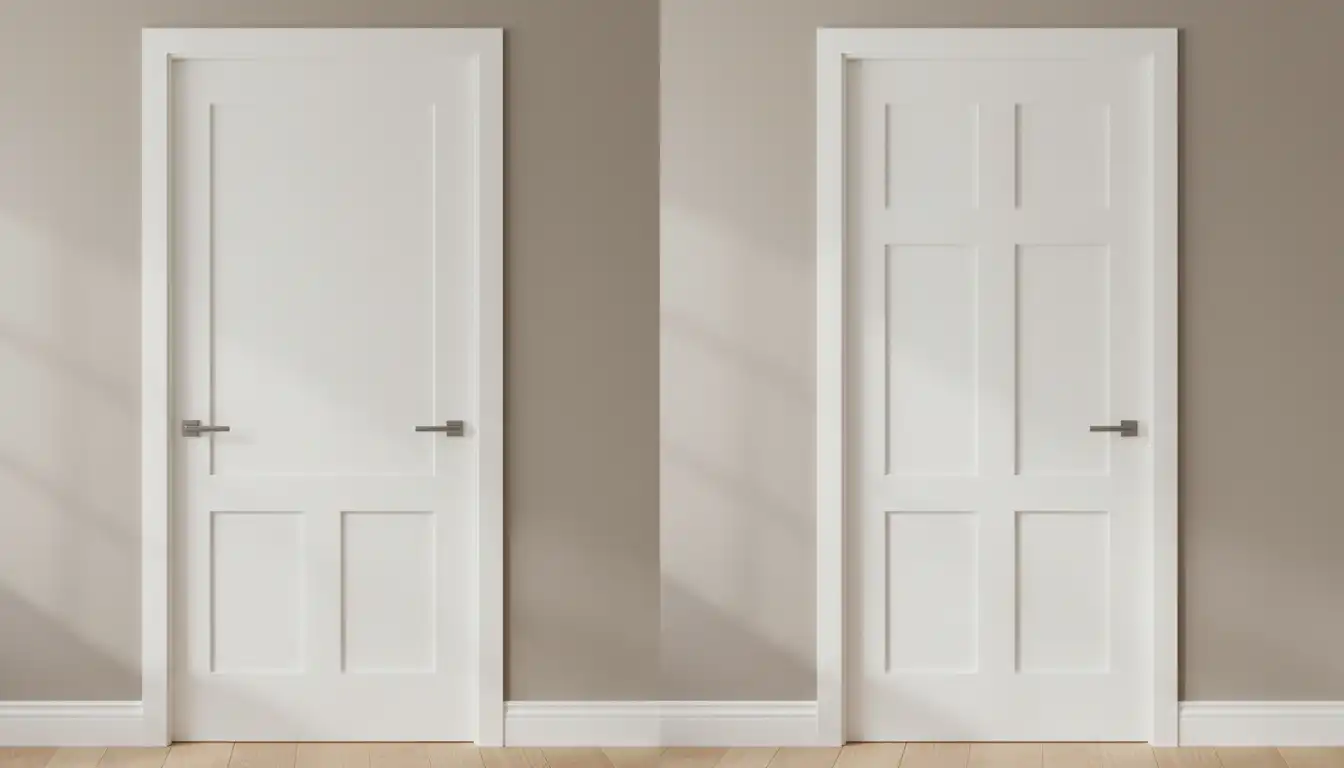
Deconstructing the 6-Panel Door: A Legacy of Tradition
The 6-panel door is arguably the most recognizable interior door design in North America. Its prevalence, however, doesn’t make it universally appropriate. Its roots are deeply embedded in history, which is why it carries such a strong traditional feel.
The Look and Feel of a 6-Panel Door
This door is defined by its six raised panels, typically with four rectangular panels on top and two larger square or rectangular panels on the bottom. The design originated from practical rail-and-stile construction, where smaller panels of wood were used to prevent the warping and cracking that a single large slab would endure.
This construction method gives it a sense of depth, substance, and craftsmanship. It feels formal, detailed, and established. This historical context is precisely why it pairs so well with homes that honor traditional design principles.
Architectural Styles That Demand a 6-Panel Door
A 6-panel door feels most at home in specific architectural settings. If you have a Colonial, Georgian, Federal, or Victorian style home, the 6-panel door is often the most historically accurate and aesthetically pleasing choice.
The complexity and detail of the door mirror the often-ornate trim, crown molding, and classic proportions found in these homes. It creates a cohesive look that feels intentional and authentic. In these contexts, a simpler door would look out of place and diminish the home’s historic character.
The Hidden Drawback of the 6-Panel Door
The very detail that makes the 6-panel door perfect for traditional homes is its greatest weakness in modern settings. In a home with clean lines, simple baseboards, and a minimalist aesthetic, the 6-panel door creates instant visual clutter.
Its busy design can fight against the calm, uncluttered feel of contemporary spaces. In smaller rooms or homes with lower ceilings, the multiple horizontal lines of a 6-panel door can also trick the eye into thinking the space is shorter and more cramped than it actually is.
Understanding the 2-Panel Door: The Champion of Simplicity
The 2-panel door has surged in popularity as interior design has trended towards cleaner, more transitional and modern aesthetics. It offers a perfect blend of classic structure and contemporary simplicity, making it incredibly versatile.
The Clean Aesthetic of a 2-Panel Door
Typically featuring two vertical panels, often with the top panel being larger, the 2-panel door is a study in elegant simplicity. The most popular variations include the classic arched-top “Roman” style or the crisp, square-edged Shaker or Craftsman style.
Its clean lines draw the eye upward, which can help create a sense of height and openness in a room. It provides visual interest without overwhelming the space, making it a supporting element rather than a dominant feature.
Architectural Styles Where the 2-Panel Door Shines
This door is a chameleon, but it truly excels in a few key styles. It is the quintessential choice for Craftsman and Arts & Crafts homes, where simplicity and honest construction are paramount. The 2-panel Shaker door is also a hallmark of the modern Farmhouse aesthetic.
Furthermore, its minimalist appeal makes it a perfect fit for Modern, Scandinavian, and Transitional homes that bridge the gap between traditional and contemporary. Its unfussy nature allows other design elements, like furniture, art, or lighting, to take center stage.
The Potential Pitfall of the 2-Panel Door
While versatile, the 2-panel door isn’t a universal solution. In a grand, historically detailed home, such as a formal Victorian or Colonial, a simple 2-panel door can feel underwhelming.
It may lack the necessary visual weight and gravitas to stand up to ornate casings, tall ceilings, and elaborate crown molding. In such a setting, it can look like a modern replacement that doesn’t honor the home’s original architectural integrity.
Head-to-Head Comparison: The Ultimate Decision-Making Table
To simplify your choice, this table breaks down the essential characteristics of each door style. Use it to match your home’s needs with the right design.
| Feature | 2-Panel Door | 6-Panel Door |
|---|---|---|
| Primary Style | Craftsman, Farmhouse, Modern, Transitional | Colonial, Traditional, Victorian, Georgian |
| Visual Weight | Lighter, cleaner, promotes height | Heavier, more detailed, creates texture |
| Perceived Formality | Less formal, more casual and clean | More formal, classic, and established |
| Best For | Spaces where you want a calm, uncluttered look | Homes that need to honor historical detail |
| Versatility | Highly versatile across modern and transitional styles | Less versatile; primarily suited for traditional designs |
| Hardware Pairing | Pairs well with modern levers and matte black or nickel finishes | Pairs well with classic knobs and brass or oil-rubbed bronze finishes |
Beyond the Panels: Critical Factors Everyone Misses
The number of panels is just one part of the equation. Two other factors—construction and scale—can have an even greater impact on the final result.
Material Matters: Solid Core vs. Hollow Core
The biggest giveaway of a cheap door isn’t the panel style; it’s the construction. Hollow core doors are lightweight, offer poor sound insulation, and feel flimsy to the touch. Solid core doors, made from composite wood materials or solid wood, have a satisfying heft, block sound effectively, and feel significantly more premium.
A solid core 2-panel door will always feel more luxurious and function better than a hollow core 6-panel door. Never sacrifice core quality for panel style. Your daily interaction with the door will be defined by its weight and sound-dampening ability.
The Impact of Scale and Proportion
Standard doors are 6 feet 8 inches tall, but 8-foot doors are becoming the norm in new construction and remodels with higher ceilings. Taller doors dramatically alter the look of the panels. A 2-panel design on an 8-foot door can look incredibly elegant and stately, elongating the room.
Before you even consider style, you must get the dimensions right. An incorrectly measured door is a useless piece of wood. Getting the 2480 door size or any other measurement perfect from the start saves immense headaches and cost down the line.
The Cohesive Home: Tying It All Together
Your home’s design should tell a consistent story from the outside in. Just as a striking 14/12 roof pitch can define the entire exterior character of your house, your interior doors define the character of the inside.
The style you choose should complement your window casings, baseboards, and crown molding. Mismatched architectural elements create a sense of unease. Strive for harmony in all these fixed details.
The Final Verdict: How to Choose Without Regret
If you’re still undecided, use this simple two-part test to find the perfect door for your home.
The Architectural Style Test
This is the most important test. Look at your home’s bones. Does it have wide, detailed trim, classic proportions, and a traditional layout? If yes, the 6-panel door is your safest and most authentic choice.
Does your home have simple trim, an open floor plan, or are you aiming for a Farmhouse, Craftsman, or Modern feel? If yes, the 2-panel door will almost certainly look better. It is the more modern, versatile, and future-proof option.
The “Visual Noise” Test
Step back and look at a room. Consider the furniture, wallpaper, rugs, and art. Is the space already visually busy with lots of patterns and lines? If so, a 6-panel door will only add to the noise. A 2-panel door will provide a calm, negative space for the eye to rest.
If the room is very simple and minimalist, a 6-panel door could potentially add some needed architectural texture. However, in most modern design schemes, less visual noise is better.
Making these foundational choices requires a consistent design vision. The same careful consideration you apply to choosing between acrylic vs quartz shower walls in a bathroom remodel should be applied here. It is a permanent fixture that underpins the entire aesthetic.
The #1 Mistake to Avoid: Ignoring Your Home’s Soul
The most jarring design mistake is forcing a style that fights your home’s inherent character. Putting a sleek 2-panel Shaker door in a formal 1920s Colonial is just as wrong as putting a fussy 6-panel door in a clean, Scandinavian-inspired new build.
This single choice has the power to either honor and elevate your home’s architecture or undermine it completely. Don’t choose based on a fleeting trend or a picture you saw in a magazine. Choose based on the story your house is already trying to tell.
Ultimately, the debate between 2-panel and 6-panel doors is not about which is superior. It is about which is appropriate. By analyzing your home’s architectural style and understanding the visual language of each door, you can make a confident choice that will look beautiful and feel right for decades to come.
