
18-Inch Closet Depth: The Design Flaw You Need to Master
You open the closet door, ready to grab a shirt, and there it is—the daily struggle. Your hangers are wedged in at an awkward angle, the shoulders of your jackets are permanently dented, and the door never seems to close quite right. If this sounds familiar, you’re likely dealing with a shallow closet, and the culprit is almost always a non-standard 18-inch closet depth.
For decades, this measurement has been a source of frustration for homeowners, making organization feel like an impossible puzzle. It’s a design choice often found in older homes or tight spaces where every inch counts. But what if this supposed “flaw” could be turned into a functional, highly organized asset? It’s not about wishing for more space; it’s about mastering the space you have.
You'll Learn About
Understanding the “Standard” and Why Yours Is Different
To appreciate the challenge of an 18-inch closet, it’s important to know the industry standard. A typical reach-in closet has a depth of at least 24 inches. This dimension is not arbitrary; it’s designed to accommodate a standard adult clothes hanger, which measures between 17 and 19 inches wide, allowing clothes to hang freely without being crushed against the back wall or the doors.
So, why do 18-inch closets exist? They are often relics of older construction methods, products of space-saving necessities in smaller homes or apartments, or found in rooms where a deeper closet would obstruct a walkway or window. While it presents a unique set of problems, understanding its origin helps in crafting a solution that works with the architecture, not against it.
The Core Problems of a Shallow Closet
Living with an 18-inch closet depth means facing a few persistent issues. Standard hangers simply don’t fit correctly, forcing them into a diagonal position that wastes precious space and can damage your clothes over time. Bulky items like winter coats or suits become nearly impossible to store without significant wrinkling and crushing.
This constant battle for space leads to clutter and disorganization. Items get lost in the back, clothes remain unworn because they’re inaccessible, and the simple act of opening your closet can become a daily annoyance. The key is to stop fighting the depth and start implementing strategies designed specifically for shallow spaces.
Unlocking Your 18-Inch Closet’s True Potential
Instead of viewing your shallow closet as a liability, it’s time for a paradigm shift. Think of it as a specialized storage area that, with the right tools and techniques, can become incredibly efficient. The secret lies in maximizing every cubic inch, from the floor to the ceiling and especially the way you hang and store your items.
The solution isn’t one-size-fits-all; it’s a combination of clever products, strategic organization, and a new way of thinking about your wardrobe. By implementing the right hacks, you can transform your frustratingly shallow closet into a model of efficiency and order.
Hanger Hacks: The First and Most Critical Fix
Your first line of defense against a shallow closet is to rethink your hangers. This simple change can have the most dramatic impact on space and usability.
Slim Velvet Hangers: The most immediate and cost-effective solution is to switch to ultra-thin, non-slip velvet hangers. Their slim profile can instantly free up inches of horizontal space, allowing more items to fit comfortably. The velvet texture also ensures that clothes, especially silky blouses or wide-neck tops, stay put.
Valet Hooks and Forward-Facing Rods: For a more radical approach, consider hardware that changes the orientation of your clothes. Instead of a traditional side-to-side rod, install valet hooks or a forward-facing closet rod. These allow you to hang clothes facing forward, boutique-style. This is ideal for showcasing favorite pieces and is perfectly suited to the limited depth.
Tiered Hangers: To maximize vertical space, tiered hangers are a game-changer. These allow you to hang multiple items, like pants or skirts, on a single hanger, freeing up significant rod space for other clothing.
Smart Shelving and Storage Systems
Beyond hangers, how you structure the inside of your closet is paramount. A single rod and a high shelf are not enough to tame the 18-inch depth.
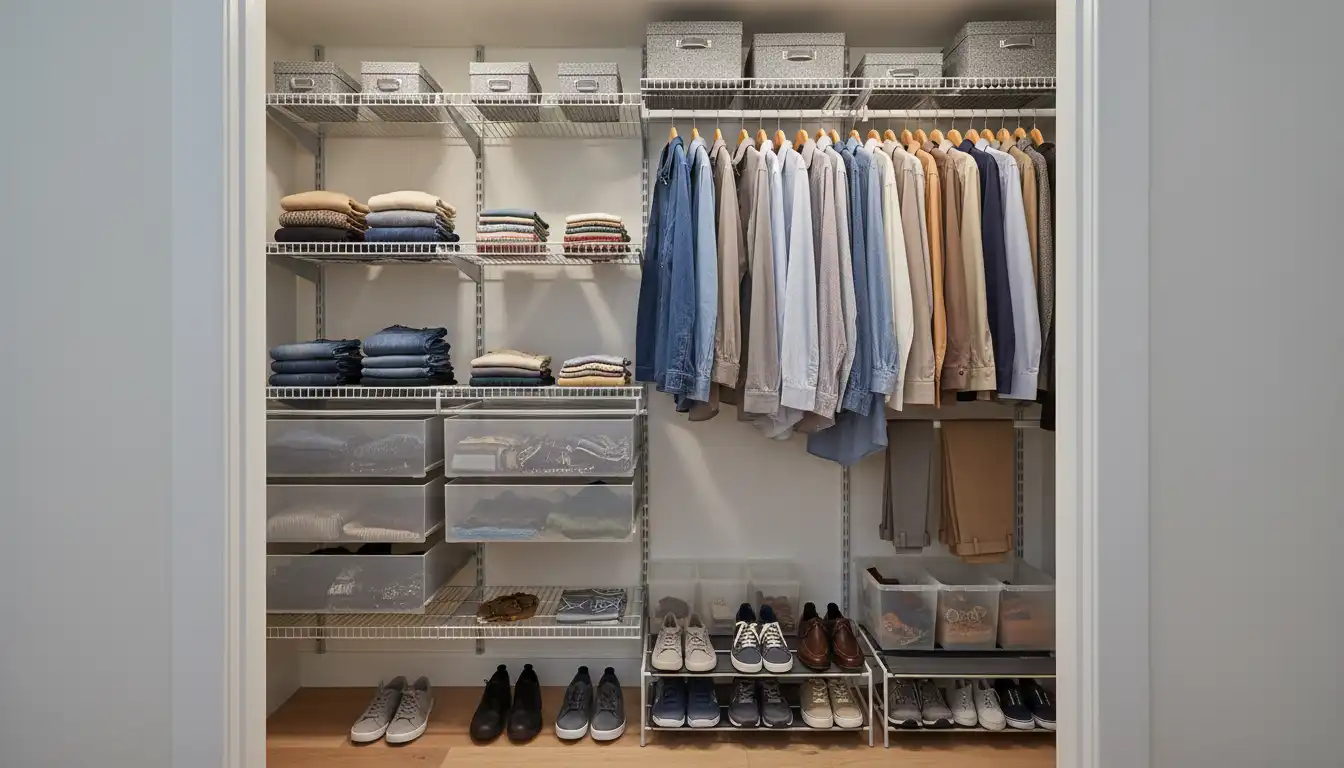
Adjustable Shelving is Non-Negotiable: Install a modular shelving system with adjustable components. This allows you to customize the layout based on your needs, whether you have more shoes than sweaters or vice versa. Placing shelves closer together for items like shoes and folded t-shirts prevents wasted vertical space between them.
Leverage the Door Space: The back of your closet door is prime real estate. An over-the-door organizer can hold shoes, accessories, or folded items, effectively adding a new storage surface without taking up any internal depth. This is perfect for keeping smaller, frequently used items visible and accessible.
Use Clear Bins and Labels: For items on higher shelves, clear storage bins are essential. They allow you to see the contents at a glance without needing to pull everything down. Labeling each bin adds another layer of organization, making it quick and easy to find exactly what you’re looking for.
The Hidden Advantage: What an 18-Inch Closet Does Best
While challenging for hanging clothes, an 18-inch depth is actually superior for certain types of storage. The key is to play to its strengths. This depth prevents items from getting lost in the back, a common problem in deeper closets where things can be buried for years.
Consider dedicating your shallow closet to specific purposes where this depth is an asset. It makes an excellent linen closet, as folded towels and sheet sets fit perfectly on 16 to 18-inch deep shelves. It can also serve as a highly efficient pantry, where cans and boxes are always visible and within reach. For children’s rooms, this depth is often more than sufficient for their smaller clothing.
Thinking strategically about space is a common theme in home design, whether you’re working on a 7×6 bathroom layout or a shallow closet. Every inch must be deliberate.
Creating Zones for Maximum Efficiency
Divide your closet into logical zones to create a system that’s easy to maintain. Dedicate specific areas for different categories of items. For example, the top shelf can be for out-of-season items stored in labeled bins. A central section might feature forward-facing rods for your most-worn outfits, while lower shelves can be designated for shoes or folded denim.
This approach transforms the closet from a single, chaotic space into a series of mini-storage stations, each with a clear purpose. This not only makes it easier to find things but also simplifies the process of putting them away, which is crucial for long-term organization.
| Storage Solution | Best For | Impact on Space | Estimated Cost |
|---|---|---|---|
| Slim Velvet Hangers | Shirts, Blouses, Dresses | High – Frees up significant rod width | $20 – $40 per 50 |
| Forward-Facing Rod | Coats, Suits, Featured Outfits | High – Completely changes clothing orientation | $15 – $30 per rod |
| Over-the-Door Organizer | Shoes, Accessories, Belts | High – Adds a new storage surface | $25 – $50 |
| Adjustable Shelving System | Folded Clothes, Bins, Shoes | High – Maximizes vertical space efficiently | $100 – $300+ |
| Tiered Pant Hangers | Trousers, Skirts, Jeans | Medium – Consolidates multiple items | $15 – $25 per set |
When to Organize and When to Renovate
For most people, the strategies outlined above will be more than enough to conquer an 18-inch closet depth. However, in some cases, a more significant change might be warranted. If your shallow closet is the primary storage in your master bedroom, you may find its limitations too restrictive for a full wardrobe.
This is particularly true when planning a bedroom’s layout, where storage is a critical component. For instance, the decision to accommodate a large bed can impact available closet space, a challenge often faced in a 13×10 bedroom king bed setup, where a shallow closet might be a necessary compromise. In such cases, investing in a high-quality, custom built-in system can make all the difference. Some homeowners might even explore high-end custom cabinetry to match their aesthetic; when considering such an investment, it’s wise to research brand reputations, much like asking is Maitland-Smith good furniture before buying a centerpiece for your living room.
A Final Word on Mastering Your Space
The 18-inch closet depth doesn’t have to be a daily source of frustration. By letting go of conventional storage methods and embracing solutions designed for shallow spaces, you can create a closet that is not only functional but exceptionally organized. It requires a shift in perspective—from seeing a problem to seeing potential.
With the right combination of hangers, shelving, and organizational discipline, your shallow closet can finally work for you, not against you. It’s time to unlock its hidden potential and prove that great organization isn’t about the size of the space, but how cleverly you use it.
