
15 Inch Overhang on Island: Essential Guide for Comfort & Safety
Designing the perfect kitchen island involves balancing aesthetic appeal with functional ergonomics. One of the most common dilemmas homeowners face is determining the correct depth for the seating area. If the overhang is too short, guests sit sideways with their knees pressed against the cabinetry. If it is too deep, the structural integrity of the stone is compromised. A 15 inch overhang on island countertops is widely accepted as the ideal dimension for standard counter-height seating, offering optimal legroom without requiring bulky vertical support legs.
However, achieving this specific depth requires careful planning regarding support mechanisms and material choices. Simply extending a slab of granite or quartz this far without reinforcement is a recipe for disaster. This guide explores the engineering, design, and safety protocols necessary for a 15-inch overhang. We will look beyond standard advice and discuss the physics of cabinet stability and long-term durability.
You'll Learn About
The Ergonomics of a 15 Inch Overhang on Island
When planning a kitchen island, comfort should be the primary driver for dimension decisions. The National Kitchen and Bath Association (NKBA) suggests specific minimums, but real-world usage often dictates more generous spacing. For a standard counter height of 36 inches, a 15-inch overhang provides the “sweet spot” for average-sized adults. This depth allows the knees to rest naturally underneath the countertop without hitting the cabinet back panel.
A shallower overhang, such as 12 inches, forces the user to sit further back on the stool. This posture leads to leaning forward to reach the plate, which causes back strain over time. Conversely, extending beyond 15 inches at counter height often yields diminishing returns for comfort while skyrocketing support costs. The 15-inch dimension allows for a relaxed posture where the user’s chest is at an appropriate distance from the eating surface.
It is also important to consider the width required per person. While depth is critical for knees, lateral space ensures elbows do not collide. With a 15-inch depth, you should allocate at least 24 inches of width per seat. This combination creates a dining experience that feels like a table rather than a temporary perch. This attention to detail transforms an island from a storage unit into a functional social hub.
The Physics of Cantilevered Stone
Understanding the gravity and leverage involved in a 15-inch overhang is crucial for safety. Natural stone like granite and engineered stone like quartz are incredibly heavy, often weighing between 18 to 30 pounds per square foot. When you extend this material 15 inches past the cabinet base, you create a significant cantilever. This acts as a lever, exerting upward force on the opposite side of the slab and downward force on the cabinet front.
Most fabricators follow a general rule that only 1/3 of the slab width should be unsupported, or up to 10 inches for granite, without reinforcement. A 15-inch overhang exceeds this safe limit for almost all stone materials. Without steel reinforcement, a heavy force—such as someone leaning on the edge or a child climbing up—could snap the stone. The tensile strength of stone is relatively low, meaning it handles compression well but tension (bending) poorly.
Furthermore, the leverage does not just affect the stone; it affects the cabinet box. Just as you need to understand mechanical leverage when using a snowblower lift to manage heavy machinery, you must recognize the fulcrum effect on your island. If the cabinets are not securely bolted to the subfloor, the weight of a heavy 15-inch overhang could theoretically tip the entire island forward if a heavy load is applied to the edge. This is a structural risk that is frequently overlooked in DIY renovations.
Structural Reinforcement Options
To safely install a 15 inch overhang on island setups, you must use hidden or visible supports. The days of relying solely on bulky wooden corbels are gone, as modern design favors clean lines and unobstructed knee space. Structural steel is the industry standard for supporting deep overhangs while remaining virtually invisible.
Flat Steel Bars: These are usually 3/8-inch or 1/2-inch thick steel bars recessed into the top of the cabinet box. They extend from the back of the cabinet out to within a few inches of the countertop edge. This method is excellent for maintaining a sleek, floating look. The weight of the stone sits directly on the steel, transferring the load back to the cabinet structure.
L-Brackets: For heavier stones or situations where cutting into the cabinet top is difficult, L-brackets are effective. These mount to the back of the cabinet wall and extend under the overhang. While slightly more visible than flat bars, they offer tremendous vertical support. It is essential to ensure the vertical leg of the bracket is fastened to a stud or a reinforced back panel, not just thin plywood.
Vertical Posts or Legs: If you prefer a traditional aesthetic, table legs can support the corners of the overhang. This completely eliminates the cantilever stress. However, legs can obstruct movement and make sweeping difficult. If you choose this route, ensure the legs are integrated into the design early on so they match the cabinetry finish.
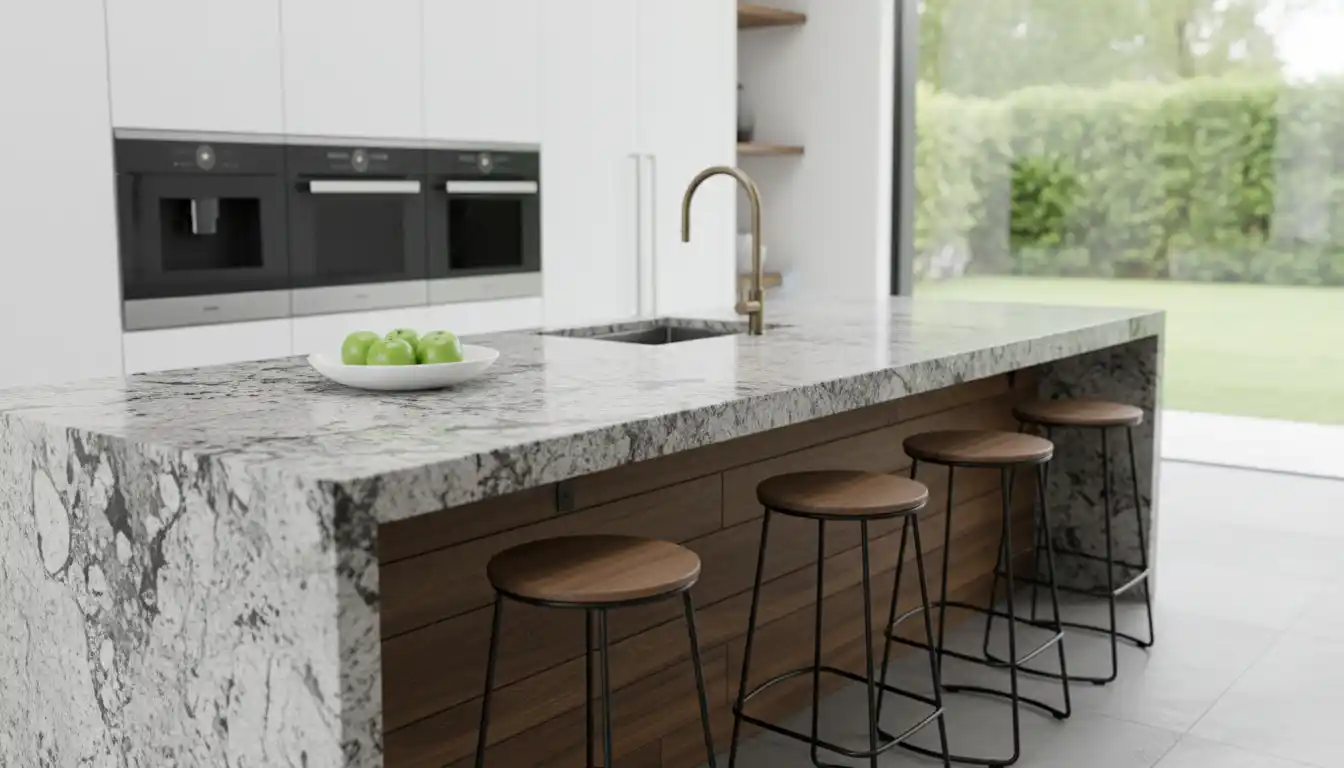
Material Specifics: Granite vs. Quartz vs. Marble
Different countertop materials have different tolerance levels for overhangs. Understanding the brittle nature of your chosen material is vital for determining the support interval. A 15-inch overhang on an island is aggressive for almost any stone without help, but some materials are more forgiving than others.
Granite: Natural granite has veins and fissures that act as fault lines. A 15-inch unsupported span is dangerous because a fissure could be hidden right at the stress point. For granite, full steel support spaced every 18 to 24 inches is mandatory for this depth.
Quartz: Engineered quartz is more uniform and has slightly higher flexural strength than granite because of the resin binders. However, most manufacturers’ warranties become void if an overhang exceeds 14 inches without support. Even though it is stronger, you should treat it with the same caution as granite to prevent sagging over time (creep deformation).
Marble: Marble is softer and more prone to cracking than granite or quartz. A 15-inch overhang with marble requires a plywood sub-top in addition to steel supports. This reduces the risk of the stone cracking under its own weight or from minor impacts.
The “Tipping Island” Hazard
A detail often missed by general contractors is the stability of the island cabinetry itself. When you add a 15-inch overhang, you shift the center of gravity of the entire island unit. If the island is relatively narrow (e.g., 24 inches deep cabinets plus the overhang), the unit becomes top-heavy and back-heavy.
If a large guest leans heavily on the overhang, or if a child climbs it, the leverage could lift the front of the cabinets off the floor. This is catastrophic. To prevent this, the island cabinetry must be anchored to the floor joists using lag bolts or substantial blocking. Do not rely on silicone or small screws into the subfloor.
This anchoring is particularly important in homes with floating floors or uneven surfaces. The connection between the cabinet and the floor is the foundation of the entire structure. Neglecting this step renders even the strongest steel brackets useless, as the failure point shifts from the stone to the cabinet footprint.
Design Integration and Aesthetics
Functionality is paramount, but the visual impact of a large overhang cannot be ignored. A 15-inch extension significantly alters the proportions of the kitchen. It can make the island look massive, so balancing it with the surrounding elements is key. Designers often use end panels or “waterfall” edges to ground the visual weight of the top.
When finishing the area under the overhang, consider the durability of the materials. Feet will inevitably kick the back panel. Using a durable paint or cladding is recommended. In open-concept homes, you might be dealing with various wall finishes nearby. For example, if you are working on a shiplap to drywall corner transition in the adjacent living room, carrying that shiplap detail onto the back of the island can create a cohesive look while providing a scuff-resistant surface for the seating area.
Additionally, consider the profile of the countertop edge. A laminated or mitered edge can make the slab look thicker, adding to the perception of strength. However, this adds weight. Ensure your aesthetic choices do not overburden the support system you have designed.
Traffic Flow and Aisle Clearance
A 15-inch overhang eats into the surrounding walkway. In a kitchen, aisle width is critical for workflow. The NKBA recommends a minimum aisle width of 44 inches for walkways behind seating. If your overhang is 15 inches and you have stools, people will be sitting about 20 to 24 inches out from the cabinets.
If the aisle is too narrow, a seated person becomes an obstacle. This disrupts the “work triangle” and can make the kitchen feel cramped. Before committing to 15 inches, tape the outline on the floor. Place a chair there and have someone walk behind it. If they have to turn sideways, the overhang might be too deep for your specific room dimensions.
You must also consider the placement of appliances opposite the seating. You do not want a refrigerator or oven door opening directly into the back of a seated guest. Proper clearance ensures that the kitchen remains functional even when fully occupied.
Ventilation and Underside Obstructions
The underside of a large island overhang is often forgotten space, but it can house critical systems. Some designs incorporate outlets or heating vents in the kick plate area. If you are rerouting HVAC to the island, ensure the vents are not blocked by the stools or the overhang structure itself.
Poor airflow in a kitchen can lead to lingering odors. While you might be investigating why an ac smells like farts in other parts of the house, trapped moisture or stagnant air under a large, enclosed island overhang can create localized mustiness. Keep the airflow unobstructed. If you are using corbels or full panels, ensure they do not box in heat registers located on the island floor.
Comparison of Overhang Depths
To help you decide if 15 inches is truly the right size for your project, this table compares common overhang depths against their support needs and comfort levels.
| Overhang Depth | Knee Comfort Level | Support Requirement | Cabinet Anchoring Need | Best Use Case |
|---|---|---|---|---|
| 8 – 10 Inches | Poor (Knees hit) | None / Minimal | Standard | Perching / leaning only |
| 12 Inches | Acceptable | Corbels / Light Steel | Standard | Small kitchens, tight aisles |
| 15 Inches | Excellent (Ideal) | Heavy Duty Steel | Critical (Lag Bolts) | Daily dining, homework |
| 18+ Inches | Luxurious | Legs / Posts Required | Critical | Large luxury spaces, tall users |
Installation Steps for Steel Supports
Installing the supports for a 15 inch overhang on island cabinets requires precision. This is typically done before the countertop templating occurs. The steel bars must be notched into the cabinet walls so they sit flush with the top of the cabinet box. This ensures the stone lays flat without rocking.
Step 1: Layout. Determine the spacing. For a 15-inch overhang, space supports every 20 to 24 inches along the length of the island. Mark the locations on the cabinet bracing.
Step 2: Routing. Use a router or an oscillating tool to cut shallow channels into the top of the cabinet frames. These channels should be the exact width and thickness of your steel bars.
Step 3: Fastening. Place the steel bars into the channels. Pre-drill holes through the steel (if not already present) and screw them securely into the solid wood of the cabinet frame. The bars should extend effectively to within 2 to 4 inches of the final edge of the stone.
Step 4: Verification. Use a long level to ensure all steel bars and the cabinet top are perfectly coplanar. Any high spots will cause stress points on the stone, leading to cracks.
Cost Implications
Opting for a 15-inch overhang does increase the budget compared to a standard 12-inch overhang. The primary cost driver is not the extra 3 inches of stone, but the fabrication and support hardware. A larger slab might be required to accommodate the width without a seam, pushing you into a higher price tier for materials.
Steel brackets specifically designed for countertops can range from $30 to $100 each. For a standard 8-foot island, you might need four or five brackets. Additionally, the labor for notching the cabinets adds to the carpentry bill. However, this investment is negligible compared to the cost of replacing a cracked slab or repairing a tipped cabinet.
Conclusion
A 15 inch overhang on island countertops represents the perfect intersection of form and function. It transforms a kitchen island from a mere prep station into a comfortable dining table, accommodating family and guests with ease. While the ergonomic benefits are clear, the structural demands cannot be ignored.
Success lies in the hidden details: the strength of the steel supports, the anchoring of the cabinet box, and the quality of the installation. By respecting the physics of heavy stone and planning for adequate aisle clearance, you can create a kitchen centerpiece that is both beautiful and safe. Whether using granite, quartz, or marble, ensuring your overhang is properly supported will protect your investment for years to come.
